
The Women's Institute, Trans Activism, and Why Nobody's Asking the Obvious Questions About Children.
The Women's Institute decision to maintain biological sex-based membership triggered the predictable outrage. TransLucent's CEO went on LBC demanding the government "man up" over it.

Pause there for a second.
The head of a trans-advocacy organisation just used a phrase that explicitly links masculinity to courage and resolve. Which is fascinating, isn’t it? Because that phrase only works if everyone understands the sex-based social meaning it carries. The very meaning their position theoretically denies exists.
But here’s what’s more interesting than that little contradiction: the legal framework protecting the WI’s decision raises some extremely uncomfortable questions about what we’re doing to children. Questions that somehow never get asked in polite company.
So let’s ask them.
The Constitutional Framework Everyone’s Ignoring.
There’s a legal analysis doing the rounds that cuts through all the noise. UK domestic courts can’t just invent new human rights beyond what the European Court of Human Rights has established in clear precedent. That’s established law from cases like Elan-Cane v Home Department.
Here’s the thing: there are precisely zero cases at Strasbourg finding that biological sex-based services violate Article 8 rights. None. Which means UK courts are constitutionally blocked from recognising such a right unless they’re fully confident Strasbourg would agree. And given how contentious this issue is, it clearly falls within what’s called the “margin of appreciation” - the discretion given to member states on contested social questions.
But even if a court could recognise such a right? Section 3 of the Human Rights Act still couldn’t override For Women Scotland. The Supreme Court already ruled that biological sex is fundamental to the Equality Act’s structure. The test in Ghaidan v Godin-Mendoza says courts can’t use Section 3 to interpret legislation against its fundamental features or grain.
So you’ve got a double-lock. Courts can’t recognise the right. And even if they could, they can’t provide the remedy. The WI decision isn’t discrimination - it’s a constitutionally protected space.
Trans advocacy groups can scream about it all they like. Won’t change the constitutional architecture.
Now Apply That Same Logic Somewhere More Uncomfortable.
Right. So if biological sex matters constitutionally - if material reality can’t just be overridden by declaration - what does that mean for how we’re treating children?
Because here’s what actually happens in many cases:
Parent observes gender non-conforming behaviour. A boy who likes dresses. A girl who hates dresses. And instead of thinking “my child doesn’t conform to stereotypes,” increasing numbers of parents are being encouraged to interpret this through a very specific ideological lens: “my child might be trapped in the wrong body.”
The child isn’t really self-identifying in any meaningful sense at that age. The parent is interpreting the child’s preferences and behaviour, then declaring an identity on their behalf.
Stay with me here, because this is where it gets properly weird. If we’re saying that pure declaration - or parental declaration on a child’s behalf - is sufficient to override biological reality, then theoretically you could dress a chimpanzee in female clothes, declare it trans, and by the logic being deployed, that would make it trans. There’d be nothing beyond the declaration to point to. No observable criteria. No verifiable state. Just the declaration itself.
Sounds absurd, doesn’t it? That’s because it is absurd. It’s the logical terminus of rejecting any objective criteria whatsoever.
But we’re not doing this to chimpanzees. We’re doing something far more troubling to actual children. We’re letting parents interpret childhood gender non-conformity through ideological frameworks, then locking those interpretations in through medical pathways that have permanent consequences.
What the Cass Review Actually Found.
Dame Hilary Cass reviewed the gender identity services for children. She’s an establishment paediatrician - nobody’s idea of a culture warrior. And her findings raise serious questions about what’s been happening.
The Cass Review documented weak evidence for childhood medical transition, poor quality studies, and significant gaps in follow-up data and outcome tracking. Clinical staff who raised concerns reported being silenced. There appeared to be an ideological capture of clinical practice. And worryingly, a significant proportion of children referred had other issues - autism, trauma, mental health problems - that seemed to be getting overlooked in favour of gender affirmation.
The Tavistock gender clinic was subsequently closed and replaced with a new service model. Sweden, Finland, and Norway - countries that pioneered gender healthcare for young people - have all dramatically restricted childhood medical transition after reviewing their own evidence. They’ve moved to psychological therapy first, with medical intervention only in extreme cases after extensive assessment.
The Swedish National Board of Health and Welfare now states that the risks of puberty blockers and hormonal treatments for minors currently outweigh the benefits. Finland’s COHERE guidelines emphasise psychological support over medical intervention. Norway withdrew its national treatment guideline entirely.
What changed? They looked at their outcome data.
The Questions Nobody Wants to Answer.
Here’s what we know happens in the affirm-first model: social transition (new name, pronouns, everyone required to validate the identity). This creates psychological investment. Which then gets used as evidence that the child “really is trans.” Which leads to puberty blockers. This leads to cross-sex hormones. Which carries risks, including potential impact on fertility.
So let’s ask the uncomfortable question: can a ten-year-old meaningfully consent to treatments that might affect their fertility? Can they really comprehend what it means to potentially not be able to have biological children when they’re twenty-five?
The Bell v Tavistock case initially suggested children couldn’t meaningfully consent to puberty blockers given the implications. The Court of Appeal overturned that, but notably didn’t say children can consent - just that it’s for doctors to assess case by case. Which means the legal question of consent remains genuinely unresolved.
And while it remains unresolved, what’s happening to children caught in this system?
The Safeguarding Inversion.
Traditional safeguarding logic goes like this: protect children from irreversible decisions until they’re old enough to properly consent.
But something remarkable has happened. The claim now is that not affirming - not socially transitioning, not prescribing blockers - constitutes harm. The safeguarding imperative has been inverted to mandate intervention rather than protect from intervention.
How did that happen? On what evidence base was this fundamental reversal of child protection principles decided?
Because when you look at what’s actually being done - suppressing normal puberty, prescribing cross-sex hormones that cause permanent changes, removing healthy breast tissue from teenage girls - these are significant medical interventions on healthy bodies.
If this were any other context, what would we call it? If parents wanted to put their child on hormones that would affect their fertility for any other reason, what would safeguarding services say?
Where Human Rights Could Actually Apply.
Here’s an argument you won’t hear in activist circles: Article 3 of the European Convention prohibits inhuman and degrading treatment. Article 8 protects physical integrity and bodily autonomy.
Legal scholars are beginning to question whether these protections could be applied differently than activists claim. Rather than mandating affirmation, couldn’t Articles 3 and 8 protect children from experimental medical interventions that lack robust evidence and carry risks of permanent effects, including on fertility?
The framework’s been inverted. “Affirmation” has become the human rights imperative. Questioning has become the violation.
The same human rights framework that can’t override biological reality in the Equality Act is being interpreted to mandate medical interventions that might permanently affect children’s reproductive capacity.
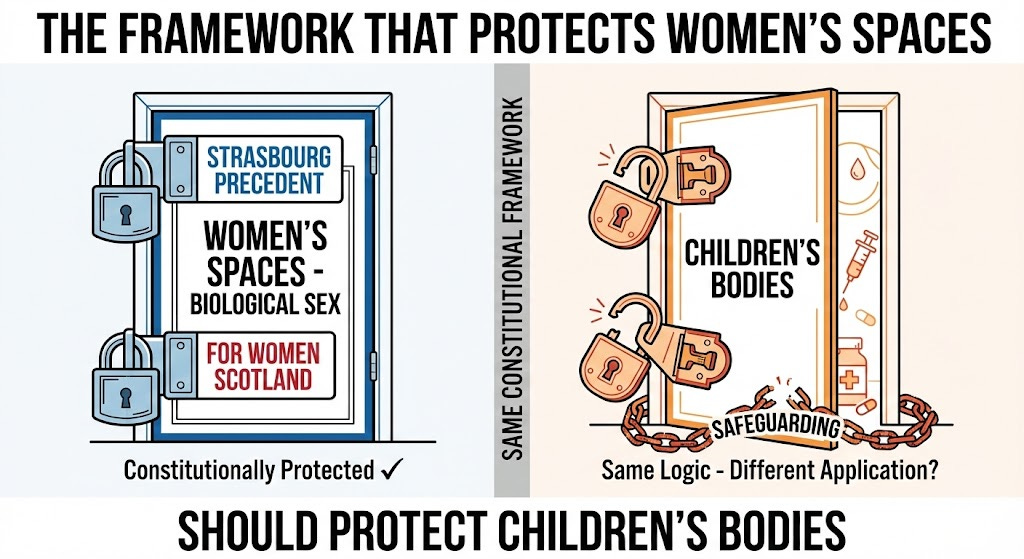
Why does it work one way for women’s spaces and the opposite way for children’s bodies?
The Demographic Pattern Nobody Discusses.
Clinical observations and referral data suggest an interesting pattern: families from professional, educated backgrounds appear prominently in childhood gender clinic referrals. This isn’t to make accusations - it’s to ask why there might be a demographic skew if gender identity were purely innate rather than influenced by parental interpretation and social context.
One possible explanation: working-class parents see a boy who likes dolls and think, “so what?” Professional-class parents with exposure to gender ideology see the same thing and think, “We might have a trans child.”
The child becomes embedded in parental meaning-making about identity. And if you think that sounds harsh, ask yourself: why would there be demographic patterns in something claimed to be purely biological and innate?
What Happens to the Detransitioners?
Young people who transitioned and then stopped - detransitioners - are beginning to speak out. Several are pursuing legal action in the UK, including cases against the Tavistock. Their arguments focus on whether they could meaningfully consent, whether alternative explanations for their distress were properly explored, and whether they were given accurate information about long-term effects.
Keira Bell’s case, though overturned on appeal, established that these questions about consent and safeguarding are legally arguable. More litigation is coming. The legal questions are: Did these young people have the capacity to consent to fertility-affecting treatments? Were they properly informed? Were alternative explanations for their distress adequately explored before medical intervention?
What happens when more of them reach their twenties and thirties? What happens if they want children and can’t have them? What happens if they feel their bodies were irreversibly changed based on decisions they weren’t really equipped to make?
The answers to these questions will arrive in courtrooms over the next decade.
The Constitutional Connection.
Here’s where it comes back to the Women’s Institute.
For Women Scotland established that biological sex is fundamental to how the Equality Act works. That constitutional framework also has profound implications for childhood transition. Because if biological sex is a material reality that can’t be overridden by declaration in law, then what’s the justification for medically intervening to change children’s sex characteristics based on parental declarations about identity?
The same constitutional logic that protects women’s spaces raises fundamental questions about affirm-first approaches to gender-distressed children.
Trans activists are furious about the WI decision. They’re demanding courts develop new rights beyond Strasbourg precedent, demanding Section 3 reinterpretation that conflicts with Supreme Court findings.
But they can’t have it. The constitutional architecture doesn’t work that way. And applying that same rigour to childhood transition reveals questions that desperately need answering.
Questions That Get You Called Transphobic.
Why did the Tavistock close? Why did the Cass Review find such significant gaps in outcome data? Why have multiple European countries reversed course after reviewing evidence? What’s in the long-term follow-up data? Can children meaningfully consent to fertility-affecting treatments? What happens to kids with autism or trauma who get interpreted as trans instead? Why are we suppressing normal puberty in healthy children based on parental interpretation of gender non-conformity?
These aren’t transphobic questions. They’re safeguarding questions.
The Cass Review asked them. Scandinavian countries asked them and changed their policy dramatically as a result. Detransitioners are asking them through tears and lawsuits. The organisations most associated with affirm-first approaches - Stonewall, Mermaids - have resisted these questions at every turn, often responding with accusations rather than evidence.
And that resistance should tell you something, shouldn’t it?
The legal framework is clear. The evidence base for childhood intervention is weak. The safeguarding questions are urgent. What’s missing is political willingness to prioritise children’s long-term welfare over ideological certainty.
The Women’s Institute and childhood transition aren’t separate issues. They’re the same constitutional question: does material reality matter, or can it be overridden by declaration?
The courts have answered for adult spaces. The Cass Review has raised it for children’s bodies. The Scandinavian countries have answered it by reversing policy.
Now Britain needs to answer it honestly. While there’s still time to protect children from well-meaning interventions that lack evidence.
References & Further Reading:
For Women Scotland Ltd v The Scottish Ministers [2024] UKSC 16 - Supreme Court ruling on sex in the Equality Act: https://www.supremecourt.uk/cases/uksc-2023-0100.html
Elan-Cane v Secretary of State for the Home Department [2021] UKSC 56 - Strasbourg constraint on domestic courts: https://www.supremecourt.uk/cases/uksc-2019-0192.html
Ghaidan v Godin-Mendoza [2004] UKHL 30 - Limits of Section 3 HRA interpretation
Bell v Tavistock [2020] EWHC 3274 (Admin); [2021] EWCA Civ 1363 - Gillick competence and puberty blockers
The Cass Review Final Report (2024) - Independent review of gender identity services for children and young people: https://cass.independent-review.uk/home/publications/final-report/
Swedish National Board of Health and Welfare - Care of children and adolescents with gender dysphoria (2022): https://www.socialstyrelsen.se/en/about-us/press-room/press/new-guidance-for-gender-dysphoria-in-children-and-adolescents/
Finnish Council for Choices in Health Care (COHERE) - Medical treatment methods for dysphoria related to gender variance in minors (2020)
Norwegian Healthcare Investigation Board - Recommendation to withdraw treatment guideline for gender incongruence in children and adolescents (2023)
Goodwin v United Kingdom (2002) 35 EHRR 18 - Right to gender recognition with qualifications
NHS England - Cass Review implementation: https://www.england.nhs.uk/commissioning/spec-services/npc-crg/gender-dysphoria-clinical-programme/cass-review/
If you think about it, it's the same regarding the conversion therapy mandated for homosexuals before the authorities were forced to admit how appalling this was. Now it's being forced on people, often teenagers, but this time first manipulating them not only into consenting to it but into actively desiring it and blaming and shaming those who question it. Insane and cult-like. And to be fair, sometimes it's the parents who bring their kids into the cult, but often they are horrified by what their child has picked up from new societal norms (or rather social contagion) encouraged in schools, health services, the media, in shops - everywhere - including effing council meetings! Not that any sensible child would be watching any council meetings. If they did they'd probably start suffering from even more weird forms of disembodiment...