
The Wrong Address: What Robert Bush And Britain's £5,140 Funerals Have In Common.
On Robert Bush, Hull's £5,140 funerals, and grieving at the wrong address.

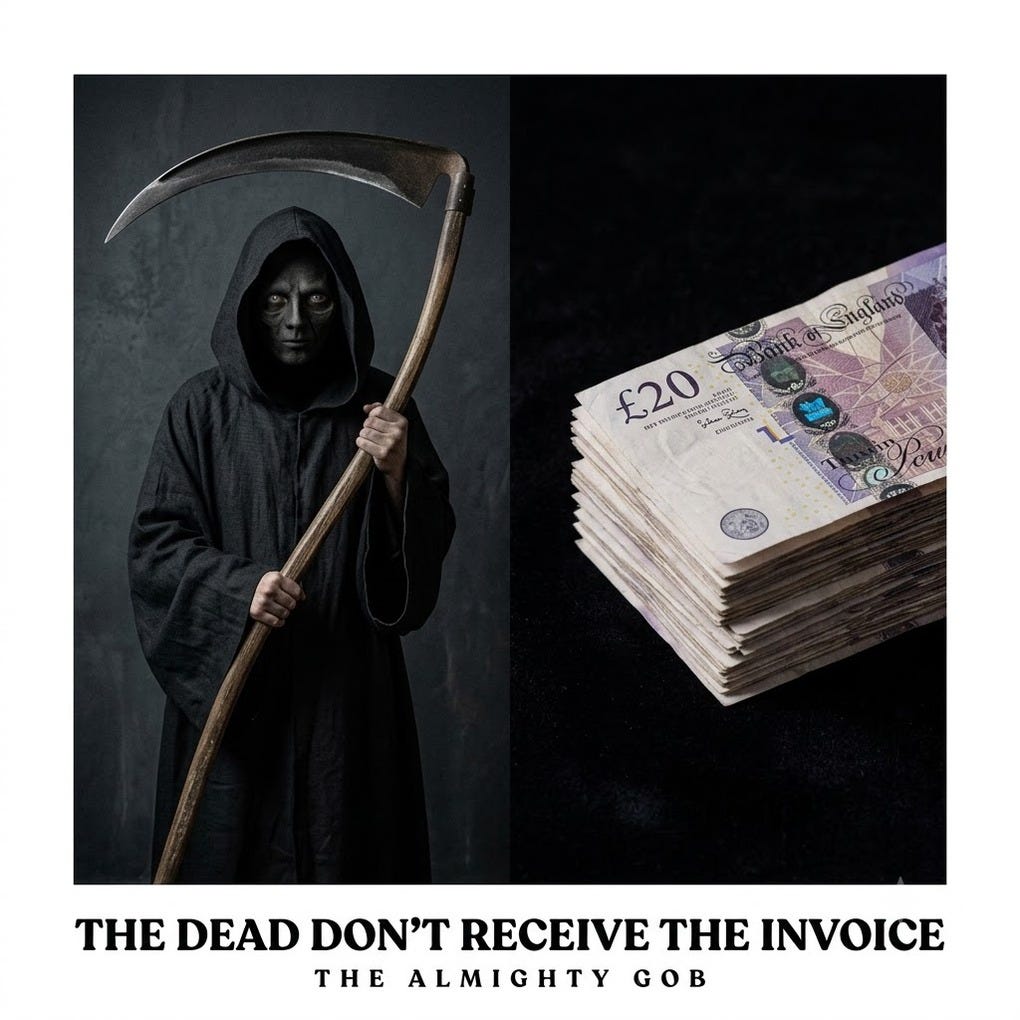
[On Robert Bush, and grieving at the wrong location]
Well. As per usual, I have no idea what I’m talking about.
So. Let’s start here, and work backwards.
I have already assured myself it will all come together further along. As I work backwards.
So. The first question I asked myself was, how do I write this backwards.
Now, in fairness, I wasn’t quite prepared for the most logical reply. SIHT.
Still. That’s neurodiversity for you.
Spelt differently, of course, it could have been far worse.
Even though it may have provided a more literal outcome.
Or. Perhaps. HTAED. Don’t ask me. I just write this stuff.
However. What I’d really like to talk about is death.
And for most. I guess the more literal outcome may well be appropriate.
Let’s start there, then. At the end.
With a man who is going to spend the next twenty years finding out what “appropriate” means, in a cell, having decided it for other people first.
Now. Back To Hessle Road.
By now, we’re probably all aware of the cold storage, humming on Hessle Road.
You picture it now, don’t you.
Racks, not shelves — that’s the word the people who found it chose, not me.
Thirty-one bodies where the paperwork said there should have been none.
One of them a stillborn baby, still waiting on a cremation that never came, for very nearly two years.
A trial date was originally set. However, an additional hearing was then scheduled for April 2026, where Bush pleaded guilty to the remaining 31 charges.
A five-day sentencing hearing commenced at Hull Crown Court on Monday, 27/07/2026, and concluded on Friday, 31/07/2026.
Yes. On 31/07/2026. Robert Bush was sentenced to twenty years, for sixty-seven offences at Legacy Independent Funeral Directors in Hull.
Preventing the lawful and decent burial of the dead. In addition to fraud, and theft.
Families handed ashes that belonged to somebody else’s mother. Somebody else’s child.
Over a hundred sets of remains sat uncollected while relatives believed the cremation had already happened. The grave already settled. The grieving, technically, already complete.
You’ll have felt some version of horror reading that. Good. So did I.
However. Horror is where most people’s thinking stops, and I’d rather not stop there.
Let’s go further in. What, precisely, was owed to those bodies. And to whom.
Remember that word — owed. Keep it somewhere close.
We’ll be sending something to a very specific address before this is done.
Now. About The Carcass.
It’s pretty well universally accepted that we’re born. We live. We die.
Or, at least that’s my hope. If not, then someone needs a strong word or two with him. That Darwin fellow.
There’ll be a clairvoyant somewhere nearby who can arrange it. Though. Don’t quote me.
Arguably, we are born to die. No matter whether it’s five minutes, five years, or fifty years after birth.
Some will die through natural causes. Some tragically. However. We all have a timeline.
Strip the sentiment off, and here’s what you actually are. A functional arrangement of enzymes, tissue, fat, bone, blood. Self-repairing, for a while. Then not.
I don’t say that to be cruel. I say it because it’s accurate, and accuracy isn’t something this country tends to extend to its dead. Never mind the living.
The personality — whatever it was that made you recognisably you — never lived in that arrangement.
It operated through it. The way a voice operates through a throat. The throat being never the voice.
Now. Here’s where grief goes wrong, and I don’t say that unkindly either. I just follow the logic.
Notice something. For the entire span of knowing somebody, you only ever reached their personality through their body. The face. The voice. The particular way they crossed a room.
You never had a version of loving them that didn’t route through the physical.
So when the part that animated them is gone and the body’s still there, your grief has nowhere else to send itself. It was never given a second address.
You’re not mistaking the corpse for the person. You’re simply standing at the last known location, because it’s the only one you’ve got.
That’s not foolishness. It’s a hardware limitation.
However. It does explain rather a lot about a funeral industry built almost entirely around maintaining that one address, in ever more expensive fashion, for people who are no longer collecting post.
The corpse is the last known location. Not the person. Just the only address grief’s ever had.
Mind. On The Spirit.
Somebody’s going to raise the spirit at this point. Fair enough.
Across traditions, there’s broad agreement that something leaves. The disagreement’s only ever about the schedule.
Some traditions say a day. Jewish mourning custom holds shiva for seven. Tibetan Buddhist tradition allows forty-nine — the bardo — before whatever it is has properly gone.
Nobody has ever measured any of it happening. One day, forty-nine days, doesn’t matter.
Humanity has only ever agreed a timetable for something nobody’s verified departing at all. Belief’s been standing in for observation for rather a long time.
I’ll take no position on whether a spirit exists. Don’t need to.
The argument only needs one fact, and I’ve already got it: nobody’s clocked the moment of departure, on any of the competing schedules, ever.
No dead person has ever sent a postcard back saying weather’s nice, wish you were here.
Which tells you everything about the schedule, and nothing at all about the destination.
So. Who Actually Benefits.
Back to Hessle Road. Whatever else Bush’s victims lost, it wasn’t the comfort of the deceased — who were, by every account and every tradition going, well past comfort or the absence of it.
What those families lost was their own ceremony. The version of events they’d paid for and been promised, in which something got witnessed, marked, closed.
Which answers the question honestly, if unfashionably. The dead don’t benefit from any of it. They’ve no preferences left to satisfy.
The dead aren’t watching the invoice. They never were.
Whatever a funeral achieves, it achieves for the people left standing at it.
I’ll grant that’s a real function, and worth taking seriously rather than waving off. Grief needs somewhere to go and something to do, and ceremony supplies both.
However. A real function isn’t the same thing as a function that costs what this country currently charges for it.
The Theatre Tax.
According to SunLife’s Cost of Dying Report 2026, the UK’s longest-running study into funeral pricing, a simple attended funeral now averages £3,828 — coffin, hearse, fee, minister.
Add the average send-off, £1,312 for the wake, the flowers, the order sheets, and the true total lands at £5,140.
Now compare that to the floor. Direct cremation, no service, has surged from 3 per cent of funerals in 2019 to 21 per cent by 2025, priced from under £1,500.
A full traditional burial with a new plot, per the National Association of Funeral Directors, now averages £5,033.
Same biological outcome, either way. Same carcass. Look at the gap again.
That gap between the two figures isn’t a disposal cost. It’s the price of the ceremony sitting on top of it — the shrine you’re paying to maintain at the only address grief’s ever had.
The dead aren’t watching the invoice. They never were. It’s the only party in the room who genuinely doesn’t mind what it comes to.
I’m not arguing the ceremony’s worthless. I’m arguing something narrower, and harder to shrug off, here at The Almighty Gob.
The industry’s quietly priced a service for the living as though it were a duty to the dead. And duties to the dead don’t haggle. They just never object to the invoice. Unsurprisingly.
The industry’s quietly priced a service for the living as though it were a duty to the dead.
Now. About What They’d Actually Want.
The standard defence, when any of this gets said aloud, is that a proper send-off is “what they would have wanted.”
Sometimes that’s even true. It’s also, conveniently, never checked against what the person actually wrote down. Not always. Anyway.
That’s not contempt for anyone currently grieving, and I’d ask you not to read what follows as such. Grief’s real. It’s owed respect.
None of this is aimed at the person standing at a graveside working out how to get through the day.
What’s fair game is the invoice arriving within days of a death, dressed up as tradition, when more often than not it’s simply the going rate.
I’ve written mine down. It’s in my Amazon published book.
It makes no difference whatsoever what happens to my body once I’m no longer using it. Bin liners, kerbside collection, petrol and a match — take your pick.
I’ll feel none of it. And I’ll most certainly not be getting up afterwards to lodge a complaint, on account of being dead. Which remains a fairly terminal condition. You know. D-e-a-d.
However. On the flip side, and there’s always a flip side. Robert Bush is going to prison for twenty years for treating the dead with contempt while charging the living for reverence.
It’s just that my position’s rather simpler, and, it turns out, rather cheaper. The dead aren’t watching the invoice. They never were. Only the living were.
Which is precisely who it was always going to be sent to.
So there’s your address, then — the one I asked you to hold onto, back near the start. Not a grave. Not an urn.
The kitchen table where the invoice actually gets opened. That’s where it was always owed.
And that’s the piece, worked all the way backwards, exactly as I told you it would be. Start at the end, land back at the beginning. HTAED and SIHT, the right way round after all.
Turns out backwards was the only honest way to write this one. Because nobody ever asks the corpse what it thought of the flowers.
Nobody ever will.
Sources and citations
Crown Prosecution Service, “Former Hull funeral director jailed for preventing lawful burials, fraud, and theft” (31/07/2026)
SunLife, “Funeral landscape changing as costs continue to rise”, Cost of Dying Report 2026
National Association of Funeral Directors, “How Much Does a Funeral Cost in the UK”
© 2026 John Langley aka www.thealmightygob.com