
They Came For Us. We Were The Wrong Target. And Nobody In Charge Noticed.
Iran attacked a British airbase with a drone. America and Israel caused it. We got the drone anyway. Sound familiar? By The Almighty Gob | thealmightygob.com

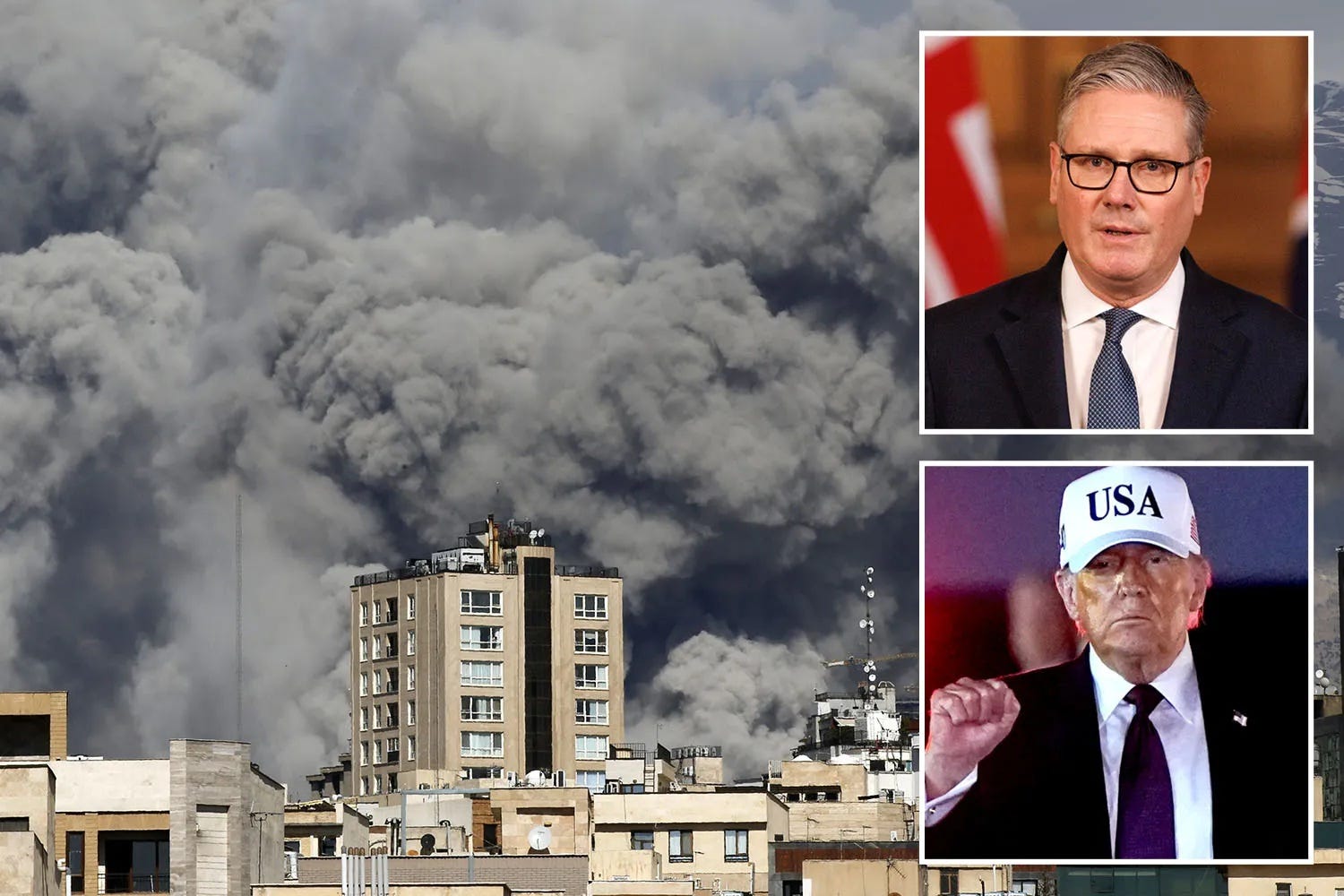
Let’s be absolutely clear about what happened.
Iran launched a military strike against a British airbase in Cyprus. Not an American base. Not an Israeli installation. A British one. On a Mediterranean island that most of the Iranian military’s strategic planners would struggle to locate on a map — as they subsequently demonstrated.
America architected the policy that inflamed the region. Israel executed the operations that drew the response. Britain, as is traditional, was somewhere in the background — making tea, mislaying the paperwork, and quietly wondering whether the defence budget could stretch to diesel.
And yet. Here we are. Somehow, we got the drone.
Ask yourself this: when was the last time Britain was at the centre of a geopolitical crisis it didn’t sleepwalk into? Take your time. I’ll wait.
The Dictionary, Allah, And A Map Of Somewhere Near Cyprus.
Iran’s decision-making process deserves a moment of genuine examination — and I use the term “decision-making” with the same generosity I’d extend to a pub dart team if someone called them “athletes.”
Somewhere in Tehran, someone who had read the word “intelligence” in a dictionary and decided it applied to them stared at a map for three months and concluded that the most effective response to American foreign policy was to inconvenience a British RAF base on a Mediterranean island.
To be fair, the dictionary was just for the job title. The actual targeting decision was outsourced to Allah. Between the two of them, they managed to miss America, Israel, and anything resembling a coherent strategic objective — but they did find Cyprus.
This is the geopolitical equivalent of a man wronged by his boss going home and kicking his own shed.
The dictionary was just for the job title. The actual targeting decision was outsourced to Allah. Between the two of them, they found Cyprus.
You have to respect the commitment, if not the logic.
Meanwhile, Back In Tehran.
Meanwhile, back in Tehran — thankfully, a location the Iranians can at least find on a map — things are not exactly running smoothly behind the scenes either.
The Supreme Leader — until very recently aged 86 — has now departed to administer the revolution from the aether in person, presumably enjoying the company of a plentitude of rather aged and somewhat cobwebbed virgins. He joins several other senior figures who have departed in recent years — some by helicopter, others by American and Israeli airstrike.
The Revolutionary Guard, once the iron fist of the regime, now operates with the frantic, directionless energy of an organisation that knows it’s in serious trouble but can’t quite agree on what kind of trouble, or what to do about it. At this rate, they could do with the same Airfix sponsorship we’re applying for. Though given the petrochemical situation, neither side can guarantee the glue.
Headless halal chickens, the lot of them.
Which explains the map reading. You don’t accidentally select Britain as your primary target unless the decision-making chain has developed some fairly significant structural gaps. This wasn’t malice. This wasn’t even strategy. This was an institution in structural collapse doing exactly what collapsing institutions do — lashing outward because looking inward had become too uncomfortable. Entirely predictable. Nobody predicted it.
Sound familiar? Keep that thought. We’ll come back to it.
One Ship. To Keep An Eye On Things.
Back in London, the response was exactly what you’d expect from a nation that once ruled a quarter of the world and can no longer agree on whether HS2 should reach Birmingham.
Four days passed. Heads were scratched. Meetings were convened. Someone produced a PowerPoint presentation with the words “Escalation: Considerations and Next Steps” in a font that said serious but not alarmist. At the rate things were moving, there was a genuine suspicion that HS2 would be completed before anyone made a decision about protecting our military and our citizens abroad.
Now, this is pure speculation — and I want to be clear that it is exactly that — but one does idly wonder whether part of those four days was spent perfecting the Prime Minister’s speech for the Grand Iftar celebrations in Central London. The timing, as they say, is entirely coincidental. Probably.
And then — the decision. We would send a Navy ship. HMS Dragon, to be precise. A Type 45 destroyer. And helicopters. Counter-drone helicopters. Which sounds impressive until you do the timeline.
Four days to reach the decision. A further couple of days to run what appears to have been an internal lottery on precisely what to send. And then — and this is the part that genuinely defies parody — six days sailing time to actually get there.
One ship. Some helicopters. Arriving approximately a fortnight after the attack. To keep an eye on things.
By the time HMS Dragon reaches Cyprus, the crisis will have either resolved itself, escalated beyond what one destroyer and some helicopters can address, or moved somewhere else entirely. It’s not a deployment. It’s a postcard. Thinking of you. Arriving shortly. Hope you’re still there.
There is a certain poetry to the name. HMS Dragon. The Welsh dragon. Dispatched to the eastern Mediterranean — running on gas turbines and diesel, since we’re being factual, but let’s say coal for the sake of the image — imported from China, naturally, because Wales, which once supplied the fuel that powered the entire imperial fleet, closed its mines decades ago. The communities hollowed out. The heritage centres went up. And the dragon that replaced them sails on someone else’s resources now.
The Welsh valleys didn’t just lose an industry. They lost the fuel that once moved Britain’s power across the world. That’s not a punchline. That’s just what happened.
So the ship would get there. Eventually. Probably.
Meanwhile, the submarine that might have made a genuine strategic statement in the Straits of Hormuz was, at that particular moment, in Australia. It was summer down there. And even the Navy deserves a break.
We used to have an army. We used to have a navy. We used to have an Air Force. All three now so depleted that the next defence budget could, realistically, be sponsored by Airfix. Some assembly required. Glue not included.
Although — and here’s where the joke stops being funny — glue is a petrochemical derivative. Solvents, synthetic polymers, all of it downstream from oil. The same oil that flows through the Straits of Hormuz. The same Straits of Hormuz that Iran has repeatedly threatened to close. So it turns out Britain couldn’t build the model kit either if things went properly sideways. The Airfix analogy is less satire than it is procurement policy.
This Is Not Winston Churchill That We’re Dealing With.
And all of this unfolding while the post-war international order is being redecorated in real time.
The alliances, the mutual defence commitments, the carefully constructed architecture of Western security — dismantled by a man who views multilateralism the way most people view a gym membership: theoretically useful, rarely visited, cancelled when inconvenient.
And sliding in next to him, eager and well-pressed, our dear Prime Minister. Who spent months cultivating Trump. Rolled out the red carpet for a state visit. Praised him at every available opportunity. Worked the special relationship like a man whose mortgage depends on it.
And then, when the moment came — when America asked to use British bases to strike Iran — Starmer hesitated. Concerned, apparently, about a potential breach of international law. Which is an admirable instinct in a barrister. Less so when your airbase is about to get droned. Worth asking, quietly, who exactly benefited from that hesitation. And who was watching to see if it happened.
Trump’s verdict, delivered to The Sun and The Telegraph simultaneously, was characteristically surgical: “This is not Winston Churchill that we’re dealing with.”
Which is, when you think about it, the most expensive sentence in British foreign policy since Suez. Churchill stood with America when it cost something. Starmer dithered, then relented, then sent a destroyer — after the runway had already been hit. Trump noticed. And in response, withdrew his support for Starmer’s Chagos Islands deal, meaning Britain may yet lose the lease on Diego Garcia as a direct consequence of the hesitation.
When asked whether Starmer’s reluctance might have something to do with Muslim voter sensitivities, Trump replied: “It could be.” Which loops neatly back to those four days, the Grand Iftar speech, and the pure speculation this piece offered earlier — which is looking considerably less speculative by the hour.
The special relationship, enduring as ever — in the sense that it remains special to us, and occasionally punishing when we forget the terms.
And the crowning irony? Starmer managed to be attacked from every direction simultaneously. Trump said he was no Churchill. His own Labour MPs — John McDonnell, Richard Burgon and others — said he’d gone too far by agreeing to let the Americans use the bases at all. And Nigel Farage called him a follower, not a leader, for taking too long to decide. He pleased nobody. Angered everyone. And his airbase got hit in the middle of it.
An institution lashing outward because looking inward had become too uncomfortable. Where have we heard that before?
Britain dispatching HMS Dragon to the eastern Mediterranean while simultaneously being publicly compared to Churchill’s lesser successors by the leader of the free world. That’s not foreign policy. That’s performance anxiety with a nautical flag attached.
Here’s The Part Nobody Puts On The Front Page.
While the political class was consulting its diary, reviewing its options, and dispatching one ship to look vaguely purposeful — the people who actually keep this country safe were, as they always are, quietly getting on with it.
Dozens of terrorist plots foiled on British soil since 2017 alone. Twenty of them Iran-backed — plots presenting potentially lethal threats to British citizens and UK residents, confirmed by the Director General of MI5 himself. You didn’t hear much about them. No press conferences on the steps of Whitehall. No sombre-faced ministers in front of flags. Just professionals, working without applause, stopping things from going very badly wrong for ordinary people on ordinary streets.
The ones who actually protect us never get the press conference. The ones who send a boat four days late always do.
That gap — between the performance of security and the reality of it — tells you almost everything about how modern Britain operates.
None Of This Is Entirely Funny. It Never Quite Is.
Somewhere in Britain tonight, someone is doing something completely ordinary.
Getting the kids to bed. Watching something forgettable on television. Making a cup of tea they’ll leave to go cold on the side. Walking the dog around the same block they always walk the dog around.
They don’t know how close it came. They never do. That’s the point.
The ordinary Tuesday continues. The cup of tea goes cold. The dog gets walked.
That’s what security actually looks like. Not a destroyer sailing towards a problem it will arrive too late to address. Not a minister at a podium telling you how seriously they’re taking it. Just someone, somewhere, doing a very difficult job so that someone else can do something completely ordinary without knowing they needed protecting.
Iran is 90 million people, most of whom had no say in the targeting decisions. They are living under a regime simultaneously aggressive abroad and increasingly fragile at home — a combination that historically doesn’t end well for anyone nearby, including the people inside it.
Britain’s hollowed military isn’t an abstraction. It’s the accumulated weight of a thousand quiet decisions made by people who will never face the consequences of making them.
The farce and the stakes exist simultaneously. That’s the bit that’s hardest to hold in your head. But hold it there anyway. It matters.
Two Countries. Two Decision-Makers. Identical Results.
But still. HMS Dragon. One destroyer. Dispatched eventually. Powered by optimism and whatever they could source at short notice.
Iran targeted Britain because America and Israel were, apparently, too obvious.
And somewhere in Whitehall, a very senior person — in possession of a masters degree in nine tenths of bugger all from the University of Aberystwyth, obtained probably two years ago — looked at the developing situation in one of the world’s most strategically sensitive waterways and thought: I know. We’ll send a boat.
Somewhere behind him, a political adviser who managed to scrape an A-level and is now on the payroll as a consultant nodded along and said: good call.
Two decision-makers. Two countries. One consulting a dictionary and Allah, the other a two-year-old masters degree in nine tenths of bugger all. Different methods. Identical results.
Nobody is saying that out loud, by the way. Notice that.
A handful of budget decisions made over two decades — not by generals, not by strategists, but by people who will never be anywhere near the consequences — produced every single vulnerability on display this fortnight. The decisions were small. The effects are not.
And somewhere in the middle, trying to get on with their lives, the rest of us.
Twenty Iran-backed plots on British soil since 2022. Could easily be twenty-one by the time you finish reading this.
Which brings us back to where we started. When was the last time Britain was at the centre of a geopolitical crisis it didn’t sleepwalk into?
You’ve had time to think about it now.
Still waiting.
I’m The Almighty Gob — an independent blogger and satirical commentator specialising in institutional accountability and the yawning gap between political rhetoric and measurable reality. I’ve published over 88 articles since May 2024.
Sources & Citations.
Assassination of Ali Khamenei — Wikipedia. https://en.wikipedia.org/wiki/Assassination_of_Ali_Khamenei
2026 Iranian strikes on Cyprus — Wikipedia. https://en.wikipedia.org/wiki/2026_Iranian_strikes_on_Cyprus
Al Jazeera. “British military base in Cyprus targeted in suspected drone attack.” 2 March 2026. https://www.aljazeera.com/news/2026/3/2/british-military-base-in-cyprus-targeted-in-suspected-drone-attack
TIME. “British Base Hit in Cyprus, Drones Downed as Iran War Widens.” 2 March 2026. https://time.com/7382076/british-base-hit-iran-war-drones-united-kingdom-terror-threat/
GB News. HMS Dragon Type 45 destroyer deployment confirmed. https://www.gbnews.com/news/world/iran-latest-raf-akrotiri-donald-trump-strikes-israel-hezbollah-lebanon-saudi-arabia
Counter Terrorism Policing UK. 40+ terror plots foiled since March 2017. https://www.counterterrorism.police.uk/latest-home-office-statistics-reveal-7-late-stage-plots-foiled-since-march-2020/
Calibre Defence. “Three observations from Iran’s drone strike on RAF Akrotiri.” 2 March 2026. https://www.calibredefence.co.uk/three-observations-from-irans-drone-strike-on-raf-akrotiri/
France 24. “Not Churchill: Trump criticises UK PM Starmer over Iran strikes.” 3 March 2026. https://www.france24.com/en/americas/20260303-not-churchill-trump-criticises-uk-pm-starmer-over-iran-strikes
Daily Caller. “Trump Tells British Newspaper He’s ‘Very Disappointed’ In Prime Minister Keir Starmer.” 2 March 2026. https://dailycaller.com/2026/03/02/trump-keir-starmer-iran-strikes-britain-diego-garcia/
HuffPost UK. “Keir Starmer Faces Backlash Over UK Bases Used For Iran Attack.” 1 March 2026. https://www.huffingtonpost.co.uk/entry/keir-starmer-faces-backlash-after-letting-america-use-uk-bases-to-attack-iran_uk_69a52f94e4b033a0453548a8
GB News. Trump: “Keir Starmer is pandering to Muslim voters.” https://www.gbnews.com/politics/politics-news-latest-spring-statement-reform-keir-starmer-nigel-farage-greens
MI5 Director General Ken McCallum. Annual threat update — confirms 43 late-stage attack plots foiled since 2017, and 20 Iran-backed plots presenting potentially lethal threats to British citizens and residents since January 2022. https://www.mi5.gov.uk/director-general-ken-mccallum-gives-latest-threat-update