

[I had a theory]
I don’t know what Melania was wearing on Easter Sunday morning.
However, I have a theory.
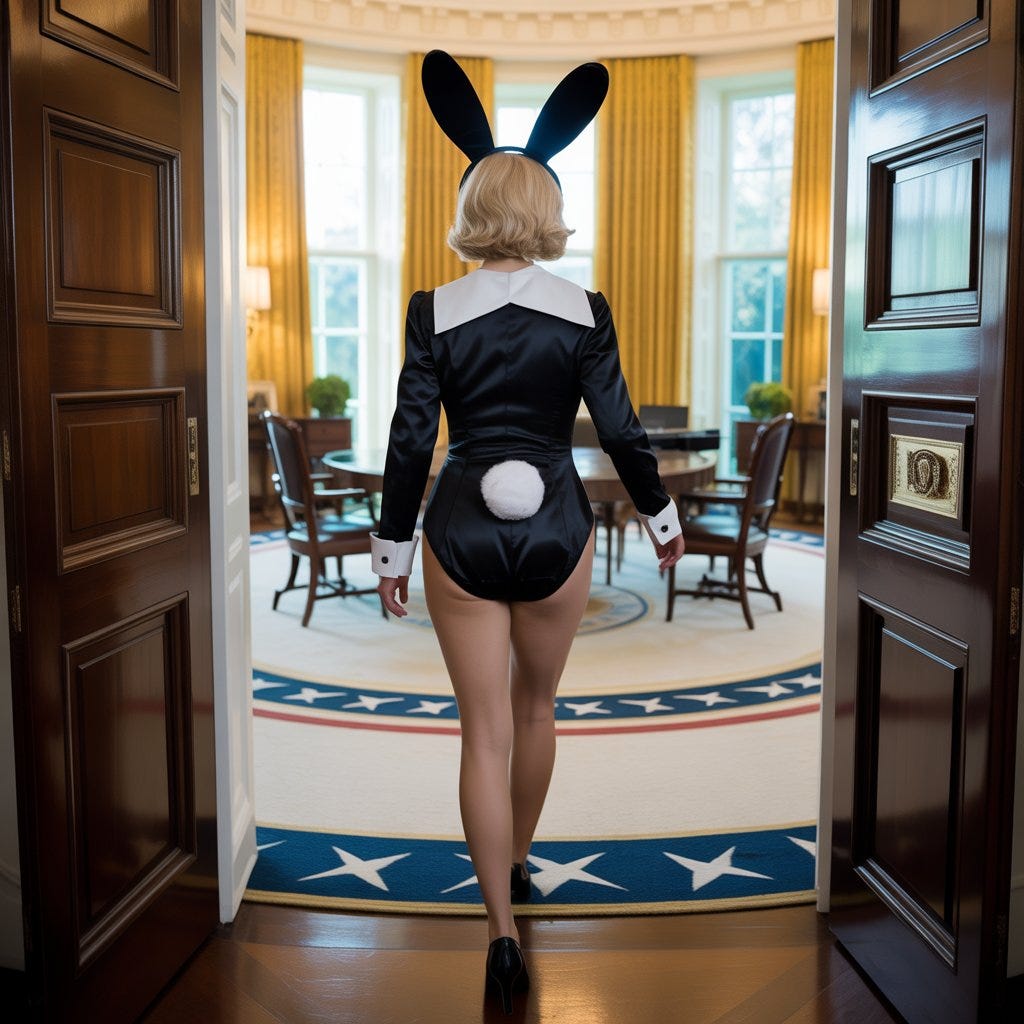
It was Easter. There are traditions. There are expectations. There are, in certain households, outfits. And when you are the First Lady of the United States and you emerge from the wardrobe on the holiest morning of the Christian calendar — a bank holiday — in something that could generously be described as festive —
Something happens to a man.
Something certainly happened to this one. The March Hare came a day late.
8:03 a.m. Truth Social. The most powerful man in the world, sitting somewhere in the White House — a building designed by enslaved people, furnished by history, watched by the world — typing on his phone.
“Tuesday will be Power Plant Day, and Bridge Day, all wrapped up in one, in Iran. There will be nothing like it!!!”
Nothing like it.
Three exclamation marks.
He’s threatening to destroy the critical infrastructure of a sovereign nation and he’s written it like a man describing a particularly good fireworks display. You can almost see the thumbs moving. You can almost hear the fries arriving.
And then it escalated.
This, from the master of understatement.
“Open the F**in’ Strait, you crazy bastards, or you’ll be living in Hell — JUST WATCH!”*
And then, with the particular serenity of a man who has made his peace with the universe, he signed off:
“Praise be to Allah. President DONALD J. TRUMP.”
On Easter Sunday.
From a self-described Christian.
Who was not at church.
The McDonald’s had, in all likelihood, already been ordered. A Filet-O-Fish. A Quarter Pounder. A Big Mac. Hot fries. A vanilla shake. The food of a man who trusts no kitchen he hasn’t vetted and no chef he didn’t hire — because, as he has explained more than once with complete sincerity, one bad hamburger can destroy McDonald’s. Somewhere in the White House a bag was sitting in a warming drawer. The most powerful man in the world, on the morning his own faith considers the holiest of the year, waiting for his fries.
He was having what the White House schedule listed, without apparent irony, as executive time.
Whatever Melania was wearing, we owe it a debt. Without it, we might never have known that Tuesday was going to be Bridge Day.
The Thing That Keeps Nagging.
Maybe.
I’ve been watching this man for years. And I keep landing somewhere I didn’t expect.
Because history has a habit — a really quite irritating habit — of making us look stupid for laughing too early.
Churchill. You know the name. You probably think you know the story. Here’s the bit they leave out of the commemorative tea towels.
The man drank before breakfast. Not occasionally. Habitually. He had what he called his Black Dog — a depression so severe that people who worked alongside him made quiet, careful arrangements to ensure he was never left alone near certain windows. His career, before 1940, was a graveyard that other politicians used to feel better about their own failures. Gallipoli. The Gold Standard. His position on India. Catastrophe after catastrophe, each one more spectacular than the last, each one followed by serious and perfectly reasonable people concluding, perfectly reasonably, that this man was finished.
And then 1940 happened.
The speeches happened.
The particular bloody-minded, irrational, against-all-available-evidence stubbornness that held a country together when every sane calculation said fold — that happened.
Same man. Same Black Dog. Same temperament that had wrecked everything before it saved everything after.
Lincoln was clinically depressed. Not melancholy in a poetic, nineteenth century, flickering-candle way. Clinically depressed. His law partners documented it. The people around him watched with the specific vigilance of people who’d learned not to take anything for granted. The kind of interior weather that in another man, another life, would have ended a career before it started.
And yet the Gettysburg Address. And yet the political intelligence — almost impossible political intelligence — to hold together a cabinet that basically despised each other, through a civil war, while carrying all of that privately. Every single day.
Tesla, by the end, was having detailed conversations with pigeons. Genuinely. Not as a metaphor. Pigeons. And he built the framework for the modern electrical world.
John Nash — schizophrenia. Full breaks from reality. Paranoid episodes that destroyed everything they touched. And a Nobel Prize. The same engine. Pointed differently.
I’m not romanticising any of this. These were not comfortable lives. The people around them paid prices that don’t get tallied anywhere because the history books are mostly interested in the genius and not particularly in the bill.
The relationship isn’t simple and nobody serious claims it is. The pattern is real — documented, persistent, showing up whether we find it convenient or not. The space where traits that would obliterate ordinary functioning can, in the right conditions, produce something the cautious and the careful simply won’t reach.
Brilliant and broken aren’t always opposites. Sometimes they turn out to be the same address. The neighbours find this unsettling.
So what’s different?
Although.
Every single one of those examples had something around them.
Churchill had cabinet. Had Parliament. Had Clementine, who pushed back across four decades with the patient persistence of someone who had decided that this was her life now and she was going to make the best of it. There was friction in the architecture. There was a gap between the raw thought and its consequence in the world, and in that gap, quietly, someone was doing the correcting.
Tesla’s obsessions hurt Tesla. Nash’s paranoia hurt Nash. The blast radius — devastating as it was for both of them personally, genuinely devastating — stopped somewhere. The brilliance had room to work because the damage, terrible as it was, was contained.
Nixon played the madman deliberately — documented strategy, coherent logic — with Kissinger running the back channel the entire time. The unpredictability was performed. The architecture underneath held.
Trump has Truth Social.
And a room where, apparently, nobody checks the spelling.
Because here’s the detail that keeps stopping me. In the same post where he threatened to bring civilisational consequences down upon Iran, he announced that “all Hell will reign down on them.”
Reign.
Not rain.
R. E. I. G. N.
He’s threatening the apocalypse and he’s used the wrong homophone. The apocalypse will, apparently, reign. Like a monarch. Like a particularly decisive sovereign who has decided that today is the day for smiting and has filled in the relevant paperwork.
This is the man with the nuclear codes.
There will be nothing like it!!!
He’s not wrong about that, actually.
Meanwhile the typo sat there. Live. Uncorrected. Going out in real time to three hundred million people while the rest of the world tried to establish whether Praise be to Allah on Easter Sunday was a deliberate geopolitical signal to the Muslim world, a theological malfunction, or simply what happens when the morning gets away from you in the White House and Melania is standing there in the ears and you’ve had a thought and the phone is right there.
The pause — the breath, the person in the room who says are you absolutely certain about this — it’s gone. What goes out now goes out raw. Unmediated. Instantly. To everyone at once. Including Iran.
That’s the bit history has no answer for. Every example that worked — that produced the breakthrough rather than the crater — had the pause built in somewhere. The laboratory wall. The cabinet table. The spouse at the breakfast table. The person in the room.
What happens when you remove all of that and hand the unfiltered output a global platform and the largest military in human history?
We are, at this precise moment in time, finding out.
He’s right. There will be nothing like it.
Back to the Bedroom.
On the same Easter Sunday. Same planet, same hour, same sunrise landing on the same bruised world.
Pope Leo XIV stood on a balcony in Rome and said, quietly, to anyone who was listening:
“Let those who have weapons lay them down. Let those who have the power to unleash wars choose peace.”
Two men. One morning.
One of them was at church.
I’m not going to tell you the madman theory is wrong. It’s real, it has a serious history, and deliberate unpredictability has genuine strategic value when the person deploying it knows precisely what they’re doing with it. That possibility deserves to stay on the table. I’m leaving it there.
What I keep coming back to — what I won’t quite put down, what keeps arriving at two in the morning when the phone is on silent and the stillness is doing its work — is the thing the examples keep showing us that we keep almost hearing.
When the madness produces the brilliance rather than the catastrophe, something in the surrounding system is doing the filtering. Absorbing the worst of it. Making sure the right bits land and the wrong bits don’t reach the bridges.
Churchill’s worst impulses had Parliament. Tesla’s obsessions had a laboratory. Nash’s paranoia had mathematics.
When that’s gone —
The question isn’t whether madness can produce brilliance.
History has answered that one. It can. Spectacularly, sometimes.
The question — the one that sits at the bottom of the rabbit hole, past the comedy, past the typo, past the bunny outfit and the executive time and the three exclamation marks — is who pays when it doesn’t.
Think about it.
Not the man in the bedroom.
Not the one at the balcony in Rome.
Not the people turning it over at two in the morning on the other side of a screen.
The people who were already living near the bridges.
They always pay. They paid for Gallipoli. They paid for the Gold Standard. They paid for every brilliant, broken, unfiltered decision that ever went all the way wrong while the man who made it was somewhere else entirely, waiting for his fries.
They never make the history books. They just make up the numbers in them.
There will be nothing like it.
He said it himself. That’s the rabbit hole.
The Almighty Gob is Bristol’s most prolific independent blogger — covering politics, power, and the gap between what institutions say and what they actually do, from City Hall to the White House, from the corner shop to the Moon. Publishing since 2020, with over 500 pieces and 88 Bristol FOI-based investigations, The Almighty Gob operates across nine social media platforms, Substack, and thealmightygob.com — reaching readers who prefer their politics without the packaging.