
Two Marches. £41 Million. One Million GP Appointments.
London, 16 May 2026. One crowd marched about Britain. The other forgot where it lived. The Almighty Gob — Published 16 May 2026.

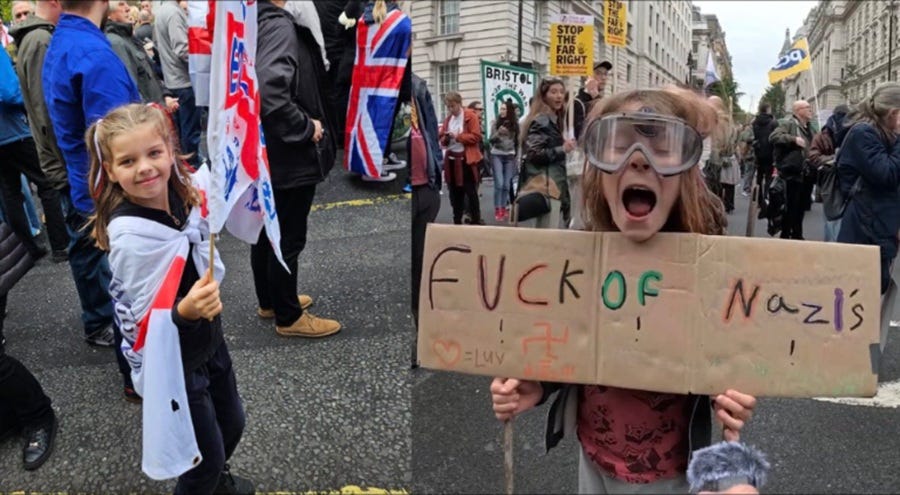
[The Two Faces of Modern Britain — London, 16 May 2026. Left: a young girl wrapped in a St George's Cross at the Unite the Kingdom march. Right: a child holding a handmade placard at the Stop The Far Right counter-protest.]
The Two Faces of Modern Britain.
If a picture says a thousand words, I am struggling to understand why I still need to write more than that. Yet here I am.
A Saturday Morning in Bristol.
It was a perfectly ordinary Saturday morning in Bristol — the kind that asks one thing of you, which is what to eat, and I was outside a café drinking a hot chocolate, the main constituent of which was milk that bore no relation to the inflatable cow that was about to pass me, mind drifting contentedly between the present moment and the question of what to do with the roast chicken carcass waiting for me at home.
A curry, I had decided. That evening. Something warm and unhurried.
The march was the ten percent of my Saturday. The chicken was the ninety. One arrived uninvited. The other was waiting patiently at home.
And then the march arrived — first the inflatable cow, then the pink inflatable pig, at which point bacon sprung to mind, then the placards: Stop Exploiting Animals, Animal Liberation, Endorse The Plant Based Treaty.
Presumably the plants signed first. The Day of the Triffids flashed in my mind, then back to the reality of the march — a crowd of people who had clearly given a great deal of thought to the welfare of livestock and considerably less to the man sitting outside the café drinking his hot chocolate.
They marched past, I watched, and I have to say I remained entirely unmoved — which felt like a perfectly adequate summary of where we are as a country in May 2026: a man trying to get through his Saturday, a cause that arrived without an invitation, and ordinary life carrying on regardless.
I went home and dealt with the chicken, which incidentally was not mine alone — the cats had a prior claim on it, and I can assure you they would not have joined the march under any circumstances, as they only protest when their food is not delivered on time.
Before I did, though, I checked the news and discovered that Bristol was not the only city marching about something other than the lives of the people doing it — London had two, and they were considerably larger.
Two Marches. One City. One Saturday.
The first assembled at Kingsway, moved through Aldwych and the Strand, and ended in Parliament Square — a flag sea of St George’s Crosses and Union Jacks, a stage, and Stephen Yaxley-Lennon — better known as Tommy Robinson — thanking the Metropolitan Police and asking his crowd to show them some respect on the way home.
The second assembled at Exhibition Road in South Kensington, moved through Knightsbridge and Piccadilly to Pall Mall, where it included Jeremy Corbyn telling the gathered thousands that the people in Parliament Square represented hatred and division and did not reflect the Britain he was proud of.
Two marches. One city. One Saturday — and four thousand officers, armoured vehicles, horses, dogs, drones, helicopters, and a policing bill of £4.5 million confirmed by the Metropolitan Police’s own Deputy Assistant Commissioner, just to keep them apart.
The argument has a postcode.
The Bill Nobody Is Talking About.
Saturday was not unusual in that regard.
Operation Brocks — the Metropolitan Police’s formal designation for Palestine-Israel protest policing — cost £24.9 million between April 2024 and March 2025 alone.
That figure comes from Freedom of Information data obtained by the Jewish Chronicle.
Across all UK police forces, the total for that twelve-month period reached at least £27.7 million.
Between September and November 2025, a further £12 million was spent by the Met policing Palestine-related protests — £3.8 million in September, over £4 million in October — requiring hundreds of mutual aid officers borrowed from other forces under powers normally reserved for major incidents.
Three Tommy Robinson rallies across 2024 and early 2025 cost a combined £3.86 million to police.
The ratio is approximately ten to one.
Thirty-seven million pounds spent policing one cause. Less than four million policing the other.
Both figures come from the Metropolitan Police’s own published FOI data.
Since October 2023, the Palestine Solidarity Campaign has organised approximately 33 national marches through the streets of London — by their own count, the 30th took place in September 2025.
Across the same period, Tommy Robinson staged three major rallies.
The policing cost of Palestine-related protest operations: £37 million. Confirmed by Freedom of Information data.
The policing cost of the Tommy Robinson rallies: £3.86 million. Also confirmed by Metropolitan Police published data.
Thirty-three marches against three rallies.
Ten pounds spent policing one side for every one pound spent policing the other.
What £37 Million Buys.
Here is what the £37 million spent policing Palestine protests could have bought instead.
1,302 newly qualified NHS nurses for a year.
920 newly qualified doctors for a year.
1,123 EHCP caseworkers for a year — the people who process Education, Health and Care assessments for children with special educational needs.
567,000 NHS dental appointments.
Nearly one million GP appointments.
370,000 potholes filled.
Here is what the £3.86 million spent policing the pro-Britain marches could have bought instead.
135 newly qualified nurses for a year.
96 newly qualified doctors for a year.
59,000 NHS dental appointments.
99,000 GP appointments.
38,600 potholes filled.
A fraction. A drop in the ocean by comparison.
These are not figures that required seven hours of research to assemble.
They were available in real time to the man sitting in the police control room in Lambeth.
Every GP appointment. Every dental appointment. Every nurse. Every doctor. Every pothole.
Keir Starmer knew exactly what those marches cost.
He watched them go past and called it a manageable Saturday.
Others might call it an unnecessary one.
The Palestine marches are a choice. The pro-Britain marches are a symptom.
However — here is the point that nobody is making.
One might reasonably argue that if this country had been governed competently — if the NHS had been properly funded, if the housing crisis had been addressed, if the democratic deficit had been taken seriously — there would have been no need for those pro-Britain marches in the first place.
The Palestine marches are a choice. The pro-Britain marches are a symptom.
One costs ten times more than the other.
The figures are not in dispute.
The combined total: approximately £41 million. Across both causes. Across both crowds.
That is what £41 million buys.
It went on keeping two crowds apart.
The Contrast Nobody Is Naming.
The contrast is the story — except it isn’t, not quite, and that is what nobody is talking about.
The Unite the Kingdom march had a legible argument, and you do not have to agree with it to follow it — immigration, sovereignty, the slow deliberate hollowing out of everything you were promised, the sense that the country is being managed for everyone except the people who live in it. These are arguments about Britain, about the roads you drive on, the hospital you struggle to get an appointment at, the house a generation has been priced out of, the debt your children will inherit before they have earned their first wage — and whatever you think of the people making them, the argument has a postcode.
You can see that, can’t you — whatever your position on the man, whatever your view of the crowd, the argument knows which country it is standing in, planted in British soil, not pretending otherwise.
The same does not apply to the other side of the city.
The Nakba Day march — organised by the Palestine Solidarity Campaign, joined by Stand Up To Racism and a coalition of trade unions and faith groups — was nominally about events that began in 1948, in a conflict 2,200 miles away, in a dispute that has no constituency in the House of Commons and no entry on the council tax register, and the people who marched were passionate, they were organised, coaches came from Bristol, Leeds, Newcastle, Norwich, Coventry, Derby and dozens of cities beyond — a nationwide mobilisation coordinated by the Palestinian Forum in Britain and Stop The War.
The question nobody on that side of the argument is willing to ask — why here, why this, and why now, when Britain itself is on fire? You have asked yourself that, haven’t you, quietly, probably not out loud, but the question was there.
The Numbers Behind the Question.
The UK national debt stood at 93.8% of GDP at the end of March 2026, according to the House of Commons Library.
The interest on that debt costs £110 billion every year.
That is £3,490 every second — more than the entire combined budget for transport, housing and the environment.
Pure dead money. Gone before a single nurse is paid, before a single pothole is filled, before a single child in temporary accommodation gets a proper roof over their head.
The NHS waiting list in March 2026 contained 7.11 million cases — 6.02 million individual patients waiting for treatment, according to NHS England and the British Medical Association.
Sixty-seven percent of British households reported their cost of living had risen in the previous month, according to the Office for National Statistics.
The average UK house price stands at 8.3 times the average worker’s annual earnings, according to the Office for National Statistics.
The government is building around 220,000 homes a year against a stated need of 300,000.
Only 8% of the British public say the government is handling the cost of living well, according to YouGov polling from January 2026. The lowest score since tracking began.
These are not abstract numbers.
They are the lived conditions of the people whose city was shut down on Saturday to accommodate two marches — neither of which addressed a single one of them.
The policing of both events raised its own separate questions — live facial recognition deployed against one crowd and not the other is a conversation worth having, but that is for another day.
There is something worth pausing on first. The people on Saturday’s march had a choice — they could march, they could take up their cause, they could walk through the capital of a democratic country and say whatever they wished without fear of arrest or imprisonment — and in the country they were marching about, that choice does not exist, nor does it in dozens of countries beyond it. The freedom to march about somewhere else is a privilege that somewhere else has never been permitted.
The Luckiest People in Britain, Seemingly.
One can only assume — and one does so with the straightest of faces — that the people on Saturday’s Nakba Day march are among the luckiest in Britain, having clearly secured a GP appointment within a reasonable timeframe, their children presumably having no special educational needs going unmet, no tribunal letters, no eighteen-month wait for an EHCP assessment, no child sitting in a corridor because the school has nowhere else to put them.
Their teeth are in excellent condition — NHS dentistry, presumably, has not been a concern — their energy bills entirely manageable, their rent affordable, their mortgage secured at a rate that does not keep them awake at three in the morning, their jobs well paid and entirely secure, no potholes outside their front door, no repair request submitted four times and acted upon zero times, no letter from the council sitting on the kitchen table that they have been putting off opening.
They have no pressing domestic concerns whatsoever, and from that position of ease they took to the streets of London on Saturday — not about any of the above, but about a conflict 2,200 miles away.
How fortunate they must be. How marvellous to have the luxury. Sound familiar? Sound like anyone you know?
There is one further observation worth making before we proceed — among the counter-protesters on Saturday was a child, young, perhaps seven or eight years old, wearing safety goggles and holding a handmade cardboard placard on which, alongside the expletive, was a swastika drawn presumably by the same adult hand that made the sign, chose the words, and sent the child into the street to carry it, while on the other side of the city a girl of similar age was wrapped in a St George’s Cross, smiling, thumbs up. The people who brought the first child to that march came to oppose hatred, and one can only hope they appreciate the irony.
The word Nazi, it should be noted, has become the all-purpose insult of our age — deployed against Brexiteers, against anyone who questions immigration policy, against people who voted the wrong way, against people who hold a different opinion from the person wielding it, used so freely and so carelessly and so indiscriminately that it has been drained of its specific and terrible historical meaning. That a child was given it to carry on a placard tells you something about the people who made the sign. That nobody on that march appeared to find it remarkable tells you something about the movement.
The Question Nobody Is Asking.
This is not an argument against caring about Palestine — the suffering there is real, the questions it raises about international law, British foreign policy and arms sales are legitimate, and if you want to make that argument, make it, because British foreign policy is a legitimate domestic concern. The question is whether a march changes it, or whether it hands the government that makes it a comfortable Saturday.
Ask yourself honestly, with the pub conversation honesty, whether marching through London under a Palestinian flag is the most effective lever available to a British citizen who wants to change British policy, or whether it has become something else entirely — something that feels important, that carries moral weight and visual drama and the warm tribal certainty of being on the right side of history, something that when you set it against the unglamorous work of demanding domestic accountability is considerably easier to love.
The left in Britain has lost its domestic vehicle and has not yet found a replacement — Corbyn was it, and for him Saturday was presumably reminiscent of Glastonbury, minus the music, and the Labour membership, and the general election he subsequently lost. One can only wonder what Brenda from Bristol would have made of it, given that she managed to summarise the entire state of British democracy in six words on a doorstep in 2017, and Pall Mall on a Saturday would not have taken her much longer.
The crowds roared at Pilton in 2017 and two years later Labour lost by a landslide, because the festival does not vote — Denton does, Gorton does, Wigan does, Bristol does — and the people in those places are carrying a cost of living crisis, an NHS in managed decline, a housing market that has locked a generation out, and a national debt that costs £110 billion a year just to service, and on Saturday the largest left-of-centre mobilisation of 2026 was not about any of that.
It was about Gaza. And you noticed that, didn’t you — somewhere between the news and the kettle and whatever your Saturday looked like, you noticed. The passion is real, the flags were real, but the question is whether the energy has found the right address.
The Cui Bono Question.
Here is the Cui Bono question.
Who benefits most from the British left’s considerable organising capacity being directed at a conflict 2,200 miles away rather than at the government that is failing its own people at home?
Keir Starmer spent Saturday in a police control room in Lambeth, warning that anyone who wreaked havoc on the streets would face the full force of the law.
He did not spend it answering for the 7.11 million people on a waiting list.
He did not spend it defending 93.8% debt-to-GDP.
He did not spend it explaining why only 8% of his own electorate thinks he is handling the cost of living well.
He spent it looking like the responsible adult in the room, while both sets of protesters obligingly pointed their energy somewhere other than directly at him.
That is a comfortable Saturday for a Prime Minister.
That is the question the left does not ask.
One Crowd Remembered. The Other Did Not.
The right has no such confusion about its address — the Unite the Kingdom march, whatever its flaws, whatever its organiser convicted of assault, mortgage fraud, and contempt of court, knew which country it was standing in, came with a domestic argument, a domestic grievance, and a domestic target, and filled Parliament Square with people who felt, rightly or wrongly, that they were making a claim on their own nation. The organisers of both marches have their own questions to answer, and only one march had a domestic address — this piece does not endorse that march, its organiser, or its politics, it observes that its argument had a domestic address, which is not the same thing.
The left filled Pall Mall with people making a claim on behalf of another one, and both crowds were angry, both crowds were certain, but this is not a claim that both crowds were the same — it is a claim that only one of them was marching about the country they live in, and only one crowd had remembered where it lived.
Twenty percent of the left’s energy — directed at domestic accountability, at NHS waiting times, at the housing crisis, at the debt, at the democratic deficit — could produce eighty percent more political pressure on the people responsible for those conditions than a hundred Nakba Day marches through the streets of a capital city that has long since learned to absorb them, admire the flags, and change nothing by Monday morning, and when the flags come down and the coaches go home the waiting list is still 7.11 million, the debt still costs £3,490 a second, the houses are still 8.3 times the average worker’s annual earnings, and Keir Starmer had a quiet Saturday.
The Palestine Solidarity Campaign has been marching since well before October 2023 and the conviction is genuine — the point is that conviction without domestic leverage is a march that ends at a rally, is reported, is filmed, is shared, and leaves you with a question that will not leave you alone: what has it changed, in the country you actually live in? The people of Gaza do not need a march through Pall Mall — they need the British government to change its foreign policy, and the British government changes its foreign policy when it fears losing power, not when it watches a march from a police control room in Lambeth and calls it a manageable Saturday.
The Islington Class.
Jeremy Corbyn, now parliamentary leader of Your Party, addressed the Nakba Day crowd and told them that the people in Parliament Square did not reflect the Britain he was proud of — he did not mention who pays for the Britain he is proud of. Corbyn owns a home in one of London’s most expensive boroughs, draws a parliamentary pension, drew parliamentary allowances for forty-three years, and is by any measure considerably more comfortable than most of the people he was addressing — he spoke to a crowd that by every measure established above had considerably more pressing things to march about than a dispute 2,200 miles away, and presumably they were all too comfortable to notice.
And together — the Islington class on the stage and the comfortable crowd below it — they marched about somewhere 2,200 miles away, while the people who were not there, the ones at home with the energy bills and the council tax demands and the potholes outside the front door, picked up the tab.
As always.
The bill, in this country, goes to the people who are too busy paying it to march.
The bill, in this country, goes to the people who are too busy paying it to march. That is you, isn’t it. That has always been you.
The March That Has Not Happened Yet.
The march that would frighten Keir Starmer is not the one that happened on Saturday — it is the one that has not happened yet, the one about the debt, the one about the waiting list, the one about the housing crisis, the one that arrives in Parliament Square talking about this country rather than another one and refuses to go home until someone answers for the 7.11 million, the 93.8%, the 8%.
That march does not have a date yet, and both sides of Saturday’s city were too busy elsewhere to organise it.
While they marched through Bristol for the animals, my stomach was marching in an entirely different direction.
Towards the curry. Towards the sauce. Towards the chicken carcass that had been waiting patiently at home for someone to do something useful with it.
Different causes. Same direction.
If the picture says a thousand words, I have managed to exceed that by one thousand three hundred and six.
Some seven hours later.
Approximately.
© 2026 John Langley / The Almighty Gob. All rights reserved. No part of this article may be reproduced, distributed, or transmitted in any form without prior written permission, except for brief quotations in reviews or commentary with full attribution.
The Almighty Gob is a Bristol-based independent publication founded by John Langley — independent Bristol mayoral candidate 2016 and 2021, and one of the city’s most forensic observers of institutional power. Publishing since 2020, with over 500 pieces across seven platforms and here, on Substack at thealmightygob.com — no party allegiance, no press accreditation, no interest in acquiring either.