
UK Government Postpones Mayoral Elections in Four Regions Until 2028.
Essex, Hampshire, Sussex and Norfolk elections delayed as Reform UK claims political motivation behind council merger timing.

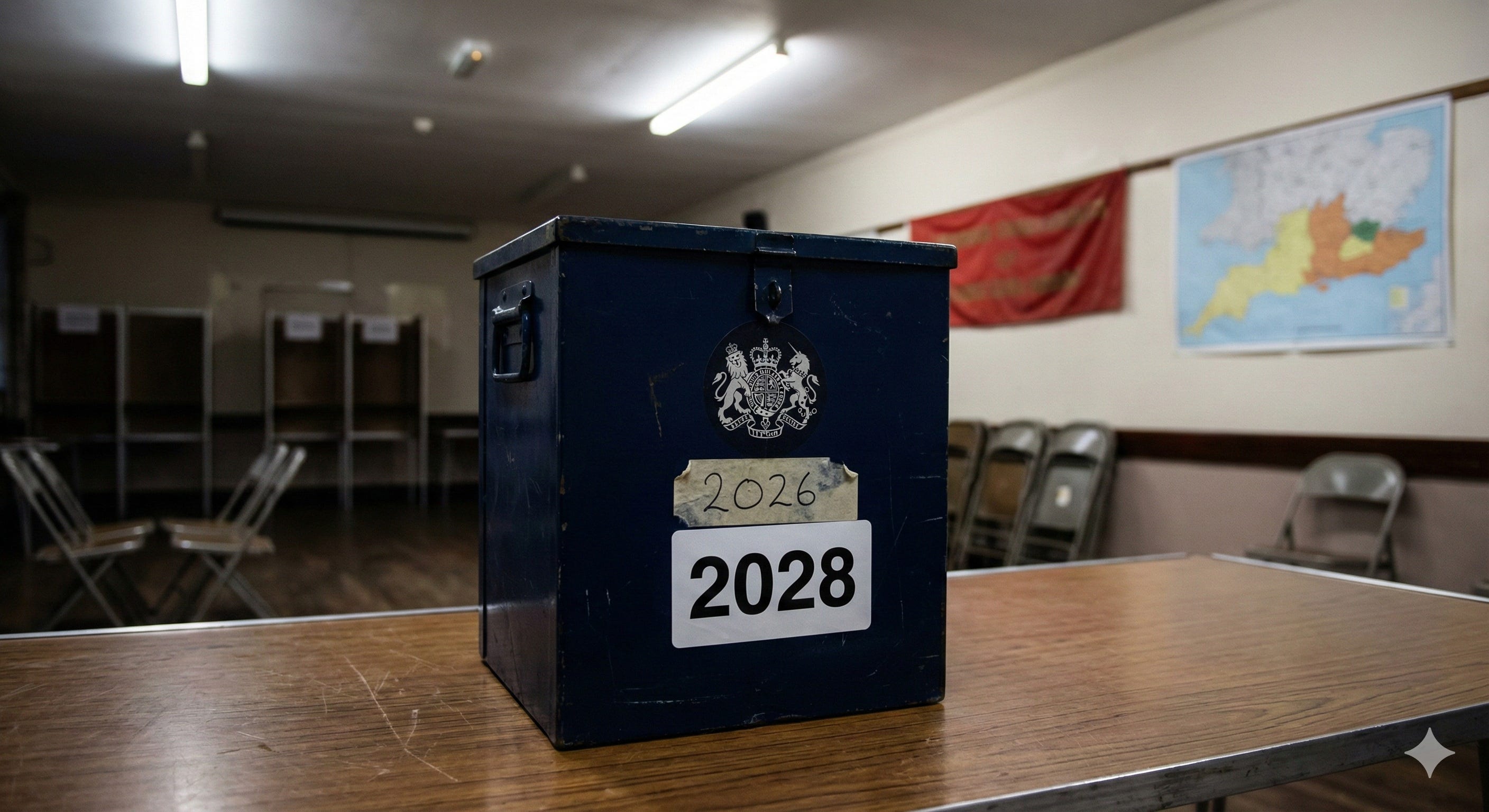
(UK ballot box showing postponed election date in empty polling station. Full article analysis)
The UK government confirmed this week it will postpone mayoral elections in four regions—Essex, Hampshire and the Solent, Sussex and Brighton, and Norfolk and Suffolk—from their scheduled May 2026 date until 2028. The decision affects approximately 4.2 million voters across southeast England.
The official justification centres on local government reorganisation. Minister’s state councils require additional time to complete mergers into larger unitary authorities, forming part of Labour’s devolution strategy. The government has committed £200 million in annual funding to support local growth during this transition.
The Political Response.
Opposition parties have condemned the postponement as fundamentally undemocratic.
Reform UK leaders describe the decision as “the behaviour of tyrants,” drawing parallels with recent restrictions on jury trial access. Party representatives claim the government is avoiding elections in Reform-strong areas where they anticipated significant gains.
Conservative and Liberal Democrat politicians have similarly criticised the move, arguing elected positions should not be postponed regardless of administrative considerations.
Government sources counter that this represents a purely administrative decision necessitated by ongoing structural reforms to local government.
What the Postponement Actually Means.
Mayoral elections in Essex, Hampshire and the Solent, Sussex and Brighton, and Norfolk and Suffolk were scheduled for May 2026. Voters in these four regions will now wait until 2028 to elect their regional mayors—a two-year delay affecting democratic representation for residents across Essex (population 1.8 million), Hampshire and the Solent (1.5 million), Sussex and Brighton (850,000), and Norfolk and Suffolk (1.05 million).
The postponement coincides with council mergers designed to create larger unitary authorities. In theory, holding elections for positions that may not exist in their current form after reorganisation creates administrative complications.
The Questions Worth Asking.
Several aspects of this decision warrant closer examination:
Timeline consistency.
Are these council mergers proceeding on schedules established before the election postponement was announced, or has reorganisation been accelerated to justify delaying votes? This distinction matters significantly.
Historical precedent.
Has the previous UK government postponed regional elections during local government reorganisation? The Local Government Act 1992 established frameworks for structural changes; however, postponing scheduled elections specifically to accommodate mergers appears to be unprecedented in recent decades. If so, under which administrations and circumstances? If not, why establish this precedent now?
The 2028 timing.
Two years provides merged authorities time to establish operational structures. It also conveniently pushes elections past Labour’s probable mid-term unpopularity period, when governing parties typically face voter dissatisfaction.
Regional demographics.
Do these four regions share electoral characteristics that make postponement politically advantageous for the current government? Recent polling data would clarify whether Reform UK's claims about their electoral prospects have a statistical foundation.
The Broader Pattern.
English local government has experienced continuous structural reorganisation for decades. Successive governments have created, abolished, merged and restructured local authorities with remarkable frequency—a pattern documented extensively by the Local Government Association.
These mayoralties themselves are relatively recent political creations, introduced as part of previous devolution initiatives. Their postponement now raises questions about commitment to localised democratic accountability versus centralised administrative efficiency.
The £200 million funding commitment suggests genuine intent behind structural reform. Financial incentives of this scale typically indicate policy priorities rather than purely electoral calculations.
However, money and motivation are not mutually exclusive. Structural reform can be both administratively necessary and politically convenient simultaneously.
What Nobody Disputes.
Council mergers in Essex, Hampshire, Sussex and Norfolk are proceeding. Whether postponement is a necessary consequence or convenient timing remains the central question.
Opposition parties claim democratic principles are being violated. Their objections would carry more weight if previous governments hadn’t also adjusted electoral timelines and boundaries when politically advantageous—a practice the Electoral Reform Society has long criticised.
The government claims administrative necessity. This claim would be more convincing with transparent timelines showing merger schedules established independent of electoral considerations.
The Underlying Reality.
Postponing elections during structural reorganisation has practical logic. Electing officials to positions that may not exist after administrative restructuring creates obvious complications.
The timing, however, provides Labour with a significant electoral advantage—avoiding potentially difficult elections during a period when mid-term governments typically face voter dissatisfaction.
Reform UK gains political capital from the victimhood narrative regardless of whether their electoral prospects were genuinely strong in these regions.
Residents of affected areas lose two years of elected regional representation while this administrative theatre plays out.
What Happens Next.
Council mergers will proceed according to government timelines. The £200 million funding will flow to participating authorities. Mayoral elections will occur in 2028 as rescheduled.
By 2028, political circumstances will have shifted sufficiently that current controversies will be largely forgotten. Whichever parties win will claim vindication. Whichever parties lose will claim the system was rigged against them.
Local government will have become slightly more centralised and remote from the residents it ostensibly serves.
And everyone involved will continue claiming their position was always about democratic principles rather than political advantage.
The Questions That Matter.
Is this postponement administratively necessary? Probably, if mergers are genuinely proceeding on established timelines.
Is the timing politically convenient for Labour? Unquestionably.
Would opposition parties do the same in government? Historical evidence suggests yes.
Do residents of these regions have any meaningful say in whether their councils are merged or their elections postponed? Evidence suggests no.
Will anyone be held accountable for the gap between democratic rhetoric and governing reality?
You already know the answer.