
Washing Your Feet in the Toilet?
How a Teacher Got Banned for Stating Facts While the School That Created the Problem Walked Away Clean.

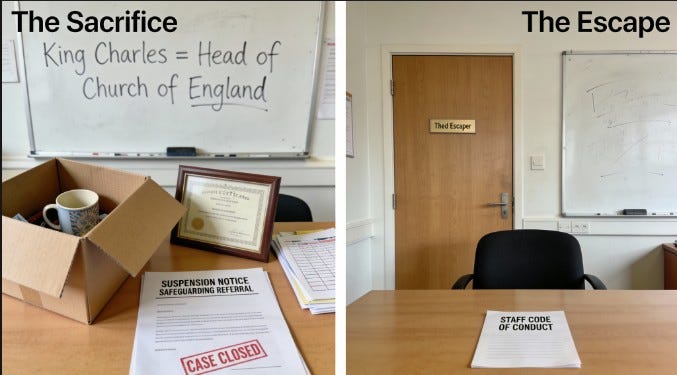
So here’s a question for you: if a teacher tells Muslim pupils they can’t wash their feet in the boys’ toilet sinks, then reminds them that Britain remains a Christian state with the King as head of the Church of England, who’s actually at fault here?
Is it the teacher for stating constitutional facts? Is it the child who needed facilities for religious practice that the school apparently didn’t provide? Or is it the school that accepted pupils with religious obligations, maintained non-faith policies, but somehow failed to keep their designated prayer room functional or properly communicated?
I’ll give you a hint: only one of these three got investigated by child abuse detectives, referred to safeguarding boards, suspended, sacked, and banned from working with children.
Nine Officials, Three Complaints, Zero Accountability.
Let’s walk through what actually happened at this London primary school, because the mechanics here reveal something rather important about how British institutions now operate.
A teacher—who understandably doesn’t want his name plastered everywhere—told pupils they couldn’t wash their feet in the toilet sinks. The school was a non-faith institution where prayers had been informally banned from the playground, and foot-washing was restricted to a designated prayer room. Standard hygiene policy, really. You don’t want kids standing in sinks. Seems reasonable.
During this conversation, the teacher explained that the school “was not a religious institution” and suggested pupils could attend a nearby Islamic school if they preferred. He also mentioned—and this is where everything went sideways—that Britain is “still a Christian state” and that King Charles serves as head of the Church of England.
Now, you might think that stating verifiable constitutional facts would be fairly unremarkable in a civics context. You’d be wrong.
Three pupils submitted written complaints. Nine people reviewed them: the local safeguarding officer, a detective sergeant from the Metropolitan Police’s child abuse investigation team, two social workers, an HR adviser, and the headteacher. Nine officials. Three complaints. All mobilised because a teacher stated that the King heads the Church of England.
Nobody—and I mean absolutely nobody—investigated why the school’s own policies created the conditions for this conflict in the first place.
The Plausible Deniability Machine.
Remember those three questions from the start? Teacher, child, or school?
The child had legitimate religious needs that required accommodation. The teacher enforced existing school policy while stating constitutional facts. The school created an impossible situation by accepting pupils with religious obligations, implementing non-faith policies, then apparently failing to maintain the facilities or communicate the alternatives that would have prevented the entire situation.
Guess which one got destroyed?
The school suspended the teacher in March 2024, then sacked him. The safeguarding officer determined he’d made “hurtful comments about Islam” and that the child had suffered “emotional harm.” Not that anything he said was factually incorrect, mind you. Just that accurate information caused subjective upset.
Notice what just happened there? The school’s policy failure—the actual cause of the conflict—completely disappeared from view. Instead, nine officials spent their time investigating whether stating that King Charles heads the Church of England constitutes a safeguarding risk.
This is institutional plausible deniability at its most efficient. The teacher becomes the firewall, his career gets obliterated, and the school walks away, positioning itself as protecting children rather than covering its own failure to provide adequate facilities for pupils it accepted.
The Pattern You’ve Already Seen.
If this sounds familiar, that’s because we’ve been here before.
Remember the hate crime data we looked at? Conviction rates under 3%, with police resources redirected toward processing subjective emotional claims rather than investigating actual crimes. Same institutional logic: the claim of harm becomes more important than whether harm actually occurred.
Or Jamie Michael, the Royal Marine veteran coaching football in Wales? The court acquitted him in 17 minutes. The jury took one look at the evidence and said, “Innocent.” The Safeguarding Board banned him anyway. Process as punishment, outcome irrelevant.
Or those 18 Green councillors in Bristol who walked out rather than listen to gender-critical constituents, then positioned themselves as victims requiring protection from documented reality?
It’s the same mechanism every time: subjective emotional claims override objective facts, institutions mobilise to punish accuracy when it conflicts with protected narratives, and the people who created the problem escape scrutiny entirely.
The Free Speech Union has assembled a dossier containing more than twelve cases where adults working with children were referred to safeguarding boards for expressing what gets categorised as “right-wing views.” Except we’re not talking about actual right-wing ideology here. We’re talking about stating that Britain has a constitutional monarchy with an established church. We’re talking about observable reality.
When Facts Become Thought Crimes.
Here’s what makes this particularly instructive: nobody disputes the factual accuracy of what the teacher said. The King heads the Church of England. Britain is formally a Christian state by constitutional structure. Islam is a minority religion in the United Kingdom.
These aren’t opinions. They’re not “views.” They’re documented constitutional arrangements that you could verify in about 30 seconds with any basic civics text.
Yet stating them triggered a hate crime investigation from the Metropolitan Police’s child abuse team.
Let that sink in for a moment. Child abuse detectives investigating a civics lesson.
The teacher successfully appealed the ban and now works part-time at a school outside London. But the process itself served as his punishment—suspension, dismissal, police investigation, safeguarding referral, career disruption, professional destruction. The appeal’s success doesn’t undo any of that. It just means he survived the machinery that was designed to destroy him.
Lord Young, director of the Free Speech Union, put it rather well: “This teacher lost his job and almost ended up being barred from the profession for life just because he pointed out to a class of Muslim schoolchildren that the national religion of England is Anglicanism. Things have reached a pretty pass in this country if a teacher can be branded a safeguarding risk because he says something that’s incontestably true.”
The Three Questions Nobody Asked.
So let’s return to those three questions, shall we?
Was the teacher at fault for stating constitutional facts while enforcing the school’s existing hygiene policy? Was the child at fault for needing religious facilities that the school apparently failed to maintain? Or was the school at fault for creating impossible conditions, then sacrificing a staff member when the predictable conflict erupted?
Nine officials investigated the teacher. Zero investigated the school’s policy failure. The child got caught between institutional dysfunction and religious obligation. The teacher’s career got destroyed. And the school gets to claim it takes safeguarding seriously because look at all those investigations.
Perfect plausible deniability. Blame travels downward to individuals. Accountability stops before reaching institutional policy.
This is how British institutions now function: mobilise overwhelming force against anyone who states uncomfortable facts, protect the institutional failures that created the problem, and position the entire process as safeguarding rather than what it actually is—institutional arse-covering at the expense of anyone unfortunate enough to be holding the parcel when the music stops.
You already know which question should have been asked. Why didn’t the school maintain adequate facilities for pupils with religious obligations it accepted? That’s the question that leads to actual accountability.
But accountability isn’t the point anymore, is it? The machinery exists to protect institutions from scrutiny, not to resolve actual problems.
And that teacher? He got to learn that lesson the hard way.
References
Marcus Donaldson, “Teacher BANNED from working with children after telling Muslim pupil ‘Britain’s a Christian state’,” GB News, 8 December 2024. https://www.gbnews.com/news/primary-school-teacher-banned-muslim-pupil-christian-country
The Free Speech Union, “Teacher banned for telling Muslim pupils Britain is a Christian country,” 9 December 2024. Referenced via GB News reporting.
Metropolitan Police Service, Child Abuse Investigation Team procedures (referenced via GB News reporting of the case).
This is why I have joined the Free Speech Union. Perhaps it's one of the few organisations I won't be kicked out of.