
What the Acronym LTN Really Means: Lies To Neighbourhoods?
Or, South Of The River. Same Bullshit, Less Noise.

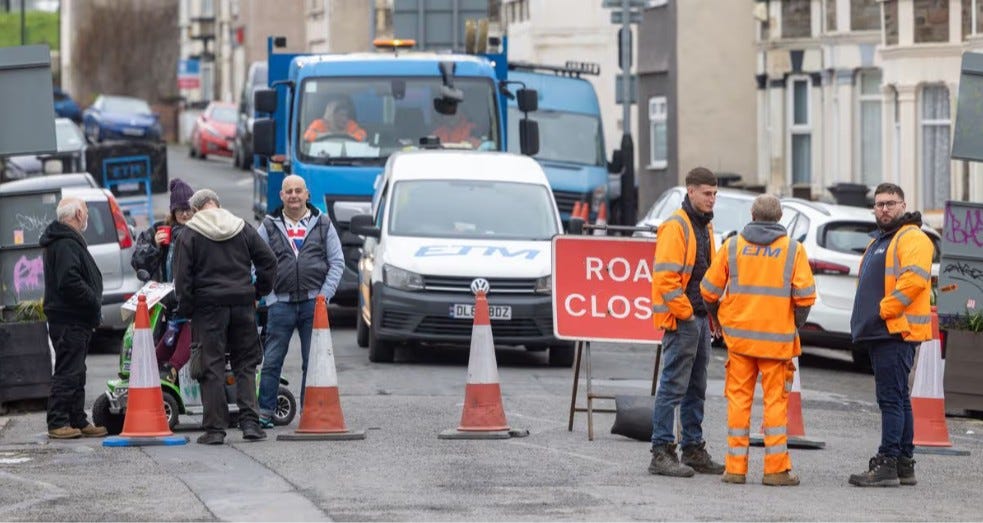
[Residents face off against ETM contractors on Avonvale Road, Barton Hill, on the morning of Friday 18 April 2026. The contractors had arrived to install a new bus gate as part of the East Bristol Liveable Neighbourhood trial. After a brief standoff, they left without completing the work. There is now no bus gate on Avonvale Road at all. Photo: Paul Gillis / Reach Plc.]
Right, here we go. In Bristol, the East Bristol Liveable Neighbourhood — the EBLN — brought modal filters, bus gates, planters, and ANPR cameras to Avonvale Road, Marsh Lane, and Barton Hill, all installed under cover of active travel policy, filtered permeability, and traffic calming.
In London, the West Dulwich Low Traffic Neighbourhood brought Experimental Traffic Orders, Penalty Charge Notices, and 24-hour camera enforcement to a community that hadn’t consented — and a High Court judicial review that found the whole scheme unlawful, the consultation unfair, and Lambeth Council in breach of due process.
Two Low Traffic Neighbourhoods. Two councils — Bristol City Council and Lambeth Council. Two different flavours of the same top-down, undemocratic imposition on communities who raised objections, submitted evidence, filed FOI requests, mounted direct action blockades, and took their elected representatives to court. The East Bristol Liveable Neighbourhood — the EBLN — is Bristol’s version of that imposition, now running for over a year. The West Dulwich Low Traffic Neighbourhood was Lambeth’s — until the High Court removed it. And in both cities, in the same week, the machinery that protects the people who built these schemes is still running — refusing to investigate, refusing to engage, refusing to acknowledge what the communities, the Information Commissioner, and the High Court itself have already put on record.
This is what LTN really stands for. Not Low Traffic Neighbourhood. Lies To Neighbourhoods.
Two cities. Same week. Neither story will surprise you. Both of them should.
There is a quality to how these things move. Not quickly. Not loudly. A planter appears. A road closes. A consultation opens and closes. A committee nods. And by the time anyone works out what’s happened, the thing is already in place and the people who put it there are already planning the next one. Bristol knows this. It has been watching it happen for over a year. The watching hasn’t stopped anything yet.
So. Bristol first.
Friday morning, 18 April 2026. Contractors turn up on Avonvale Road in Barton Hill. Their job is to finish what they started the day before — the old bus gate on the west side of the Marsh Lane junction had already come out on Thursday without a hitch. Friday was supposed to be the easy bit. Paint the road, drop the new bus gate on the east side, done.
They didn’t finish. They left.
A small group of residents blocked the road. Melissa Topping — from Redfield, if you want the detail — led them. The contractors, ETM, had a brief stand-off, looked at the situation, and drove away. There is now no bus gate at all. The old one has no signage. The new one was never installed.
“This is what the community wants,” said Topping. “And this is why we took action this morning.”
Cllr Ed Plowden, the man in charge, allegedly perhaps, of Bristol City Council’s roads and transport, called it “really disappointing.” Said the changes were a direct response to community feedback. Said “a very small group of people” were in direct opposition to what their neighbours had asked for.
243 objections. 23 in support. That’s what the TRO statutory consultation returned on the specific proposed changes to the modal filters — not a general vote on the EBLN as a whole, though Melissa Topping and others made clear that for many residents it felt like exactly that.
“A very small group,” said the man whose side got 23. Clearly, the dictionary version of small somehow got lost in interpretation on its way to him.
Look — this isn’t where the story starts. It’s closer to the middle. The East Bristol Liveable Neighbourhood has been running for just over a year. Before that, in the spring of 2025, Bristol City Council turned up at this junction at 3am with hired security and around 60 police officers to install the bus gates. Sixty officers. Three in the morning. For a bus gate. Both the police and the council ended up apologising. The word heavy-handed was deployed, which in council-speak is about as close to we completely misjudged this as you’re going to get — and about as far from we’re sorry as it’s possible to be while still technically facing the right direction.
The Almighty Gob has been tracking the EBLN for a while. Back in March 2026, the ICO ruled that the council had wrongly called a resident’s information request about EBLN road blocks manifestly unreasonable — which is legal language for vexatious, which is bureaucratic language for stop asking us things. Someone asked why their road was blocked. Bristol City Council tried to make the question itself illegal. The Information Commissioner told them no.
So that’s where we are. The bus gate is gone. Not because the council came to its senses. Because Melissa Topping parked her disability scooter on the patch of road they wanted to tarmac. Tarmacking over a disability scooter, it turns out, was beyond the contractors’ remit.
And it gets sharper. The new location for the bus gate — the one that never got installed — was right outside Hamblins, the fish and chip shop on Avonvale Road. The owner, Armin Amadi, had been saying for months that the original junction closure was killing his trade. The council’s answer — after a TRO statutory consultation that produced 243 objections — was to move the bus gate directly in front of his counter, and kill his business completely. In council-speak, he’d had his chips.
“In council-speak, he’d had his chips.”
“What kind of malevolence is that?” asked Topping.
Bureaucratic malevolence, since you’re asking. The particular kind that doesn’t need a villain. It just needs a process — the right box ticked, the right committee nodded through, the right consultation technically completed. Two hundred and forty-three people say no. Twenty-three say yes. The council weighs them up and calls it listening. Of course, others will have an entirely different name for it. Bullying springs immediately to mind. So does contempt. Pick whichever one you think fits a council that looked at a man’s failing business and decided the solution was to finish it off.
Now London. Same week. Different story. Same thing underneath it.
Jonathan Fowles was a key witness in the High Court case that found the West Dulwich Low Traffic Neighbourhood unlawful. The case was brought by the West Dulwich Action Group — over a thousand local residents and businesses who raised more than £50,000 to be heard. Lambeth Council had run the whole scheme illegally — the consultation was unfair, due process hadn’t been followed, the LTN had to go, and the fines had to be returned. Over a million pounds of them, as it turned out.
During the proceedings, both Fowles and Lambeth’s Deputy Council Leader, Rezina Chowdhury, produced sworn witness statements. Signed on oath. The judge looked at both statements, noted they flatly contradicted each other, and decided it was “unnecessary to resolve this factual dispute” because it didn’t change the outcome.
Fowles says Chowdhury lied three times.
If the recording says what Fowles says it says — and he has it, and she proceeded knowing it existed — then there is a word for what appears in that witness statement. It is not misrecollection. It is not difference of interpretation. Courts have a specific word for it. Lambeth Council, apparently, does not.
And here’s the thing — he has a recording. Before he finally got a face-to-face meeting with Chowdhury — seven written requests ignored before that point was reached — he told her he was recording the conversation. She said that was fine. They proceeded.
Three specific lies, he says. Let’s go through them.
One. Chowdhury wrote on oath that there had not been “at any point a refusal to engage with those who might be critical of what the council was proposing.” Fowles points out that by her own admission, she ignored seven separate, polite, written requests to meet and discuss concerns about the LTN. If that’s not a refusal to engage, what is?
Two. She wrote that “at no point did I say the words ‘anti-LTN’ nor suggest this was the reason for not continuing to correspond.” What she actually told him, Fowles says, was that she had ignored his requests because she believed he was “against LTNs.” Anti-LTN. Against LTNs. Same thing. She said it. She gave it as the reason. The recording is there.
Three. Chowdhury claimed she knew he was against LTNs because he’d sent her an email two years earlier saying so. Fowles says he wrote no such email — that two years before he met Chowdhury, he didn’t even know what an LTN was. She was challenged in the High Court to produce this email. She couldn’t.
Fowles made a formal complaint to Lambeth Council. Eight months ago.
They haven’t investigated it.
The Times dug into this and found that Lambeth Council hasn’t formally investigated a single complaint against any councillor in over a decade. Not one. The Local Government Ombudsman wrote to the council’s chief executive last year specifically about this. The complaints machinery exists. It just doesn’t move.
Chowdhury hasn’t responded publicly to any of this. Her previous position on her witness statement: “as I recall.”
As I recall. On oath. In the High Court. As I recall. Which is either the most convenient memory in the history of local government, or it isn’t a memory problem at all.
Now. While all of that is still warm — while the contractors are barely back in the van and the Lambeth complaint is still sitting unopened after eight months — Bristol City Council is already planning the next one.
The South Bristol Liveable Neighbourhood. The SBLN. Southville, Bedminster, Ashton Vale, Malago Vale, Windmill Hill, Perrets Park, and Totterdown. Eleven distinct neighbourhoods. Dozens of modal filters. One-way roads. An expanded residents’ parking zone. Installation planned for late 2026. The full business case decision coming before the Transport and Connectivity Committee later this summer. The SBLN. Or, as others might prefer — Sod Bristol, Let’s Normalise. Or, if you’re less inclined toward generosity — Same Bullshit, Less Noise.
The man bringing it forward? Cllr Ed Plowden. The man whose side got 23.
Something worth sitting with for a moment: the same man who oversaw 60 officers at 3am on the East Bristol Liveable Neighbourhood, who called a community blockade disappointing, who weighted 23 against 243 and called it balance — is now standing at the door of eleven new neighbourhoods with the same set of keys. The door isn’t locked. It never was.
Over 3,000 people have already signed a petition against the scheme. Residents marched to City Hall in February. Labour called for the £900,000 allocated to the business case to be redirected — their own leader saying publicly there wasn’t enough community support to justify modal filters in Southville and Windmill Hill.
These are people’s streets. Their children’s school runs. Their trade. Their daily routes. Their mornings. For them, which side of a planter they wake up on is not abstract — it is the difference between a business that opens and one that doesn’t.
And then, two days ago — the same week as the Avonvale Road blockade — independent research published to every Bristol City councillor and to WECA mayor Helen Godwin found that the council’s central justification for the SBLN has no evidential basis. The WECA funding for the scheme is only available if the council can demonstrate high levels of through-traffic — vehicles cutting through residential streets to reach other destinations. That is the stated basis for the entire proposal. The research, produced by data analyst Chris McEvoy and published via the Keep Bristol Moving Substack, found that the council’s own traffic data does not support this through-traffic claim. Separately, analysis of STATS19 collision figures Bristol-wide from 2020 to mid-2025 found the safety case equally wanting — the data doesn’t show the problem the scheme is supposed to solve. Collision data, incidentally, being a crash course in how to piss residents off.
That research is now on the desk of every councillor who will vote on this. What happens next will tell you everything you need to know about whether any of this was ever actually about safety — or about targets, metrics, and the appearance of progress for people who will never live with the consequences.
Plowden’s stated position on the SBLN, for the record: “We’re listening, we’re taking all of that engagement and responses, and we’re trying to make the scheme better — rather than simply saying ‘you’ve had your say, now we’re going to do it anyway.’” The latter part of that sentence is the reveal that conveniently passes by while you’re taking in everything before it.
Avonvale Road was on a Thursday and a Friday. The SBLN vote is later this year. Worth keeping that sentence in mind when it arrives.
So, here’s what ties all three of them together.
There’s an old trick. You don’t need the story to be true for very long. You just need it to be true for long enough that the thing gets built, the road gets closed, the gate goes in, the fine gets issued, the complaint sits in a drawer, the next scheme gets funded, the vote gets cast. After that, the truth or otherwise of the original story stops mattering to anyone with the power to do anything about it. By then, they’re already on to the next one. You see —
“The lie doesn’t have to hold forever. It only has to hold long enough.”
In Bristol: sixty officers at 3am on the East Bristol Liveable Neighbourhood was proportionate. The TRO consultation result meant the community wanted the bus gate moved. Calling an FOI request about EBLN road blocks vexatious was a legitimate legal position. The through-traffic and collision data justifies the next scheme.
None of it held.
The ICO knocked the FOI position back. The community knocked the bus gate back with a scooter and a blockade. The apology for the 3am operation arrived in its own time — after the fact, after the damage, after the point.
And the through-traffic and collision data is now on record, in writing, with the people who will cast the deciding vote. Guess the people who won’t be included in that? Possibly you.
In Lambeth: the lie was built on oath, in the High Court, in black and white — and it has been protected ever since not by being proved true, but by never being examined. Eight months. No inquiry. A decade of the same non-process — not broken, as it turns out, but operating exactly as designed.
This isn’t conspiracy. It’s architecture. It’s the complaints process that never opens. It’s the consultation that reads two hundred and forty-three against twenty-three and finds balance. It’s the committee chair who finds a community blockade “really disappointing” without finding it equally disappointing that his side managed twenty-three — and who is now preparing to bring the same playbook to eleven new neighbourhoods on the other side of the city. It’s the deputy council leader whose witness statement says one thing and whose recording says another, and who has faced no formal inquiry in eight months because the institution that would conduct that inquiry answers to nobody who wants it conducted. That’s not a system that has failed. That’s a system that has worked.
Melissa Topping parked her scooter on the road. The contractors went home.
Jonathan Fowles has a recording, a signed statement, and eight months of silence. Selected deafness, it seems, is a commonality between councils.
South Bristol has a petition, a data challenge, and a vote coming.
Two cities. One pattern. Three chapters. And the same question running through all of them: what exactly do you have to do before someone investigates?
Lies To Neighbourhoods. Worth keeping that in mind next time a council tells you it’s for your benefit. It might also be Lies To Note, for future reference.
The Almighty Gob is a Bristol-based publication founded by John Langley — independent Bristol mayoral candidate 2016 and 2021, and one of the city’s most forensic observers of institutional power. Publishing since 2020, with over 500 pieces including 88 FOI-based Bristol investigations. Across seven platforms and Substack at thealmightygob.com — no party allegiance, no press accreditation, no interest in acquiring either.
The Almighty Gob is a Bristol-based publication founded by John Langley — independent Bristol mayoral candidate 2016 and 2021, and one of the city’s most forensic observers of institutional power. Publishing since 2020, with over 500 articles, across seven platforms and Substack at thealmightygob.com — with no party allegiance, no press accreditation, and, no interest in acquiring either.
Also, I think like Lambeth BCC has not investigated any complaints about councillors for many years. Interestingly, this issue was raised in many questions to full council on the night Barton House was suddenly evacuated, leading to that meeting being cancelled...
It's not the research on collision data that's been sent to all councillors, it's the research on through traffic - you may need to correct that.
The pro and contra numbers from the EBLN Objection Report also need verifying. The consultation made clear it was not about a general for or against the scheme as a whole, but about the individual TROs.