
When Children Need Permission to Be Children.
On precocious adults, puberty blockers, and the ideology that ate everything.

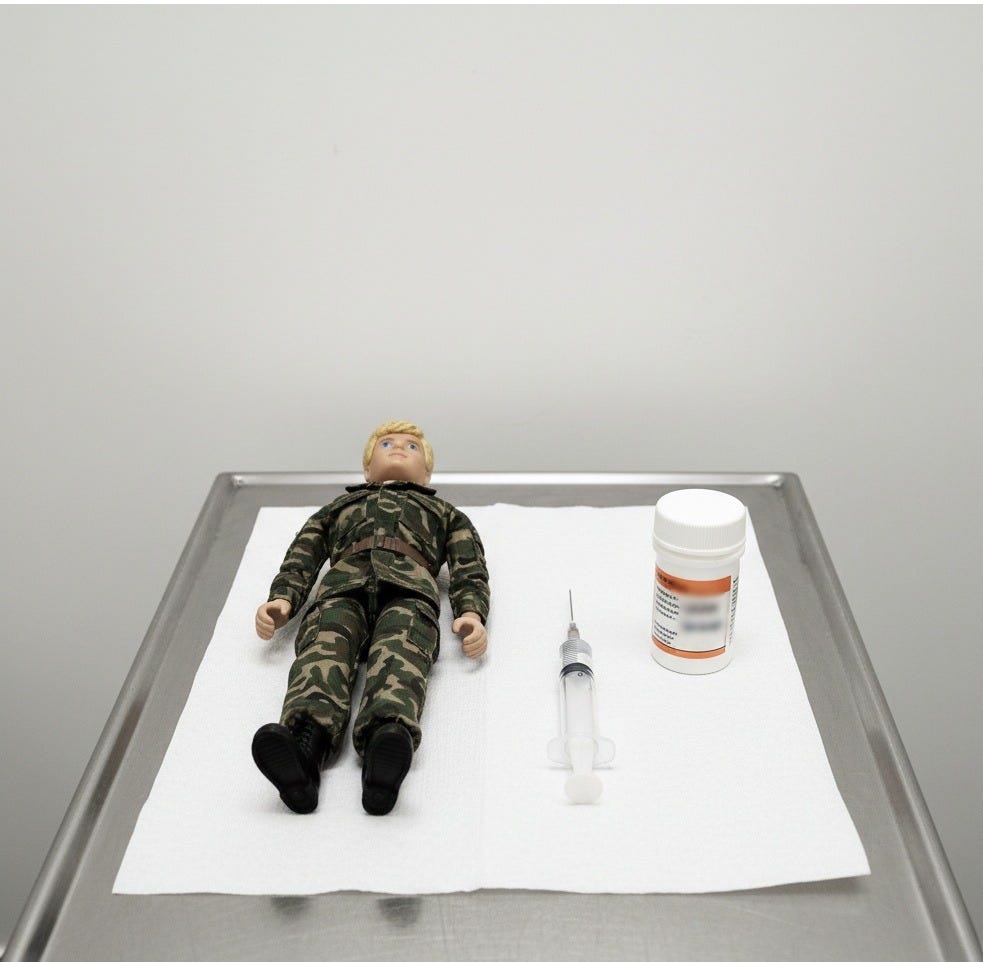
Here’s a question worth sitting with: After how many thousands of years of civilisation are we suddenly discovering that the world needs puberty blockers?
Not “should children have access?” or “what does the evidence say?” - but the more fundamental, why now? What changed?
The standard answer: We’ve always had a small population with genuine, persistent gender dysphoria. Medical technology has advanced. GnRH agonists were developed in the 1980s for precocious puberty - kids hitting puberty at five or six, creating serious developmental problems. Later, clinicians wondered if the same technology could help gender-dysphoric adolescents. The capability emerged, so we applied it.
Sounds reasonable until you check the numbers.
Tavistock gender clinic referrals in England: 77 cases in 2009. By 2018? 2,590 cases. That’s 3,300% in under a decade. The demographic flipped entirely - from predominantly natal males with early-childhood-onset dysphoria to predominantly adolescent females with sudden-onset cases, clustered in friend groups, correlated with social media usage. When a condition’s prevalence explodes 3,300% whilst its demographic inverts completely, and research shows most gender-questioning children naturally resolve without intervention, that’s not the discovery of a hidden population. That’s social contagion meeting medical supply. Who wanted this to happen?
The Cass Review - Dr Hilary Cass’s independent review commissioned by NHS England - confirmed what whistleblowing clinicians had been saying: weak evidence for benefit, and the pathway effectively locks children in. Studies show 96-98% of children starting puberty blockers progress to cross-sex hormones, compared to the majority who’d otherwise naturally desist.
So we’re not meeting an existing need. We’re manufacturing a patient population. And there’s serious money in it: Jazz Pharmaceuticals’ Lupron generated $669 million in 2019. Each transitioned child becomes a lifelong medical patient requiring hormones, surgeries, ongoing monitoring, and side effect treatment. This isn’t a conspiracy - it’s commerce recognising opportunity when ideology opens the door.
Which raises the obvious question: if evidence shows puberty blockers don’t reliably benefit the children receiving them, who is benefiting? Parents gaining social status from having a “trans child”? Clinicians protecting careers through affirmation-only protocols? Institutions justifying existence through ideological compliance? Pharmaceutical companies creating lifelong customers? Activists using children’s bodies as proof that their framework describes reality?
Spoiler: it’s not the kids.
The Precocious Adults.
There’s a medical term for children hitting puberty too early: precocious puberty. Legitimate condition, requires intervention because development is happening when it shouldn’t.
But there’s no term for adults who’ve accelerated past wisdom, caution, and protective instinct into ideological territory where they’re experimenting on children. Call them precocious adults: authority without judgement, biological adulthood without psychological maturity around children’s needs.
Not every parent or clinician fits this - some genuinely believe they’re helping. But there’s a recognisable subset: parents for whom the child’s “trans identity” meets their psychological needs more than the child’s. Parents are converting their four-year-olds’ dress-up play into a fixed identity requiring medical intervention. Parents use children’s bodies as ideological calling cards. And we’re calling that care, are we?
Here’s what we know about childhood: children do imaginative play. Role-play, test boundaries, try on identities. A boy puts on his sister’s dress. A girl insists she’s a pirate for six months. These are phases - normal, healthy, temporary. My generation played with Action Man and Barbie, swapped them around, and nobody thought we needed experimental drugs. We turned out fine. Well, fine-ish. The point is: we turned out as ourselves, not as projects shaped by adult ideology during vulnerable years.
But we’ve created a system interpreting childhood play through rigid ideology, then locking children into identities formed during phases. These aren’t parents acting in children’s interests - they’re parents using children’s bodies for validation, status, proof that their ideology is correct.
The child’s body pays the price.
The Consent Paradox.
A child cannot leave school at eight, get a driving licence, marry, join the military, get tattooed without parental consent, buy alcohol, enter contracts, or consent to sex with adults. Can’t, in most cases, get ears pierced without a parent present.
We have these thresholds because children lack a developed prefrontal cortex, life experience, capacity for life-altering decisions. We protect children from undeveloped judgment.
We don’t let them choose bedtime. Don’t trust their judgment on meals because most would choose Haribo for breakfast and call it nutrition.
But somehow, on this one issue, we trust a child - often the same child who last week insisted they were a dinosaur - to consent to experimental intervention that sterilises them, halts development, affects bone density, brain development, and sexual function, with minimal long-term data, channelling them towards irreversible pathways.
Makes perfect sense, doesn’t it?
So whose interests are served when we make this one exception to every safeguarding principle? Not the child’s - they can’t meaningfully consent and aren’t benefiting. So whose?
If an eight-year-old said, “I want to be a surgeon, amputate my healthy arm to practise,” we’d recognise a mental health crisis requiring support. We’d get the child help, not a scalpel. But “I want to stop my normal puberty” gets affirmed as an authentic identity requiring medical facilitation.
That’s not medicine. That’s ideology using children as validation, isn’t it?
The Pattern Underneath.
This isn’t isolated malpractice. It’s one manifestation of a pattern across institutional domains - council governance, education, medicine, activism. Same operating system: unfalsifiable belief, reality conforms to framework, contradicting evidence ignored, dissent equals heresy, institutional capture spreads it, material consequences for people, benefits for system-runners.
Bristol City Council can’t build promised affordable homes but implements schemes 54% of residents oppose, calling critics reactionary. Green councillors walk out during gender-critical statements rather than debate. Institutions across the UK adopt contested policy definitions from lobbying groups with undisclosed funding, despite government rejection and documented concerns.
Different content, same structure. When evidence is weak, but adoption is universal, ideology isn’t serving stated beneficiaries. Ideology uses them to serve itself.
This explains why puberty blockers became standard despite thin evidence. Why questioning got clinicians labelled transphobic, not engaged. Why parental concerns got dismissed as bigotry, not safeguarding. Why Cass’ findings - after years of whistleblowers - came as “surprise” to an establishment that’d decided science was settled.
Ideology required validation. Children’s bodies provided it. Anyone pointing out the emperor’s nakedness got called a bigot and shown the door. Nothing sinister about that pattern, is there?
Everything, Everywhere.
Same frameworks appeared simultaneously across institutions - Bristol, Manchester, Edinburgh, Cardiff - despite different populations, needs, politics. Not conspiracy, but synchronisation too precise for accident. Same universities producing same frameworks. Same consultancies selling same products. Same NGOs setting “best practice.” Same social media creating instant consensus. Same institutional cowardice is making resistance career suicide.
It’s a distributed ideology coordinated through shared training, incentives, language, funding, and fear of being called regressive.
Puberty blockers? Just one output. One manifestation of ideology replacing evidence, symbolic performance replacing care, and institutional self-protection trumping vulnerable populations.
The Question We’re Not Asking.
After thousands of years, we don’t suddenly need puberty blockers. Children don’t need experimental intervention in healthy processes based on feelings formed during normal developmental phases.
But ideology needs them - to validate unfalsifiable claims, demonstrate institutional commitment, create material reality proving the framework correct. It needs children’s bodies as proof.
And it’s found precocious adults - in clinics, councils, activist organisations, professional bodies - willing to provide them. Adults with certainty without wisdom, authority without protective instincts, frameworks without questioning whether they serve the children in their care.
The question isn’t whether civilisation suddenly needs puberty blockers. It’s whether we’re still capable of saying no to ideology when children are the price. Whether some things - children’s bodies, their right to develop naturally, their future fertility and sexual function - aren’t negotiable. Whether some experiments shouldn’t be run.
Because right now? We’re failing that test. Spectacularly.
Which brings us back to where we started: after thousands of years of civilisation, why now? Because for the first time in history, we’ve built a system where adults benefit from experimenting on children - and made it unfashionable to say no.
After thousands of years protecting children from adults’ worst impulses, what made us forget?
Are we going to remember in time?
Frequently Asked Questions.
What is the Cass Review?
The Cass Review is an independent review of gender identity services for children and young people commissioned by NHS England and led by Dr Hilary Cass, a paediatrician and former president of the Royal College of Paediatrics and Child Health. Published in 2024, the review examined the evidence base for medical interventions, including puberty blockers, finding “remarkably weak” evidence for their benefit and raising serious concerns about the treatment pathway effectively locking children into medical transition.
What are puberty blockers, and what were they originally developed for?
Puberty blockers are GnRH agonists (gonadotropin-releasing hormone agonists) originally developed in the 1980s to treat precocious puberty - a legitimate medical condition where children begin puberty abnormally early (age 5-6), causing documented physical and psychological harm. The drugs pause puberty temporarily. Their use was later extended to gender-dysphoric adolescents, though the Cass Review found weak evidence supporting this application.
What percentage of children who start puberty blockers continue to medical transition?
Multiple studies, including the Dutch protocol studies (de Vries et al., 2012), show that 96-98% of children who begin puberty blockers progress to cross-sex hormones and further medical transition. This contrasts sharply with research showing that the majority of gender-questioning children who do not receive medical intervention naturally desist - meaning their dysphoria resolves as they mature.
How much did Tavistock gender clinic referrals increase?
The Tavistock Gender Identity Development Service in England saw referrals increase from 77 cases in 2009 to 2,590 cases in 2018 - a 3,300% increase in under a decade. The demographic profile also shifted dramatically, from predominantly natal males with early-childhood-onset dysphoria to predominantly adolescent females with sudden-onset cases, often clustered in peer groups.
What is the commercial value of the puberty blocker market?
Jazz Pharmaceuticals’ Lupron, the primary puberty blocker used in gender treatment, generated $669 million in revenue in 2019. Each child who begins medical transition becomes a lifelong patient requiring ongoing hormones, surgical interventions, monitoring, and treatment of side effects, creating substantial long-term revenue streams for pharmaceutical companies.
What does “precocious adults” mean in this context?
The term “precocious adults” is an inversion of “precocious puberty” - describing adults who have reached biological maturity and institutional authority without developing the wisdom, caution, and protective instincts that should accompany responsibility for children’s welfare. These adults apply rigid ideological frameworks to children’s normal exploratory play, converting temporary developmental phases into fixed identities requiring irreversible medical intervention.
References:
Cass, H. (2024). Independent Review of Gender Identity Services for Children and Young People: Final Report. NHS England.
https://cass.independent-review.uk/
de Vries, A.L.C., & Cohen-Kettenis, P.T. (2012). Clinical management of gender dysphoria in children and adolescents: the Dutch approach. Journal of Homosexuality, 59(3), 301-320. https://doi.org/10.1080/00918369.2012.653300
Jazz Pharmaceuticals plc. (2020). Annual Report 2019. Dublin: Jazz Pharmaceuticals.
Littman, L. (2018). Parent reports of adolescents and young adults perceived to show signs of a rapid onset of gender dysphoria. PLOS ONE, 13(8). https://doi.org/10.1371/journal.pone.0202330
Steensma, T.D., McGuire, J.K., Kreukels, B.P.C., Beekman, A.J., & Cohen-Kettenis, P.T. (2013). Factors associated with desistence and persistence of childhood gender dysphoria: a quantitative follow-up study. Journal of the American Academy of Child and Adolescent Psychiatry, 52(6), 582-90. https://doi.org/10.1016/j.jaac.2013.03.016
Tavistock and Portman NHS Foundation Trust. (2018-2019). Gender Identity Development Service: Summary Statistics. Retrieved from NHS Digital.
About The Author
The Almighty Gob is a satirical commentator operating thealmightygob.com, a Substack publication focused on institutional accountability and UK policy analysis. With a background examining Bristol City Council governance failures, Green Party contradictions, and institutional adoption of contested definitions, The Almighty Gob approaches political and social issues from an anarch philosophical position - maintaining analytical detachment while documenting how ideology operates through institutions. Previous investigations include Bristol’s failed Bottle Yard Studios privatisation, the East Bristol Liveable Neighbourhood scheme implemented despite majority resident opposition, and ongoing examination of institutional capture across UK councils and government bodies.