
When Your Elected Representatives Refuse to Listen: Bristol's Democracy Crisis.
5 minute read Part 3 of an ongoing series documenting Bristol Green Party's refusal to hear from constituents.

The Pattern That Keeps Escalating.
In July, I covered 18 Green councillors walking out when gender-critical speakers addressed them. In November, I covered former Lord Mayor Paula O’Rourke’s resignation, citing Supreme Court precedent about democratic duty.
Now, Conservatives are tabling a motion demanding the council reaffirm basic democratic principles—unlikely to even be debated.
The pattern isn’t just continuing. It’s becoming normalised.
What Actually Happened.
Bristol Live reports the last two council meetings saw “angry exchanges between women’s rights campaigners and leaders of the Greens.”
July 2025: 18 of 27 Green councillors walked out three times—once per speaker.
September 2025: Several councillors walked out again after finding public comments “offensive.”
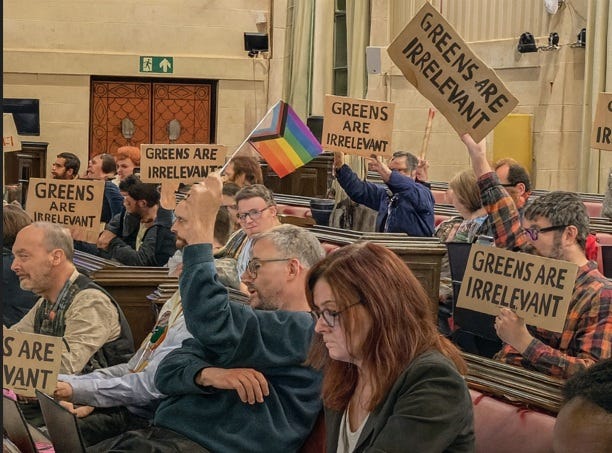
November 2025: Green councillors stayed but held up placards and pride flags while speakers addressed them—branded as “intimidating.”
Let that sink in.
You pay their salaries. You elected them. You followed the rules. And when your turn came to speak, they either walked out or held up signs while you tried to address them.
The Councillor Who Cited Supreme Court Precedent.
Former Green group leader and Lord Mayor Paula O’Rourke resigned from the party in November—not from the council, but from the party she could no longer defend.
Her resignation wasn’t emotional. It was constitutional.
O’Rourke cited R (on the application of Bridges) v Chief Constable of South Wales Police [2020] UKSC 31: elected representatives have a constitutional duty to hear from constituents regardless of whether those views are comfortable.
Her statement cut through the performance:
“Walking out is a refusal of democratic duty. Holding placards in the face of members of the public is intimidating. It risks deterring citizens—particularly women—from ever raising concerns with their elected representatives again. The chilling effect is real, and it is corrosive.”
Read that again. “A refusal of democratic duty.” Not disagreement. Failure to do the job.
Political consequence: O’Rourke’s resignation stripped the Greens of their majority. They now hold 34 of 70 seats—still the largest bloc, unable to govern alone.
Green supporter response within 48 hours: Critics called “TERFs,” compared to Nazis. One declared O’Rourke “shouldn’t have been allowed to be a Green Councillor candidate.” Nazi comparison deleted. TERF accusations stayed up.
Not one engaged with her constitutional arguments. Just rhetorical terrorism—thought-terminating clichés to shut down debate.
When someone cites Supreme Court law and your supporters respond by saying critics “shouldn’t have been allowed” to stand for election, you don’t have a political disagreement. You have a crisis of legitimacy.
The Language Game.
Bristol Live reports the Green Party’s response:
“Councillors have every right to feel safe in their place of work. Local politicians everywhere cannot be expected to stay in a room if they feel under attack for their very existence.”
Notice the conflation:
Physical safety (legitimate workplace concern)
Emotional comfort (not guaranteed in politics)
Hearing disagreement (what democratic representation requires)
Citizens used the public forum to express policy concerns through proper democratic channels, following council rules.
But framing this as “safety” and “under attack for their very existence” transforms their discomfort into victimhood, and citizens exercising democratic rights into aggressors.
This is the pattern I documented after O’Rourke’s resignation: deploy thought-terminating language (”unsafe,” “under attack,” “TERF”) to avoid actual arguments. It’s linguistic manipulation designed to shut down democratic debate.
Power Dynamics.
Citizens: No institutional power. Followed the rules. Limited speaking time.
Green councillors: Hold institutional power. Control the chamber. Outnumber speakers. Face no consequences. Deploy tribal signalling to exclude dissent.
Ask yourself: who has the power to intimidate whom?
Walked out: Your views are so unacceptable that we won’t even listen.
Held placards: We’re making sure you know we’re not listening.
That’s not self-defence. That’s institutional bullying.
The Motion That Won’t Get Debated.
Councillor Jonathan Hucker tabled a motion for 9 December: reaffirm commitment to “open dialogue, civic respect, and representative impartiality.”
Unlikely to be debated. “Time constraints.”
Every councillor voting against states: My emotional comfort matters more than citizens’ democratic rights.
Make a note of those names.
What This Means.
If you hold views the Green Party finds uncomfortable, they walk out, hold signs, claim victimhood, and face no consequences.
If this behaviour is acceptable for one set of views, it’s acceptable for all. Today, it’s gender-critical feminists. Tomorrow, it’s anyone raising anything uncomfortable.
Planning objections? Walk out. Budget criticisms? Placards. Performance questions? “We feel unsafe.”
Paula O’Rourke says councillors must listen. She resigned over it.
Green councillors showed you what they think. I’ve documented it three times.
The Questions They Won’t Answer.
If Green councillors must refuse to listen, how can they represent all Bristolians?
You don’t represent only those you agree with. That’s not democracy. That’s echo chambers. When supporters say people with certain views “shouldn’t have been allowed to be a candidate,” you’re advocating political exclusion based on thought-crime.
If policy disagreement through proper channels equals an existential attack, any criticism becomes illegitimate.
The power differential is clear. The institutional advantage is obvious. Why is this framed as self-defence, not institutional bullying?
O’Rourke named the chilling effect: people self-censor because engaging results in humiliation or institutional aggression.
The Bottom Line.
July 2025: 18 councillors walked out three times
November 2025: O’Rourke resigned; supporters called critics TERFs
December 2025: Motion asks for democratic principles; unlikely to be debated
Pattern established. Refusal to engage continues.
The principle: Democracy doesn’t require agreement or liking what you hear. But democracy absolutely requires listening.
When elected representatives decide listening is optional—when they elevate emotional comfort above duty—they’re not doing democracy at all.
Bristol’s Green councillors chose performance over duty. O’Rourke resigned rather than be associated. She made constitutional arguments. They responded with TERF accusations and political exclusion demands.
That tells you everything about democracy versus tribal conformity.
What choice will you make?
Accept that your elected representatives can refuse to listen? That institutional power can be wielded against citizens?
Or remember you pay their salaries, you elected them, they serve at your pleasure?
The 9 December meeting shows where every councillor stands. Watch who votes for. Watch who votes against. Watch who abstains.
Remember those names.
If they won’t listen now, they never will.
Excellent article as always.
BCC: Actively (and knowingly) working against the majority.
I find myself repeating that over and over on FB and BL.
O'Rourke 'should never have been a Green candidate in the first place' - because the essence of 'greenness' is now the belief that nature gets it so wrong that a whole swathe of people are born in the 'wrong bodies'. Political environmentalism now means fighting nature and replacing it with transhumanism. How Orwellian is that?
Am I right in understanding that the Green party's behaviour is in support of 'trans' people who are councillors/work for the council? So are they doing all this to stand by e.g. Labour's Kaz Self and Kaz's right to use the ladies' toilets in the council building?