


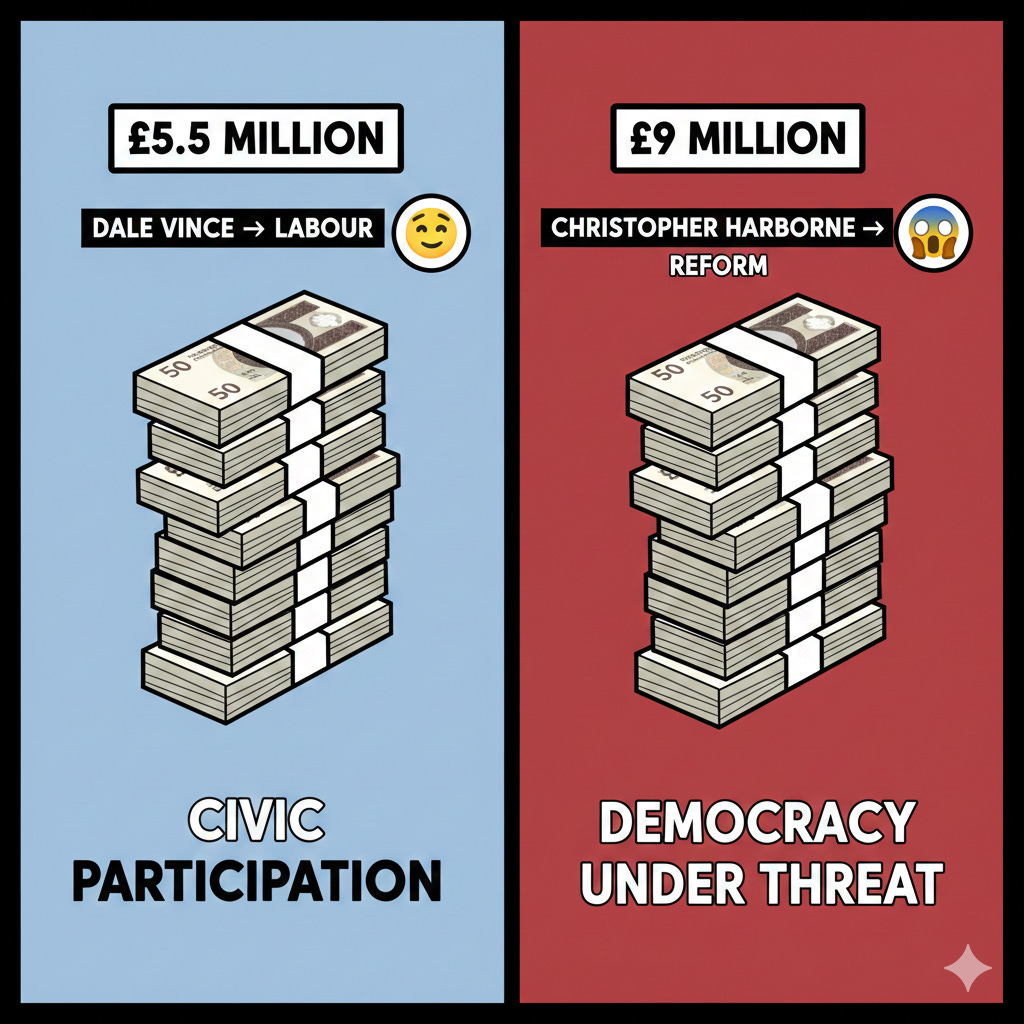
Dale Vince gives Labour five and a half million quid. His company claims to be “Britain’s greenest energy supplier” whilst flogging you 99% fossil fuel gas. When journalists check if he’s actually offsetting the carbon like he claims? No active carbon credits. None. The response? Oh, we bought some “two years ago” and our current programme is “under review.”
So Britain’s greenest energy supplier is currently not offsetting anything whilst claiming carbon neutrality. And collecting £123 million in government grants.
Media reaction? Silence. The occasional puff piece about green entrepreneurship.
Christopher Harborne gives Reform nine million. Media loses its collective mind. Democracy is dying. The Electoral Reform Society—who never noticed Vince—suddenly sees “alarming trends.”
Same mechanism. Different tribe. Completely different rules.
The Three Questions.
Is this practical? Only if you believe different rules should apply based purely on social respectability rather than actual behaviour.
Is it logical? Only if you’ve convinced yourself that Vince’s greenwashing fossil fuel operation is fundamentally different from Harborne’s crypto millions.
What’s the likely outcome? The same corruption continues uninterrupted whilst we argue about which mega-donors we prefer.
When the mechanism serves your team, you don’t see a mechanism. You see civic participation.
How the Game Actually Works.
Vince isn’t lobbying for green subsidies. He’s offering Labour ministers “ready-made policy platforms” through his foundation. He’s not asking for favourable policy. He’s writing it. Whilst his company banks government grants.
Harborne owns chunks of Tether and a defence contractor called QinetiQ. Reform becomes the first UK party to accept Bitcoin donations. You genuinely think crypto regulation doesn’t feature in those conversations?
Same game. Both playing it. One gets called civic participation, the other threatens democracy itself.
The difference? Vince went to the right schools. Harborne made his money in crypto from Thailand.
The corruption’s identical. The postcode differs.
The Sainsbury Standard Nobody Discusses.
Lord Sainsbury gave Labour £16 million between 1996 and 2006. They made him Science Minister in 1998. Know what the Science Minister does? Controls the budget for research councils.
Know what Sainsbury’s foundation funds? Biotech research.
So he’s donating millions to the party that makes him the minister controlling the budget funding the research his foundation funds. For eight years.
A Labour NEC member literally told the BBC this would be seen as corruption in any other country. Press reports described him as “unsackable” because of his importance as a donor.
Later he gives the Lib Dems £8 million—half their election funding. Then returns to Labour with another £2.5 million. His dead cousin left the Tories £10 million in his will.
The biggest donors to all three main parties share the same surname. Buying influence across the spectrum like a diversified investment portfolio.
And we’re supposed to clutch our pearls about Harborne?
What Changed.
Trade unions used to fund Labour transparently. Paid affiliation fees, received structural power in return—NEC seats, conference votes, the ability to nominate leaders. Everyone knew precisely what they wanted: employment law, worker protections, collective bargaining rights.
In 1992, unions provided around 75% of Labour’s funding. By 2023, just £5.9 million of Labour’s £21.5 million came from unions—replaced by companies and individual donors giving £14.5 million.
At the 2024 election, unions contributed £2.4 million total. Sainsbury alone gave £2.5 million.
Unite—once Labour’s biggest donor—refused to donate or endorse the manifesto after giving £3 million in 2019. The unions representing millions through democratic structures got squeezed out. Replaced by individual billionaires operating through dinner parties and informal access.
Media called unions “paymasters.” Corrupting influence wielding too much power.
Let me translate: When millions of workers pool resources democratically to pursue clear policy goals, that’s corruption. When individual billionaires buy access through personal relationships to advance their business interests, that’s civic participation.
The Green Party Comedy Interlude.
Zack Polanski, Green deputy leader, says Harborne’s donation proves “weakness in British democracy.” Talks about Greens building “a movement funded by people, not eye-watering cheques.”
His party accepted £3,000 from Vince in a seat Labour lost by 1,500 votes. Didn’t report it for nearly a year.
So when Vince bankrolls you in a marginal, that’s people-powered politics. When Harborne gives Reform money, democracy’s dying.
What Money Actually Buys.
Money doesn’t buy influence within the rules. Money buys the people who write the rules.
Sainsbury wasn’t lobbying for biotech policy. He was the minister implementing it whilst his foundation funded the research.
Vince isn’t asking for green subsidies. He’s drafting the policy defining what gets subsidised whilst banking £123 million in grants. Now he wants donation caps. After he’s already spent millions reshaping the landscape.
Harborne could do the same. Crypto regulation. Defence spending. All shaped by the party he’s funding.
The mechanism’s identical. The only people pretending otherwise are the ones benefiting from the pretence.
The Frank Hester Memory Test.
Frank Hester gave the Tories £15 million. Made racist comments. Sustained media campaign demanding the Conservatives return every penny.
Dale Vince makes controversial comments linking the Bondi Beach massacre to Israeli actions in Gaza. Ministers suggest Labour might review future donations. Nobody demands returning the £5.5 million already banked.
Same pattern. Your donor makes offensive comments, return everything. Our donor makes offensive comments, maybe reconsider next time.
The Bit Nobody Says Out Loud.
Trade unions had explicit power—seats, votes, nominations. Everyone knew what they wanted and how they pursued it.
Individual billionaires have implicit power—dinners, advisory roles, the threat of defection. Nobody knows what specific policies get shaped in those conversations.
We traded transparent institutional influence for opaque personal influence. And we call this progress.
The Choice You’re Being Offered.
You get two options:
Respectable mega-donors—Vince, Sainsbury, proper schools and progressive rhetoric—buying policy through Labour. Feel good because it’s “clean money” even when it’s fossil fuel gas sold as green energy.
Or vulgar mega-donors—Harborne, crypto wealth, Thailand-based—buying policy through Reform. Feel concerned because it’s “dark money” even when the mechanism’s identical.
Both lead to the same destination. You’re just choosing which flavour you prefer.
The only honest positions are: cap all mega-donors or cap none of them. Ban union influence and individual billionaire influence, or permit both transparently.
What’s intolerable is pretending respectable corruption is different from vulgar corruption based purely on which team benefits.
The Logical Conclusion.
The outrage isn’t about the mechanism. It’s about whose tribe benefits.
Vince gives millions whilst his company supplies fossil fuel gas as green energy and banks government grants. Media silence.
Harborne gives millions with crypto and defence holdings. Democracy’s dying.
The pattern holds across every case. When mega-donors fund parties the commentariat supports, it’s civic participation. When they fund parties the commentariat opposes, it’s corruption.
You can participate in this selective outrage if it makes you feel better. You can pretend your team’s mega-donors are different, better, more legitimate.
Or you can recognise you’re being offered a choice between red pill and blue pill when both lead to the same Matrix.
The outrage is the control mechanism. You pick a tribe, defend your tribe’s donors, attack the other tribe’s donors, and the capture continues uninterrupted.
Money changed the rules. We’re just arguing about which mega-donors we prefer to let play the game.
Sources and Citations.
Electoral Commission records: Labour donations from Dale Vince via Ecotricity (£3.4m since 2020, total exceeding £5.5m). OpenDemocracy investigation July 2024 into Ecotricity carbon credit claims and £123m government grants. Christopher Harborne donation to Reform UK (£9m, August 2024). Electoral Reform Society and IPPR statements on mega-donor trends. Lord David Sainsbury donations to Labour (£16m, 1996-2006), appointment as Science Minister 1998-2006, Gatsby Foundation biotech funding. Sainsbury donations to Liberal Democrats (£8m, 2019) and Labour (£2.5m, 2024). Lord John Sainsbury bequest to Conservatives (£10m, 2022). Trade union funding decline: from 75% (1992) to £5.9m of £21.5m total (2023). Unite donation history and 2024 election non-participation. Byline Times investigation into Dale Vince Green Party donation (£3,000, Swale constituency, July 2023). Harborne business interests in Tether, Bitfinex, and QinetiQ. Reform UK Bitcoin donation announcement. Zack Polanski Green Party statements on Reform donation. Frank Hester Conservative donation and subsequent controversy. Dale Vince Bondi Beach comments and Labour Party response.
All information sourced from Electoral Commission public records, established media reporting (OpenDemocracy, Byline Times, Financial Times, Guardian, BBC), and official party statements.
I had a run in with Dale Vince a few years ago when I went to Forest Green Rovers and didn't get to see Bristol City lose. I had to take the arrogant sh*t to the Football Ombudsman. https://www.bristolworld.com/sport/football/bristol-city-fan-gets-forest-green-rovers-ticket-refunded-after-independent-football-ombudsman-ruling-3519282