
Why Muslim Voters Fled Labour for the Greens—And Why It Won't Last.
Has Islam become a far-left religion in the West? Or have Muslim voters simply run out of options?

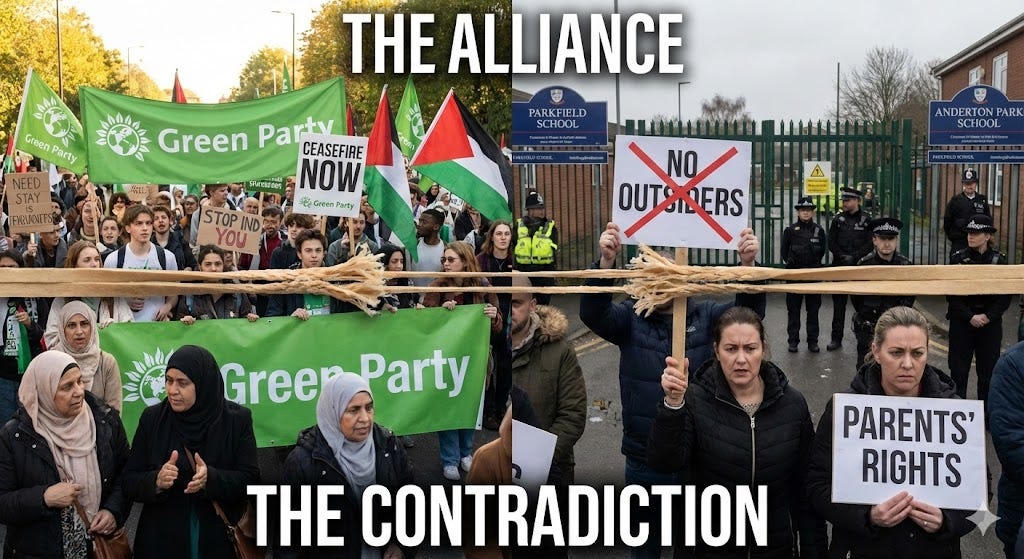
Walk through any Green Party meeting in Birmingham or Bradford, and the alliance seems real. Muslim voters are fleeing Labour in droves, most landing with the Greens. But this isn’t ideological convergence—it’s political homelessness seeking temporary shelter. The same contradiction that shattered Labour’s Muslim alliance exists in the Green-Muslim coalition. It just hasn’t been tested yet. Think of tolerance as an elastic band: stretch it too far, and it either snaps back or breaks entirely. The Greens are about to learn what Labour discovered over Gaza.
The Great Labour Exodus: Where Muslim Voters Went.
The 2024 election saw 25 Muslim MPs elected—the highest ever. But the story isn’t representation, it’s realignment. Labour haemorrhaged Muslim votes across constituencies with large Muslim populations. In Birmingham Perry Barr, Blackburn, Leicester South, and Dewsbury and Batley, independent pro-Gaza candidates defeated sitting Labour MPs. Where independents didn’t win, the Greens and other parties picked up the protest vote.
The numbers tell the story. In the 21 constituencies where more than 30% of the population is Muslim, Labour’s vote share dropped by 29 percentage points—from an average 65% in 2019 to 36% in 2024. The total number of Labour votes in these seats fell from over 600,000 in 2019 to just under 300,000 in 2024—representing more than half of Labour’s overall vote loss between elections.
Shadow cabinet member Jonathan Ashworth lost Leicester South to independent Shockat Adam by just 979 votes. The Muslim Vote campaign helped elect five independent MPs, four of them Muslim, all running on pro-Gaza platforms. Wes Streeting, now Health Secretary, saw his majority in Ilford North collapse to just 528 votes against British-Palestinian candidate Leanne Mohamad.
The trigger was clear: Keir Starmer’s Israel-Gaza position crossed a theological red line. When he said Israel had the “right” to cut off water and power to Gaza, then refused to call for an immediate ceasefire, he wasn’t just making a foreign policy misstep. For many Muslims, Palestine isn’t a policy preference—it’s religious solidarity with the ummah, the global Muslim community.
Seven Labour MPs lost the whip for voting against the two-child benefit cap. Dozens of councillors across London boroughs—four in Lambeth, four in Hackney—were suspended for supporting Gaza ceasefire motions. In November 2023, 56 Labour MPs defied the whip to vote for the SNP’s ceasefire motion. Ten frontbenchers resigned or were sacked, including Jess Phillips and Yasmin Qureshi.
The message was clear: toe the party line or face consequences. So Muslim voters left. Four independents won seats outright. But many Muslim voters defaulted to the Greens—a party with infrastructure, ballot access, and crucially, no track record of forcing uncomfortable choices. The Greens haven’t had to navigate the contradiction yet. They’ve simply inherited Labour’s refugees.
Where Muslim Values and Green Politics Actually Meet.
The Muslim-Green alliance works—temporarily—because it’s built on foreign policy and economic critique. Both opposed the Iraq War, Afghanistan, and Israel’s Gaza campaign. Islamic finance principles reject usury; Greens oppose extractive capitalism. Both feel marginalised by mainstream politics and champion anti-imperialism.
But notice what’s missing: any domestic social policy conflict.
The Greens haven’t had to ask Muslim candidates to publicly affirm LGBT-inclusive education in primary schools. They haven’t forced a vote on gender self-identification in women’s spaces. They haven’t demanded support for sex-positive education that contradicts Islamic teaching on modesty and premarital relations.
Why? Because the Greens are fundamentally a protest party. They promise everything because they’ll never have to deliver at scale. They can oppose war, champion Palestine, and critique capitalism without governing Birmingham schools or writing national education policy. As long as foreign policy remains the salient issue, the domestic contradictions don’t matter.
Labour had the same luxury once. They maintained the Muslim-progressive coalition for years by keeping certain contradictions off the table. Gaza ended that. It forced a choice between party discipline and constituent conscience.
The Greens have simply postponed the same test.
Where the Elastic Is Already Snapping.
You don’t need to speculate about what happens when the contradiction becomes unavoidable. It’s already happening at local government level, where national media doesn’t watch as closely.
Birmingham witnessed mass protests in 2019 when Muslim parents objected to LGBT-inclusive relationship education at Parkfield Community School and Anderton Park Primary. Hundreds of demonstrators gathered outside school gates for months, eventually forcing the schools to suspend their “No Outsiders” programme. A High Court banned protests near the schools, but the message was clear: when domestic social policy conflicts with religious conviction, those convictions don’t bend.
At Westminster, the elastic stretched further. Shabana Mahmood embodies the contradiction. She’s a “lifetime supporter of Palestinian rights” who posted “#FreePalestine” in 2014 and called for a ceasefire in March 2024. But she also abstained on the November 2023 ceasefire vote and refused to resign from the shadow cabinet over Labour’s Israel position. She acknowledged in February 2024 that Labour had “lost the trust of Muslim voters,” then stayed anyway.
Now she’s Home Secretary—appointed in the September 2025 reshuffle, replacing Yvette Cooper. She’s responsible for counter-extremism policy, engagement with Muslim organisations, hate speech law, regulation of sharia councils, and the Prevent strategy. She cannot compartmentalise anymore. Her portfolio forces unavoidable choices: Will she defend Prevent or water it down? Will she engage with Muslim organisations Labour has blacklisted, like the Muslim Council of Britain? When the next blasphemy controversy arrives, will she defend absolute free speech or argue for religious sensitivity?
Every decision tests whether religious conviction or political ambition wins.
Of 19 Labour Muslim MPs, only two hold government positions—Mahmood and Tulip Siddiq (Economic Secretary to the Treasury). Most are backbenchers precisely because the frontbench requires choices that force the contradiction into the open. Rushanara Ali was appointed homelessness minister in July 2024, only to resign in August 2025—13 months later—over a landlord scandal involving her own rental properties while serving as minister for homelessness.
The grassroots evidence is clear: when the issue comes to their doorstep, sincere religious belief wins.
Why Religious Conviction Trumps Political Allegiance.
Here’s the fundamental asymmetry the left doesn’t grasp: political allegiance is transactional and temporary. Religious conviction claims eternal truth and consequences.
Islam teaches tolerance—but tolerance isn’t acceptance. It’s forbearance. It’s “I profoundly disagree with you, but I will coexist anyway.” That requires structural tension, like an elastic band under constant strain. You can’t tolerate something you already agree with.
Consider the counter-example: Rishi Sunak is a practising Hindu. He took his oath on the Bhagavad Gita, observes Diwali, is publicly vegetarian. Yet his faith never created political tensions because Hinduism doesn’t make the same totalising political claims. There’s no Hindu equivalent to the ummah demanding solidarity with Hindus worldwide. Hinduism, as commonly practised in the West, accepts the secular-religious divide. But Islam, in its orthodox interpretation, doesn’t recognise that framework—it makes comprehensive claims about law, society, and governance that resist separation into distinct spheres.
The left mistakes this strategic tolerance for ideological convergence. They imported Muslim communities into a progressive coalition by treating Islam as an identity (like race) rather than a belief system (like ideology). They assumed generational assimilation would secularise Muslim communities, that tolerance would evolve into acceptance would evolve into endorsement.
But orthodox Islamic theology doesn’t accept the secular-religious divide that post-Christian Europe takes for granted. There is no “render unto Caesar” in Islamic jurisprudence. For observant Muslims, faith and governance are inseparable—they don’t split neatly into “private belief, public secularism.”
This isn’t unique to Islam. Any sincerely held religious belief that makes claims about how society should be organised will eventually collide with secular progressive politics. The difference is scale and timing: Islam is the only major religion in contemporary Britain with both the demographic weight and the theological framework to make this collision politically consequential right now.
When domestic policy forces the same choice—between God and government, principle and party—observant Muslims will choose their faith. Not because Islam is uniquely incompatible with progressive politics, but because sincere religious conviction always operates at a different level than political expediency.
Gaza proved this on foreign policy, where Muslim and left-wing interests naturally aligned. Domestic social policy will prove it where it directly contradicts.
What Happens When the Greens Govern.
The Greens picked up Muslim voters not through ideological alignment, but because they haven’t yet forced the choice Labour did.
Political homelessness doesn’t create new homes—it relocates the problem. The same tension that broke Labour’s coalition remains, waiting for the Greens to test it.
Green Party analysis shows they finished second in 40 constituencies in 2024. Of those, 22 have Muslim populations exceeding 10%. They’re explicitly targeting these areas for future growth. But growth means governing. And governing means making choices.
Eventually—whether in Bristol, Birmingham, or Bradford—Greens will control a council with a significant Muslim population. They’ll face the school gates moment. They’ll have to choose between LGBT-inclusive education mandates and Muslim parent concerns. Between party policy on gender ideology and religious conviction on sex segregation. Between absolute free speech and religious sensitivity.
The same councillor suspensions that plagued Labour over Gaza ceasefire votes will plague the Greens over domestic social policy. The same frontbench resignations. The same electoral punishment.
And they’ll learn what Labour learned: you can’t build a permanent coalition on contradictions you’re afraid to acknowledge. You can’t maintain an alliance by avoiding the tests that reveal incompatibility.
Islam hasn’t become far-left. Muslim voters haven’t suddenly adopted progressive social values. They’ve simply moved from one party that forced an uncomfortable choice to another party that hasn’t forced it yet.
The elastic band doesn’t stretch forever. It either snaps back or it breaks entirely. When sincere religious belief meets incompatible political demands, belief wins. Every time.
Written at 2 AM when my neurodivergent brain decided sleep was optional and pattern recognition was mandatory. This is what insomnia delivers when random thoughts suddenly crystallise into entire political analyses that won’t let you rest until they’re written.