
Y2K Got One Thing Right. They Fixed The Computers. While We Were Left Out.
We Are The Bug. And 26 Years Later, We're Still Left Out. Because We Never Knew. Until Now.

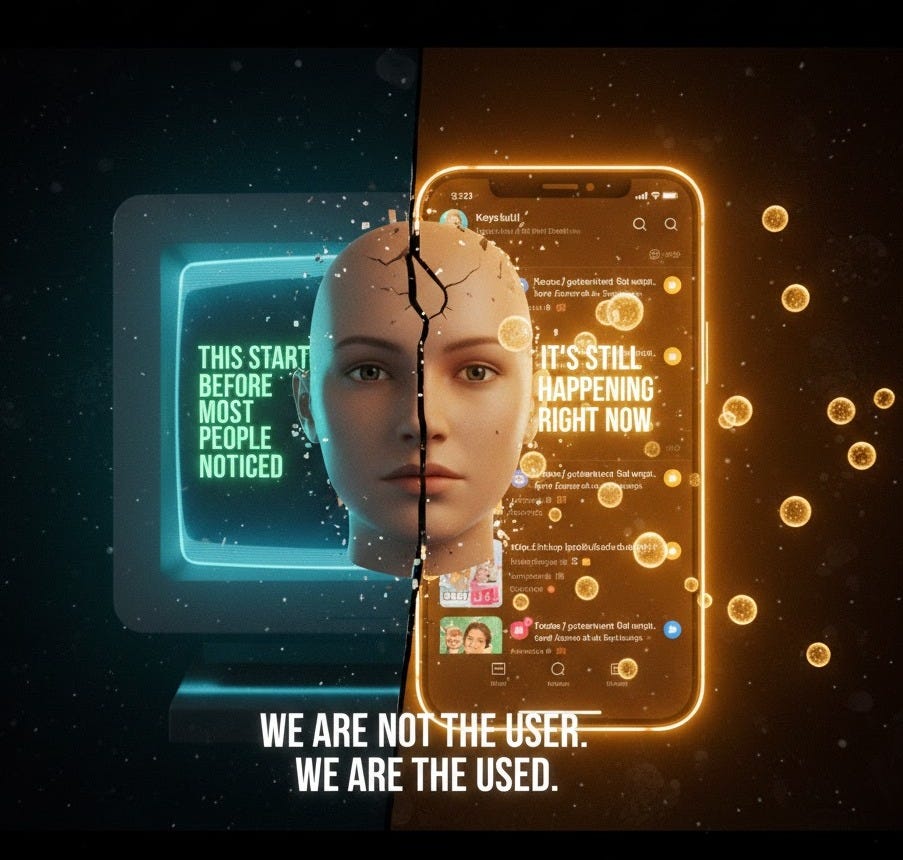
Whether you were there or you’ve only heard about it, everyone knows the story. Midnight. December 31st 1999. The whole world glued to a screen waiting for civilisation to fall over. And then? Nothing. The lights stayed on. Everyone laughed, called it a hoax and cracked on.
Only nobody noticed. While we were all staring at those screens waiting for the machines to break - the real bug was quietly installing itself. Not in the computers. In us. And unlike Y2K, nobody’s even acknowledged it exists. It had no countdown. No warning. No midnight alarm. It was already inside before anyone thought to look. And you felt it. Even if you couldn’t name it.
Ask yourself something honestly. When did you last feel genuine anger about something happening on your own street? Your own town? Something you could actually do something about?
Now ask yourself how long ago it was that you last felt genuine outrage about something happening in a country you’ve never visited, couldn’t point to on a map six months ago, and have absolutely no ability to influence whatsoever. Take your time with that. Because somewhere between 1999 and now, something quietly swapped those two things around. And nobody asked your permission.
It didn’t happen overnight. First came broadband. Then the smartphone in your pocket. Then the feed. A personalised, algorithmically curated, never-ending feed that knew what made you angry before you did. Three steps. Roughly a decade. And by the time most people noticed something felt different, the rewiring was already done.
Now there’s a fourth step. AI. Not the science fiction kind. The quiet kind. The kind that’s already deciding what you see, what you read, and what you feel before you’ve even picked up your phone this morning. It doesn’t do your thinking for you. It just makes sure that by the time you start thinking, the direction of travel is already set. And nobody asked your permission for that either.
So let’s be honest about what’s actually happened here. Between 2008 and 2017 psychological distress in young adults rose by 71%. Not gradually. Not slightly. 71%. And that was before AI entered the equation.
Today nearly half of all teenagers say social media has a mostly negative impact on their peers. Not their enemies. Their peers. The people they actually know. And if you’re running seven or more social media apps - which most people under 30 are - you are three times more likely to be showing symptoms of depression or anxiety right now. Three times. While being absolutely convinced you’re simply staying informed.
Meanwhile the school at the end of your road is crumbling. The local hospital has a four hour wait. Your council is selling off community assets while promising to replace them. Yet that’s not what’s trending. That’s not what the feed served up this morning. And here’s the question nobody in charge particularly wants you to ask. If your emotional energy is permanently directed outward toward things you can’t fix - who benefits from the fact that you’re too exhausted to look inward at the things you can?
That’s exactly what a bug does. It convinces the infected system that it’s functioning normally while everything quietly degrades from the inside. The system doesn’t know it’s broken. It just keeps running. Louder. Faster. More convinced than ever that it’s working perfectly. Sound familiar?
Here’s what I know from standing outside all of it. The people who seem the most informed are often the most manipulated. Marching for causes they couldn’t explain six months ago. Trying to fix systems they don’t understand in countries they’ve never visited. All the while their own system is running corrupt. Their own street. Their own community. Their own thinking. Nobody fixes the world from the outside. You start from the inside. Always have. Always will. Only the feed doesn’t want you looking in that direction. Because a person who’s fixed themselves is considerably harder to manipulate.
So next time you find yourself staring at a screen. Outraged. Distressed. Emotionally wrung out by something happening on the other side of the world. Remember that room full of people on December 31st 1999. Staring at their screens. Waiting for a catastrophe that never came. The catastrophe did come. Just not where anyone was looking. It came quietly. Through the screen. Into the space between your ears. And it’s still there now. Running silently in the background. The question isn’t whether you’ve got the bug. The question is whether you’re ready to do something about it.
Start with what’s actually in front of you. When did you last write to your councillor about bin collections that haven’t happened in three weeks? When did you last challenge the decision to close your road to through traffic while your elderly neighbour can’t get a delivery? When did you last ask why knife crime in your area is rising while the council is busy congratulating itself on its climate credentials?
These things are happening. Right now. On your street. In your town. To people you actually know. They’re just not trending. Nobody’s organising a march about them. And the people making those decisions are counting on the fact that you’re too busy being angry about something a thousand miles away to notice what they’re doing right on your doorstep.
Remember that screen you were staring at this morning? The outrage. The distress. The cause you can’t influence from your sofa. That’s not you. That’s the bug running. And here’s the thing about bugs. They only survive in systems that don’t know they’re infected. Y2K didn’t destroy the computers. Something did quietly destroy our ability to think locally, act locally and change the things that are actually within our reach.
They fixed the computers. While we were left out. Twenty six years later we’re still left out. Still infected. Still convinced we’re functioning normally while everything around us quietly degrades. The computers got their fix in 1999. We’re still waiting for ours. And the only person who can actually restart that process is the one reading this right now. Your reboot begins now. Not tomorrow. Not after the next scroll. Right now. The feed’s been running your system long enough. You just didn’t realise did you?
Think about it.
SOURCES & FURTHER READING
Social Media and Teen Mental Health - Pew Research Center 2025
Social Media and Mental Health Statistics - ElectroIQ 2025
Social Media and Mental Health - SingleCare 2025
Social Media Use and Interpersonal Distrust Among Gen Z - UCL Institute of Education 2025
Digital Depression: A New Disease of the Millennium? - Ghaemi S.N. 2020