
You Are Made Of Oil.
When net zero means nothing at all, it means exactly that. Doesn't it? The Almighty Gob | thealmightygob.com.

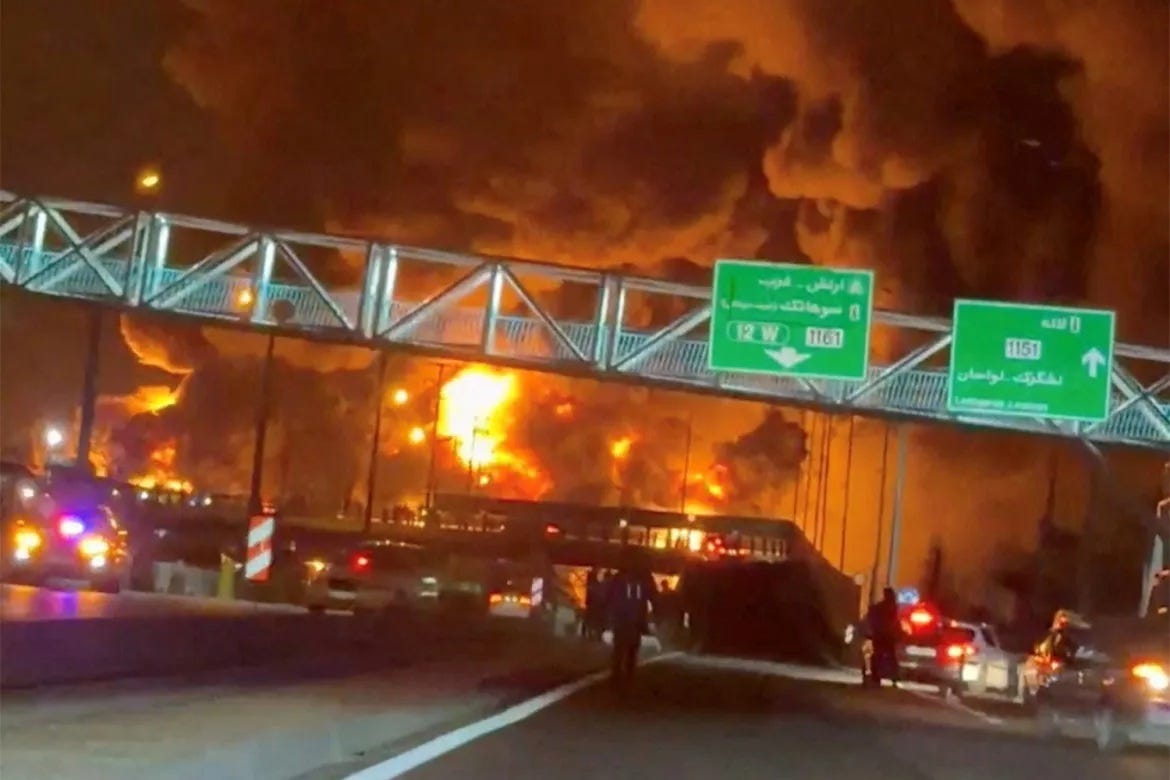
The radio came on yesterday morning before I was properly awake to receive it. The way it does. Sliding into the room ahead of you, already talking, already mid-sentence about something you haven’t caught up with yet.
Something about the Straits of Hormuz. Oil. The Middle East. Price per barrel going up.
I lay there for a moment and a thought arrived — the kind that comes before you’ve had the chance to defend yourself against it.
How much of the world actually runs on oil?
Not the obvious part. Not the petrol, not the diesel, not the planes. Everybody knows that part, or thinks they do. The other part. The part that doesn’t announce itself. The part that just sits there quietly, underneath everything, holding the whole thing up.
I needed to think. So I did what I always do. Got out of the house. Into the fresh air. Let the morning work on me.
It was somewhere between the front door and the end of the street that the world started giving me answers I hadn’t asked for.
The road. Just the road itself.
Bitumen. Which is oil. The surface every person in this country walks on, drives on, cycles on — oil. The white lines — oil-derived. The kerb adhesive — oil. The drainage beneath it — oil-derived compounds throughout.
And the potholes.
Anyone who has made any kind of journey through this country recently knows exactly what I’m talking about. The ones that appeared overnight after the last hard frost. The ones that have been there so long they’ve acquired a kind of local notoriety. The ones that swallow a front wheel so completely you feel it in your spine three streets later.
They damage cars. They blow tyres. They bend wheels and crack suspension components and produce repair bills that nobody budgeted for.
They put cyclists on the tarmac. They put motorcyclists in ambulances — and a motorcyclist hitting a deep pothole at speed is not an inconvenience, it is a potentially fatal event.
They catch pedestrians on dark evenings.
They are, in the most unglamorous and immediate way imaginable, a public safety crisis sitting in the surface of every B-road and residential street in the country.
And they are filled with tarmac.
Which is oil.
The machinery that lays the repair — diesel. The lorry that carries the materials — diesel. The hi-visibility jackets on the workers — oil-derived synthetic fabric. The cones — oil-derived plastic. The road markings reapplied afterwards — oil-derived paint.
The car that hit the pothole — built using oil at every stage of manufacture, its damaged tyre made of oil-derived rubber, taken to a garage stocked with oil derivatives, repaired by a mechanic whose tools were manufactured using oil, driving away on a road made of oil.
The ambulance that came for the motorcyclist — diesel. The hospital it drove to — constructed, equipped, and stocked from floor to ceiling with petrochemical products. The surgery, if it came to that — oil in the anaesthetic delivery system, oil in the sterile draping, oil in the gloves, oil in the instrument packaging, oil in everything surrounding the bed during recovery.
The pothole is not a footnote to the oil argument.
The pothole is the oil argument. Right there in the road. Ordinary, unglamorous, unavoidable.
I was rolling through all of this on my mobility scooter when the thought settled. And then it had a second thought inside it, the way they do.
The mobility scooter.
Manufactured in China — as the overwhelming majority of mobility scooters sold in Britain now are.
The plastic body panels — oil. The ABS casing — oil. The rubber on the tyres — oil. The wiring insulation — oil. The seat foam and fabric — oil-derived. The battery housing — oil-derived plastic.
Every component made in a Chinese factory running on oil, assembled by machinery running on oil, loaded onto a container ship burning oil, delivered by a lorry running on diesel.
The vehicle carrying me through a world made of oil, observing a world made of oil, is itself made of oil.
And then the China thought opened further, because these things do.
China. Sixteen million barrels of oil. Every single day. 2024.
The world’s largest importer of crude. Eleven million barrels a day coming in — from Russia, Saudi Arabia, Iran, Iraq, anywhere it can source them. In 2025, those imports hit a record high.
At the same time — the world’s largest electric vehicle market. Solar capacity being deployed at a scale nobody else is approaching. Record renewables investment.
All of it. Simultaneously. Because China understands something that most Western political discourse cannot quite locate — energy is power and materials are civilisation. You do not dismantle the foundation while you are still building the replacement.
You build the replacement first.
Over half of China’s oil imports pass through the Straits of Hormuz. The thing on the radio yesterday morning.
When the price goes up there, it goes up in the factory that made the mobility scooter. It goes up in the shipping cost that brought it here. It goes up in the tarmac that will eventually fill the pothole underneath the wheels.
The whole chain tightens simultaneously, invisibly, and the connection between a geopolitical flashpoint in the Persian Gulf and a mobility scooter on a British street is not metaphorical.
It is direct.
Without the scooter, I wouldn’t have left the house yesterday morning. Which means none of this would have occurred to me. The plastic body of a mobility scooter, it turns out, is load-bearing in more ways than one.
And this isn’t about me. There are millions of us.
Millions of mobility scooters globally. Millions of people whose independence, whose ability to leave the house, whose connection to the world outside depends entirely on a machine made from oil-derived materials.
Elderly people. Disabled people. People recovering from illness or injury. People for whom a mobility scooter is not a lifestyle choice but the difference between participating in life and not participating in it at all.
We are part of the situation. Every one of us. Part of the same dependency the protesters on the road have never once mentioned, because it doesn’t fit the story they’re telling.
And then the prosthetic limbs. The powered wheelchairs. The hearing aids. The home medical equipment. The assistive technology of every kind that gives people their lives back — all of it tracing back to petrochemical manufacturing. All of it made possible by oil.
It did cross my mind, somewhere along the way, to wonder what the scooter would be made of in a world without oil. Coconut fibre presented itself as an option. I don’t know why. It just did.
The global demand for coconuts required to replace the plastic bodywork of every mobility scooter in the world would be, by any reasonable estimate, catastrophic for coconuts. There would be land clearance. Water crises. Communities displaced. Shipping fleets burning — something — to move coconuts from wherever coconuts come from to wherever mobility scooters get made.
And within eighteen months, there would be protesters.
Attached to coconut palms.
With rope.
Deeply concerned.
Ninety percent of the supply chain of all industrially manufactured products depends on oil-derived services or oil-derived products. Ninety. That figure comes from the Geological Survey of Finland and it isn’t a rounding error. It is the architecture of the whole thing, from the foundations up.
The world doesn’t run on oil the way a car runs on petrol — swap the fuel and carry on. The world is made of oil.
It’s in the shaver on the bathroom shelf. It’s in every blister pack and plastic bottle in the medicine cabinet. It’s in the IV bags and sterile packaging in every hospital ward in the country.
It’s in the fertiliser that grew your breakfast, the machinery that harvested it, the lorry that moved it, the packaging it sat in on the shelf.
Over three and a half billion people are alive today because artificial fertiliser — synthesised using oil and gas — produces enough food to feed them. Three and a half billion. That is not a political position. That is arithmetic.
Remove the oil and the arithmetic changes. In the most brutal direction arithmetic has available to it.
Which brings us, as things tend to, to a group of people gluing themselves to roads.
The people in the high-visibility jackets are not stupid people. They are frightened people, frightened of something real. The climate is changing. The science is not in serious dispute. The fear is not without foundation.
But somewhere between the fear and the action, a question got skipped.
The glue — oil derivative. The road — bitumen, which is oil. The tyres on the cars they are stopping — oil-derived rubber. The zip ties — oil-derived plastic. The high-visibility jackets — synthetic fabric, which is oil. The smartphones filming the whole event — assembled in a factory running on oil, shipped on a vessel burning oil, encased in oil-derived materials.
They are, in the most precise and literal sense the English language can offer, oil protestors made of oil, sitting on oil, using oil to protest oil.
Sitting directly on top of the potholes that only oil can fix. On a road that only oil can maintain. Blocking vehicles built substantially from oil. Filmed on devices made in Chinese factories running on oil, in a country that imports more oil than anywhere else on earth and has absolutely no intention of stopping.
Just Stop Oil.
They hung up the hi-vis in April 2025. The oil is still there.
One notices this and doesn’t quite know where to put it.
What if they actually got what they say they want? Not as a symbolic victory. Not as a policy paper. Actually. The oil stops.
Within days, global shipping halts.
Within two weeks, food distribution begins to fail in countries that import their food — the United Kingdom produces less than half of what it eats.
Within a month, hospitals are rationing equipment. Not budgets. Equipment. Because the sterile packaging, the disposable instruments, the IV lines, the drug delivery systems — it all traces back to a petrochemical plant that is no longer operating.
The people most likely to survive that world are rural, practical, self-sufficient people with land and tools and knowledge of how to grow things. Not urban activists with good intentions and philosophy degrees and a very impressive social media presence.
The protest is only possible because oil works. The ambulance that would come if something went wrong on that road runs on diesel. The hospital at the end of that journey is built from and stocked entirely with petrochemical products. The medication in the drip is synthesised using hydrocarbon chemistry.
There is no opt-out clause. You do not get to be against it and simultaneously be kept alive by it. The position collapses the moment you follow it all the way down.
Which most people don’t. Because following things all the way down is uncomfortable, and there’s always something else on.
And then, because days like this one tend to go all the way, there’s Trump.
Not a sentence anyone writes with particular enthusiasm. But the thought arrived and it has to go somewhere honest.
When he talks about drilling and energy independence, the reflex in certain quarters is to dismiss it immediately. Understandable.
But the underlying observation — that energy security is national security, that a country dependent on foreign oil is a country that can be held hostage by whoever controls the chokepoints, that domestic production means you are not at the mercy of whatever is happening in the Straits of Hormuz on any given morning — that observation is not wrong.
It is boring and correct, which is the hardest kind of correct to get anyone excited about.
One doesn’t have to endorse the messenger to follow the logic.
China already follows the logic. It imports record quantities of oil while simultaneously building record quantities of renewable capacity. Not choosing between energy sources. Accumulating all of them. Quietly. Strategically. Without a placard in sight.
The world needs to stop burning oil as quickly as genuinely viable alternatives can be built and scaled. Solar is now the cheapest electricity in human history. Electric vehicles are genuinely displacing demand. These transitions are real and they matter.
But the world will depend on oil as a material — as the base for plastics, pharmaceuticals, fertilisers, synthetic fibres, road surfaces, mobility scooter body panels, the ten thousand components of daily life — for decades beyond any plausible timeline for ending combustion.
And in the meantime, the nations that control their own energy supply will have options that the nations that don’t will simply not have.
Both of those things are true. Simultaneously. Neither side in the public argument is saying both of those things simultaneously. And so the argument continues, loud and certain and not quite in contact with the actual problem.
While the potholes get deeper.
I got home just after lunchtime. Parked the scooter. And before anything else, I stood in the bathroom for a moment.
Just looked around.
The light switch — plastic. The light socket — plastic, almost certainly made in China. The toilet tissue — packaging plastic, cardboard tube sealed with oil-derived adhesive, delivered by a diesel lorry. The medicine cabinet — every bottle, every blister pack, every tube. Oil. The shaver on the shelf, which started this whole morning. Oil.
The landing. The light fittings. The switches. The sockets. The lampshade. The furniture fixings. The kitchen appliances — every handle, every seal, every casing. The home furnishings from Poundland or anywhere else — the packaging, the product, the materials. Oil, oil, oil.
And the windows.
PVC. Polyvinyl chloride. Installed specifically for energy efficiency. To reduce heat loss. To lower the carbon footprint of the house. Recommended by the very people most concerned about fossil fuel dependency.
Made entirely from oil.
The energy-saving window. Made of oil. Fitted to a house made substantially of oil. On a street made of oil. In a country that cannot decide what it thinks about oil.
There is no corner of a room, no drawer, no shelf, no fitting, no appliance that doesn’t contain it somewhere. The home isn’t a refuge from oil dependency. It is the densest concentration of it you will encounter all day.
You already knew this. You just hadn’t looked at it directly before now.
I spent the rest of the afternoon with the data, the reports, the figures, the forecasts. The International Energy Agency. The U.S. Energy Information Administration. The researchers who spend their working lives on exactly this question.
I wrote through the night. As I usually do. Not every night. But mostly.
What the research knows — what anyone who follows the evidence honestly knows — is that the dependency is total, the transition will take generations not decades, and the gap between what the activists are demanding and what the physics and chemistry of the situation will actually permit is not a policy disagreement.
It is a different relationship with reality.
And then there is net zero. Whatever that means, on any given day of the month, nowadays.
The target. The pledge. The thing governments sign up to at summits and corporations print on their annual reports and activists march for and everyone, everywhere, agrees is the necessary destination.
Net zero. The complete elimination of carbon emissions from human activity.
In a world made of oil.
Where PVC windows are made of oil to save the energy that oil produces. Where solar panels are manufactured in Chinese factories running on oil, shipped on vessels burning oil, mounted on brackets that trace back to petrochemical production. Where electric vehicles are built using oil at almost every stage of their manufacture, charged by electricity still substantially generated using oil and gas, running on roads made of oil past potholes filled with oil.
Where the delegates arriving at the net zero conference travelled on roads made of oil, in vehicles made of oil, carrying phones made of oil, wearing clothes made of oil, to discuss eliminating oil.
The net, in net zero, assumes there is something left over after the calculation. Something that balances. Something that cancels out.
But when the dependency runs this deep — when it is not a habit to be broken but a material reality woven into the structure of everything — the net doesn’t balance.
It amounts to net zero.
In the other sense of that phrase entirely.
Here you are.
Reading this on a screen made partly of oil. Sitting in a chair that is partly oil. Wearing clothes that are partly oil. In a building sealed with oil-derived materials on a street made of oil.
You are not observing the oil dependency from a safe distance.
You are inside it.
You were always inside it.
The question of what replaces it is not an environmental question, though people will keep treating it as one.
It is not a political question, though people will keep fighting about it as one.
It is a civilisational question — what holds eight billion people above the line, and what you build and prove and deploy at scale before you remove the thing that is currently doing the holding.
And the cost of living.
The thing that has dominated every kitchen table conversation, every political interview, every headline for the past several years. Prices going up. Budgets not stretching. People choosing between heating and eating.
Nobody in that conversation — not the politicians, not the commentators, not the economists on the radio — said the quiet part plainly.
When the price of oil goes up at the Straits of Hormuz, the price of everything goes up. The food on the shelf. The packaging it came in. The lorry that delivered it. The heating bill. The goods in every shop. The cost of making anything, moving anything, storing anything.
The cost of living crisis was never a separate story.
It was always this story.
Wearing different clothes.
Nobody with the power to answer that question is answering it.
The radio is on again this morning. Someone is still talking about the Straits of Hormuz. Oil. The price going up. It sounds more serious now than it did yesterday.
Yesterday I went out for fresh air and came back carrying this.
Reached for my phone to write it down.
The phone. In its plastic case.
Which is made of oil.
There it is. Right back where we started.
You knew this. You just hadn’t said it out loud.
When net zero means nothing at all, it means exactly that. Doesn’t it?
Sources.
The following sources underpin the research and figures in this piece. Readers are encouraged to go directly to them.
International Energy Agency — Global Energy Review 2025 Annual analysis of global oil demand, supply trends, and the expanding role of petrochemicals. https://www.iea.org/reports/global-energy-review-2025/oil
International Energy Agency — Oil 2025 Medium-term oil market analysis to 2030. The petrochemical industry as the dominant source of future demand growth, EV displacement of transport demand, and geopolitical supply risks. https://www.iea.org/reports/oil-2025/executive-summary
International Energy Agency — World Energy Outlook 2025 Global energy transition scenarios, renewable deployment records, and the continued parallel growth of fossil fuel consumption alongside clean energy expansion. https://www.iea.org/reports/world-energy-outlook-2025/executive-summary
U.S. Energy Information Administration — Short-Term Energy Outlook, February 2026 Current global liquid fuels consumption and production forecasts. Brent crude price trajectory and demand growth by region through 2027. https://www.eia.gov/outlooks/steo/pdf/steo_full.pdf
U.S. Energy Information Administration — Global Oil Markets Real-time global production and consumption data, supply disruption tracking, and inventory forecasts. https://www.eia.gov/outlooks/steo/report/global_oil.php
U.S. Energy Information Administration — China Crude Oil Imports Data on China’s crude oil import volumes, sources, and trends including the growth in petrochemical feedstock demand. https://www.eia.gov/todayinenergy/detail.php?id=64544
Columbia University Centre on Global Energy Policy — Where China Gets Its Oil: Crude Imports in 2025 China’s record crude oil imports in 2025, stockpiling strategy, and the geopolitical dimensions of China’s energy security approach. https://www.energypolicy.columbia.edu/where-china-gets-its-oil-crude-imports-in-2025-reveal-stockpiling-and-changing-fortunes-of-certain-suppliers-including-those-sanctioned/
Visual Capitalist — China’s Crude Oil Imports by Country China’s 11.1 million barrels per day import volume in 2024, source countries, and the role of the Straits of Hormuz in China’s energy supply chain. https://www.visualcapitalist.com/chinas-crude-oil-imports-by-country/
Worldometer — China Oil Consumption Statistics China’s daily oil consumption of over 16 million barrels, domestic production figures, and import dependency data. https://www.worldometers.info/oil/china-oil/
Wikipedia — Peak Oil (updated March 2026) Synthesises multiple primary sources on oil dependency across supply chains, food systems, and industrial manufacturing. Source for the Geological Survey of Finland finding that 90% of all industrially manufactured product supply chains depend on oil-derived services or products. https://en.wikipedia.org/wiki/Peak_oil
Enerdata — Can Oil Be Replaced? Global Oil Trends, Emerging Economies and By-Products in the Energy Transition Oil’s structural role across the transport sector and petrochemical industries. Source for the figure that petroleum fuels 92% of the global transport sector. https://www.enerdata.net/publications/executive-briefing/global-oil-market-trends.html
Our World in Data — Fertilisers and World Population Artificial fertiliser’s role in sustaining global food supply. Source for the figure that fertilisers derived from fossil fuel processes feed over 3.5 billion people. https://ourworldindata.org/fertilizers