
You Haven't Lost Your Mind. Tech Lost It For You. And You've Been Too Busy To Notice. True?
And the worst part is — it felt completely natural.

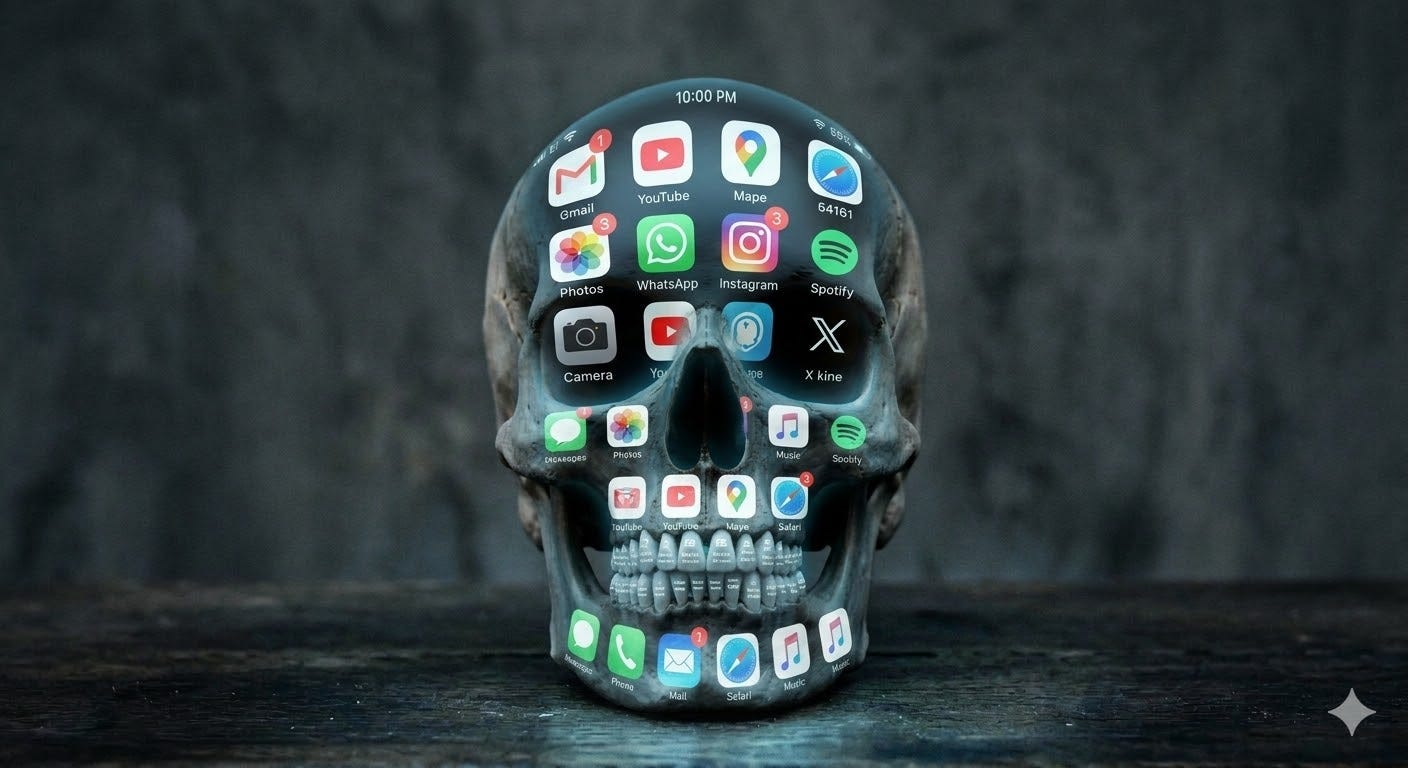
When did you last sit in complete silence and let your brain do something difficult on its own?
You’re already thinking about your phone. Right now. While reading this. Aren’t you.
No phone. No music. No television murmuring in the background. No podcast filling the gap. Just you, a thought, and the mild discomfort of having to actually follow it somewhere.
Take your time.
Because if that question made you slightly uncomfortable — if you had to think quite hard about when that last happened — then this piece is already doing what it came here to do.
Something has been happening to you. Gradually. Pleasantly. With your full co-operation.
And this is what it looks like.
The Handover — How You Gave It Away One Trade at a Time.
Here’s how it started. Go back far enough and it started before the technology entirely.
Before books, conversation. Before conversation, observation. Each generation handed something over and called it progress.
But books did something technology doesn’t. Books required you to bring something to them. You had to construct the images. Build the world from the words. Hold the thread of an argument across two hundred pages and remember where it started when it ended. The book was passive. You were the engine.
Technology reversed that. The technology is the engine. You’re the passenger.
And it happened so gradually that each individual handover felt not just reasonable but obvious. Why memorise a phone number when the phone holds it? Why learn to navigate when the map talks? Why sit with a difficult question when the answer is three seconds away? Every single trade made complete sense in isolation.
That’s the surreptitiousness of it. No single moment where you’d have said no. No obvious line crossed. Just a long, comfortable, frictionless slide — each step so small you chose it freely, right up until the day you looked up and noticed the muscle had gone.
Do you remember that day? Or did you not notice at all?
And here’s what makes it different from every previous handover in human history — books, radio, television each changed how you received information. Technology changed how you generate thought. That’s a different organ entirely.
A person who grew up with books and no television still had to think to be entertained. A person who grew up with television still had to imagine to read. A person who grew up with a smartphone in their hand from childhood has been handed a device that thinks, decides, navigates, remembers, recommends, and responds — on their behalf, in real time, before the need is even fully formed.
The brain, presented with that, does exactly what any well-designed efficiency system does.
It outsources.
Not with a moment of weakness. Not with a decision made under pressure. It started the way all the important surrenders start — with something that made life easier.
The phone knew the route, so you chose to stop memorising routes. The spell-checker caught the errors, so you chose to stop learning the spellings. The algorithm knew what you wanted to watch next, so you chose to stop deciding. The search engine had every answer in under three seconds, so you chose to stop sitting with questions long enough to form your own.
Each trade felt like progress. Frictionless. Efficient. Reasonable. Didn’t it.
What you didn’t notice — what none of us noticed — is that your brain isn’t a hard drive. It’s a muscle. And muscles you choose not to use don’t stay in standby, waiting patiently for the day you need them.
They atrophy.
They weaken.
They forget what the work felt like.
Does that sound familiar?
So you’re now scrolling through content engineered by behavioural scientists specifically hired to maximise the time you spend on the platform — designed to deliver the sensation of stimulation without the requirement of thought. Junk food for the brain. Engineered to the same precision as the exact salt-fat-sugar ratio that keeps you eating when you’re already full.
And just like junk food, the damage isn’t just what it puts in. It’s what it crowds out.
You choose the scroll over the long read. You move away from the difficult question rather than toward it. The silence — the actual, unmediated silence where your brain does its best uninterrupted work — becomes something you reach to escape rather than something you choose to inhabit.
But the technology is only part of it. Because long before the smartphone, long before the algorithm, there was something older and more powerful shaping the words coming out of your mouth.
The people around you.
You listened to family. Friends. Teachers. The television in the corner of the room. And without deciding to, without even noticing, you began to sound like them. Their words. Their phrases. Their way of naming things. Because sounding like the people around you meant you belonged to them. And belonging, for a social animal, isn’t a luxury. It’s survival. It kept your ancestors alive for hundreds of thousands of years before books existed.
So you copied. Naturally. Gratefully. Without a second thought.
And then the crowd got bigger.
The algorithm learned which emotional words generated the most engagement and fed them back amplified. Suddenly the crowd wasn’t just your family and your street — it was millions of people, all using the same word, the same degraded way, all providing the same social signal at once. Belong. Agree. Repeat.
The mimicry that once bound a village together got scaled to a civilisation.
And the words spread. Not because anyone decided to spread them. But because every conversation, every scroll, every shared post was a quiet lesson in which words kept you inside the circle — and which words put you outside it.
You learned fast. You always do.
The last time you called someone a racist — were those your words? Or did you borrow them from someone whose approval you needed at the time?
The last time you said you felt threatened by something online — did you actually feel threatened? Or did you reach for the word because everyone around you was reaching for it and you didn’t want to be the one standing outside the circle?
The last time you said you weren’t comfortable with something — was that a genuine boundary? Or was it the easiest word to use because the room had already decided and you weren’t quite ready to disagree?
Because here’s what the mimicry costs you that nobody mentions. It isn’t just the words. When you borrow someone else’s word, you borrow their meaning with it. Their level of outrage. Their target. Their conclusion.
You didn’t form that opinion.
You inherited it.
And you’ve been defending it as your own ever since.
And there’s a clinical term for what the technology accelerated. One academic said my five-minute articles are too long.¹ So, that’s my writing, laid out in a sentence. I’ve been documenting British institutional dysfunction, political language, and the erosion of independent thought for over a decade. I’ve published more than five hundred pieces. And in that time, I’ve watched the average reader’s tolerance for a sustained argument shrink to the width of a thumbnail.
Steven Hayes developed the concept through decades of clinical work. He called it experiential avoidance.
Here’s what it means.
When an uncomfortable internal experience arrives — a difficult thought, an unwanted feeling, a memory you’d rather not revisit, a sensation of anxiety or inadequacy or doubt — the natural human instinct is to move away from it. Push it down. Distract from it. Replace it with something easier. That instinct isn’t weakness. It’s the brain doing exactly what it’s designed to do — minimise pain and maximise comfort in the immediate moment.
The problem Hayes identified is this: the more you practice moving away from internal experience, the less able you become to tolerate it. The threshold drops. What started as a response to genuine distress becomes a reflex triggered by mild discomfort. Then by any discomfort at all. Then by the mere anticipation of discomfort. Until the space between encountering something difficult and reaching for the escape has collapsed entirely.
And the cost — the cost Hayes kept documenting — is that the things most worth doing in a human life almost all involve discomfort. Genuine relationships. Meaningful work. Honest self-examination. Changed minds. All of it requires you to move toward difficult internal experience rather than away from it.
Experiential avoidance, practised long enough, quietly removes your access to all of it.
What have you stopped reaching for?
Hayes observed it in individuals. What nobody anticipated is that you’d build an entire civilisation around it.
So look around you. Every scroll past a difficult thought. Every podcast dropped into silence before it fully forms. Every notification accepted as permission to stop concentrating. Every comfortable deployed as a veto against an opinion that required engagement. Every threatened used instead of sitting with the discomfort of disagreement.
All of it is experiential avoidance. Frictionless. Beautiful. Available twenty-four hours a day. Monetised at scale.
What started as a clinically observed individual pattern became a collective cultural default. Not because you’re weak. Because you were handed the most sophisticated avoidance infrastructure ever built — and every single feature of it was designed to feel like exactly what you needed.
The technology didn’t create experiential avoidance. It industrialised it.
And once you’ve industrialised the avoidance of internal experience, the next step writes itself. Because if your own discomfort is something to be escaped rather than inhabited — if moving away from feeling is the learned reflex rather than moving toward it — then sooner or later, someone will come along and confirm that your instinct was right all along.
That your discomfort wasn’t something to grow through.
It was something that had happened to you.
The Feeling That Became a Fact — How Discomfort Got a Procedure.
While all this was happening to your capacity for thought, something else was happening to your capacity for feeling.
Someone decided that your discomfort constitutes injury.
Not physical injury. Not measurable, demonstrable, evidenced harm. Your emotional discomfort. The friction of encountering something you didn’t agree with, didn’t like, or didn’t want to hear. That friction — which every previous generation understood as simply being alive — got reclassified.
It got a name. Emotional harm.
And once it had a name, it needed a procedure.
harm (noun) “physical or mental damage or injury.” — Oxford English Dictionary
A primary school teacher stated constitutional facts in a civics lesson. Factually accurate. Constitutionally verifiable. Nine officials were deployed. The Metropolitan Police child abuse team investigated. A safeguarding referral was made.
The finding wasn’t that the teacher had said anything false.
The finding was that accurate information had caused emotional harm.
It’s a strange kind of safety, isn’t it. The kind that requires you to stay permanently fragile to qualify for it.
Ask yourself what it taught you.
It teaches you that discomfort is damage. That the most helpful response to information you don’t like is to report it rather than examine it, question it, argue with it, or sit with it long enough to understand it. To wait for an institution to deploy nine officials and validate your feeling as an injury. You expect the lifeboat to come and rescue you, so to speak.
This is learned helplessness with a life jacket on.
The psychologist Martin Seligman identified learned helplessness through experiments in the late 1960s. Dogs that received unavoidable electric shocks eventually stopped trying to escape them — even when escape became possible. They had learned that their actions made no difference. They settled. They stopped trying.
Now ask yourself what happens when you’re taught — from the age of five, in the place specifically designed to shape how you think — that your emotional discomfort is an injury requiring institutional response.
You find it easier to hand that capacity over than to develop it yourself.
You find it easier not to try.
You settle. Comfortable in your life jacket. You’ve been saved. Though, from what exactly, other than yourself perhaps?
And here’s the full stop worth reaching: when you choose to avoid discomfort rather than move toward it, you move away from thinking. Because thinking — real thinking, the kind that changes your mind, the kind that follows an argument somewhere you didn’t expect to go — involves discomfort. It involves sitting with not-knowing. It involves moving toward the friction of having your assumptions challenged rather than away from it.
Choose the friction. Choose the thought.
You know the old advice — feel the fear, and do it anyway. Here’s what the system built around you offers instead: feel the fear, and run away, regardless. It’s frictionless. It’s available immediately. And it’s been dressed up as self-care.
Which is exactly what the technology was already encouraging you to do — move away from difficulty, not toward it. From the other direction, arriving at the same place.
And while all of that was happening to your thinking and your feeling, something else was being quietly taken. The words you’d have used to describe any of it.
The Words That Would Have Named It — And What Happened to Them.
There’s a third thing happening alongside the other two. Quieter. More patient. Longer in the making.
The vocabulary you’d reach for to describe any of this has been traded away.
And the simplest way to show you what’s available — still available, right now, waiting for you — is to go back to the source. To the definitions the words came with. Before the machine got hold of them.
comfortable (adjective) “making you feel relaxed and free from pain.” — Cambridge English Dictionary
That’s it. That’s what it meant. A physical state. A chair, a pair of shoes, a temperature. Something you could measure.
Now listen to how you use it.
I don’t feel comfortable with that opinion. Translation: I disagree with you and my disagreement requires no further justification, because my comfort is the standard everything else is measured against. A word describing a sofa has become a personal veto. A physical sensation has become a political position.
Comfortable, misused, becomes learned helplessness made grammatically respectable.
threatened (adjective) “expressing a threat of harm or violence.” — Oxford Advanced Learner’s Dictionary
Now listen to how you use that one.
I felt threatened by what they posted. Posted. On a screen. From a distance. By someone who has never met you and is nowhere near you.
The word threatened carries the weight of actual danger. Violence incoming. Harm imminent. Report. Block. Escalate. Call the police. Call an ambulance. This is critical to my life.
Yet what actually happened is that someone said something you disagreed with on social media. But once the word threatened enters your sentence, your emotional calibration shifts to danger — and your response gets calibrated to match. Not to what happened. To what the word implies happened.
That is the vocabulary of genuine danger being borrowed to describe mild disagreement — and in doing so, making it harder for you to name genuine danger when it actually arrives.
Now look at these three together.
paedophile (noun) “a person who is sexually attracted to children.” — Cambridge English Dictionary
hebephile (noun) “an adult with a sexual preference for pubescent children, typically those aged 11 to 14.” — Psychology Today / Archives of Sexual Behavior
ephebophile (noun) “a person with a primary sexual interest in mid-to-late adolescents, generally ages 15 to 19.” — Wikipedia / Archives of Sexual Behavior
Three words. Three distinct clinical categories. Three completely different profiles, risk patterns, and legal implications.
You’ve heard one of them. Just the one. Ask yourself why.
Paedophile — used as a kill shot. Applied to anyone, about anything, requiring no evidence. A word the NSPCC itself has warned is being misused in ways that actively damage child protection (NSPCC child protection guidance). Once it lands, the conversation ends.
Hebephile and ephebophile — you were never taught them. They never made it past the classroom door. Never appeared in a headline. Never got repeated until they stuck. So the single blunt instrument of paedophile gets swung at everything — the 19-year-old and the 17-year-old, the teacher who made a misjudgement, the categories that call for completely different clinical, legal, and safeguarding responses. All of it collapses into one word that now means none of them precisely.
The vocabulary that child protection actually needs has been crowded out by the word that gets the most clicks.
And then there’s this.
racist (adjective) “showing or feeling the belief that the members of a particular race are less intelligent, less able, etc. than those of your own race, and treating them unfairly as a result.” — Cambridge English Dictionary
Read that. Read it slowly.
Then think about the last time you heard that word used in any context that actually matched it.
Racist. Once a workable description of something specific you could point to. Now a general moral disqualifier. Your argument is invalid. You’re a bad person. No further engagement needed.
Harm. Once reserved for things that caused actual damage. Now the administrative classification for a child hearing a fact they didn’t like in a civics lesson.
Threatened. Once describing actual danger. Now describing how you feel about a post you read on your phone.
Comfortable. Once describing a physical state. Now your personal right to be free from intellectual friction at all times.
Once the word lands, the thinking stops. That’s not a side effect. That’s the point.
When your brain is encouraged to outsource its thinking to technology, it finds fewer reasons to notice your vocabulary is being traded away. When your vocabulary is traded away, you find fewer precise words to describe what learned helplessness feels like. And when you’ve been guided into learned helplessness, you find less motivation to rebuild either.
So. Three mechanisms. Each one making the other two easier to sustain. Each one invisible from inside the system it creates.
Around you.
And inside you.
Which means the person sitting next to you in that pub — the one nodding along, the one reaching for the word that doesn’t fit, the one who inherited an opinion and is defending it as their own — isn’t a stranger to any of this.
Neither are you. And if you follow this road to its logical end — outsourced thinking, institutionalised feeling, borrowed vocabulary — someone else is managing every function that makes you an autonomous adult. You may as well be in nappies. The joke is that it sounds absurd. The dependency isn’t.
So. Where does all of this actually live? Not in a research paper. Not in a think piece. Not in a clinical framework with a Latin name.
In a pub. On any day. Same as it ever was.
Back in That Pub — Where It All Lands.
You know the one. There’s always one.
Someone is being called a paedophile for something they’re not. You nod along. You move past it. You choose not to ask what the word means, whether it applies, who benefits when it doesn’t.
You’re not stupid. Understand that clearly.
You’re someone whose cognitive muscle you’ve been encouraged to rest for a decade of frictionless technology. Someone whose capacity to move toward discomfort was reclassified as injury and institutionally confirmed as such.
Someone who reaches for threatened when you read a post on a screen. Someone who says comfortable when what you mean is I’d rather not engage with that. Someone whose vocabulary — the precise, specific, load-bearing vocabulary that would let you say actually, that’s not what that word means — has been traded away so gradually you chose each trade freely.
You were handed the tools for all of this. Gradually. Pleasantly.
With your full co-operation.
And here’s the question worth sitting with — the one that technology offers to skip past for you, the one institutions are happy to process on your behalf, the one the degraded vocabulary makes it easier to avoid:
When did you last sit in complete silence and let your brain do something difficult on its own?
You remember the question. Don’t you. It was the first thing on this page.
The discomfort you felt when you read it?
That’s not harm. That’s your brain remembering what it’s for. Or, have you forgotten already?
I’m John Langley — The Almighty Gob — an independent blogger and satirical commentator based in Bristol. I write about British institutional dysfunction, the slow erosion of language, and the quiet disappearance of independent thought. Find me on Twitter/X, Facebook, Instagram, LinkedIn, Threads, Reddit, and Bluesky.
¹ The academic who suggested these articles are too long is warmly invited to submit their own work for review. I’ll try to stay awake.