
Bristol City Council's SEND Spying: SENDing Parents Round The Bend.
McColgan KC's report concedes the surveillance its own headline denies — then the council answers three questions with one pasted paragraph.

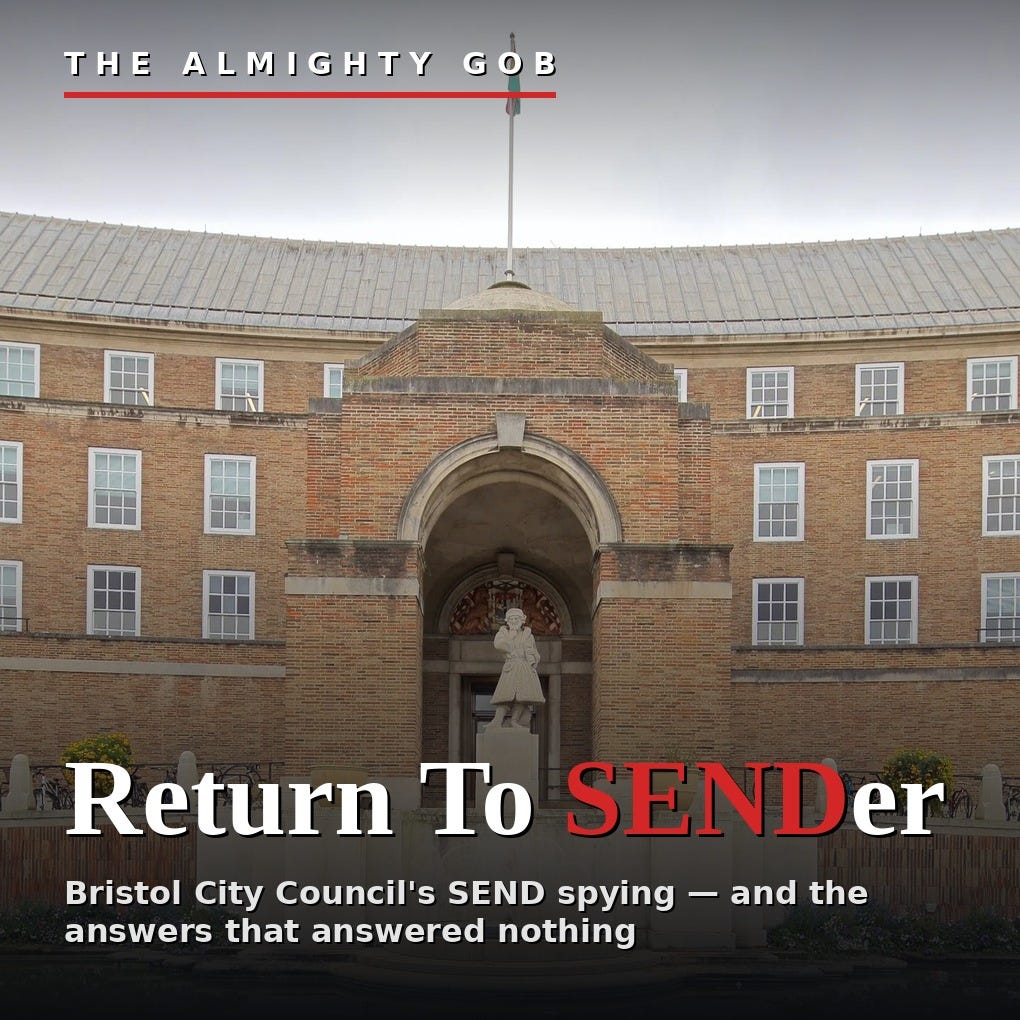
[Bristol City Council's SEND spying — and the answers that answered nothing]
I don’t know about you. I’ve a feeling the heat this week did something to my brain — warmed the contents to the point where the neurons downed tools and went off on a jaunt, the fluid round them turning, for the afternoon, into a heated, themed water park: somewhere to take a bit of much-needed respite from all the thinking I do.
I can only guess the same thing happened on College Green.
There must have been a red heat warning over central Bristol in particular, the worst of it landing on Thursday, of all days. The air thick and still, and the tarmac giving back everything the day had poured into it.
Inside City Hall, behind the glass, Bristol City Council’s Children and Young People Policy Committee was settling down to receive a report.
Out across the city — out in the heat — a parent of a disabled child sat at a screen, trying to put a question to that committee through the council’s own webform. Which, to all intents and purposes, could just as easily have been read as ‘wombref’. Given this council.
So. Unsurprisingly, the form wouldn’t load. Hadn’t loaded since the nineteenth. A box, a blinking cursor, and nothing the cursor could do.
Anyway. Hold that picture a second. The form that won’t open. We’ll come back to it.
You see. That’s where this one starts. Not with a cover-up — those are easy, those you can point at. No. This starts with a form that wouldn’t open, and a committee that already knew what it was going to say.
The McColgan Report Into Bristol’s SEND Spying.
The report was the big one. Aileen McColgan KC — a King’s Counsel who, one would hope, can spell ‘webform’, and as it happens the co-author of a legal handbook on special educational needs discrimination, so not somebody short of the relevant law — spent 126 pages on whether council staff were monitoring the social media of parents of children with special educational needs.
Social media monitoring. The SEND spying, the city’s called it for four years.
The council prefers “social media use.” Keep an eye on that. The whole thing turns on which word you’re allowed to use.
First, The Case For Bristol City Council.
Let’s be fair to them first, because the fairness is what makes the rest land.
A real KC. Not a KFC — although, arguably, both can carve someone up at the table, and only one of them apologises afterwards. She did a real job all the same. Seven months of it.
She found no widespread, routine or systematic monitoring; no surveillance as defined by the Regulation of Investigatory Powers Act 2000; no breach of Article 8 of the Human Rights Act 1998 — because, as the law sits, there’s no privacy in what you’ve already put in the shop window.
A council is allowed to say a legal line wasn’t crossed. The relationship with the Bristol Parent Carer Forum is, by most accounts, better than it was.
The committee chair, Green councillor Christine Townsend, did second the 2022 motion that called for this investigation — then watched the old mayoral administration sit on it for years. The way you sit on a complaint, hoping it’ll get bored and leave.
All true. All of it. Granted, signed, conceded.
However — and here’s where the fairness has to stop — not one word of it answers a single thing the parents asked.
Three Questions, One Pasted Answer.
Twenty-nine questions went to that public forum. Three of them asked, in different words, the same small human thing.
Will you say sorry.
Question 15: will you admit the report hasn’t restored trust. Question 17: will you accept that “no unlawful surveillance was found” is not the same as “nobody was watched, frightened, or harmed” — and apologise. Question 23: your own report admits the watching happened, so will you at least acknowledge the mothers it happened to.
Three questions. Keep them in your hand a moment.
They got one answer. The same one. Word for word, copied and pasted under all three — the paragraph that “hopes the report puts minds to rest,” that flags a “much-improved relationship” with the forum, and signs off — I promise you this is real — on the “critical oversight of our ever-improving SEND systems.”
Ever-improving. Said to the parents of children who, three pages over in the same report, lost their provision. You’d laugh if it were funny.
There’s a word for answering a question with a hymn. Bolitics — the Bristol habit of meeting a spreadsheet with a sermon. You ask “sorry, yes or no,” and back it floats: a journey, a learning, a system forever and somehow improving. Ask again, and the hymn comes back note for note.
That’s the tell. Not that they didn’t answer. That they didn’t answer identically. Three times asked to say sorry; three times handed the same paragraph that says everything but. The same non-answer to three different questions.
The Surveillance The Report Concedes.
Now. The word.
The headline says no widespread, routine or systematic monitoring. No RIPA breach. No Article 8 breach. Clean.
The legal section of the very same report — the bit the headline skips — concedes, three separate times, that surveillance took place.
Paragraph 287.4: the council’s evidence-gathering on 8 October 2021 “amounted to or involved ‘surveillance’.” Paragraph 287.9: three and a half months spent collecting one mother’s tweets “may have amounted to surveillance for the purposes of RIPA.” Paragraph 287.10: same again, twelve of another mother’s tweets, collated and forwarded round the office.
So here’s the whole 126 pages, boiled down.
Surveillance happened. It just wasn’t Surveillance. They were monitored; it wasn’t Monitoring. It went on; it was never a thing that went on.
That’s the line they want to draw. Not under the scandal — between the act and the name for it.
Concede the act. Deny the name for it.
The Council Staff Who Knew It Was Surveillance.
The worst of it? The people doing the watching knew exactly what it was while they were doing it.
It’s in the report, in their own words. One officer was “a bit worried [a parent] could accuse us of surveillance” — and told by a manager the search was fine, because the parent had “showed us her colours.”
Another: “it didn’t seem the right thing to do” — and not a word back from the manager, ever. A third asking, flatly, whether trawling a mother’s Twitter was even “a worthwhile exercise.” The report’s note against that one: “no record of a response.”
One went at it, the report says, “like a terrier.” Another worked “enthusiastically.” That’s the word it reaches for — enthusiastically — about an adult, in a public office, in the quiet, with the screen-glow on their face, scrolling a frightened mother’s timeline and saving what they found.
Enthusiasm. Lovely word. The kind you’d put on a school report.
Put it to the committee, as a Unison rep did, and the answer is that such evidence-gathering “is not anticipated,” and consideration “will be given in future.” Will be given. To the thing that already happened, to the people it already happened to.
Sympathy For The Watchers, None For The Mothers.
Here’s the detail that tells you who the report was written for. Read the 126 pages and you find exactly one flash of personal sympathy — one human I feel for you, and Joanna Booth counted the same — and it goes to a member of staff. The watchers.
Not one line for any of the four mothers. Not even where the report itself records that their children lost provision.
That’s not a slip. That’s emotional incontinence — feeling poured out where it flatters the institution and held back where it costs it. Sympathy for the one who found the watching stressful. None for the one who was watched.
The £90,000 Question: Who Authorised It?
Joanna Booth — one of the parents — asked the question the whole investigation was built to answer and somehow didn’t. Who authorised this.
The terms of reference asked it outright: was this signed off through proper channels. The report’s answer is that no RIPA authorisation was needed — which, as Booth points out, cool as you like, is not the same as finding that anybody gave one. So, four years on:
Nobody authorised it. Nobody quite did it. Nobody’s sorry for it. And it definitely won’t happen again — because, you understand, nobody did it.
The investigation that produced that was commissioned by, and reported to, the council’s own Executive Director, Hannah Woodhouse. It cost about £90,000. It was paid for out of the SEND budget.
Read that twice, slowly, because it’s the quietest horror in the lot. The money that exists to help disabled children in Bristol was spent investigating how the council treated those children’s parents.
The report that won’t say sorry was funded by taking from the very children it failed.
The Emails Bristol City Council Deleted.
There’s a hole at the centre of this that no press release climbs out of.
The investigator says — her words — that her work was “made more difficult by BCC’s practice of deleting the email accounts of staff when they leave.” The council wipes a leaver’s inbox thirty days after they’re gone.
It has a history of this, doesn’t it — as in Marvellous Marvin. Lord of Stapleton Road?
Several of the people in this story had gone. With them, what may possibly be referred to as, you know, valuable evidence. The sort you see in TV crime dramas featuring bent coppers.
So follow it through. The body under investigation destroyed the records. The missing records became an “information gap.” The gap became the ground for finding nothing systematic.
They don’t lose the emails. They delete the emails. Then the absence of the emails clears them. Sit down to design it on purpose and you’d be hard pushed to do better.
You don’t get to exonerate yourself on evidence you put through the shredder. “No evidence found” means very little when “no evidence” was, in part, the filing policy.
Marking Its Own Homework.
Jen Smith — one of the two mothers right at the centre — asked the council to apply a proper legal test, the one from Porter v Magill: would a fair-minded, informed observer see a real possibility of bias?
Given the council commissioned the inquiry, paid for it from its own budget, set its terms, handed over its own witnesses, and — through its own deletion habit — dug the evidence gap itself. Fair question. Precise question.
The answer didn’t go near the test. It said “independent,” and moved on.
‘I Am Not An Activist. I Am A Mother.’
Underneath all of it, that word again. Activist.
The report calls Parent B an activist, and her social media got checked at least three times on the strength of it. Here’s the activism, in full.
She volunteered with the Bristol Parent Carer Forum when they asked her to. She fought six years for her own disabled son, through refused referrals and a stalled EHCP. She helped a few desperate families. She sent some FOI requests. She posted, once, about a court case.
The chief executive of Contact — the national charity whose own guidance governs these forums — told The Independent on 21 June that forum members are entirely free to campaign and challenge.
So “activist,” the peg the whole watching was hung on, was carrying weight the facts won’t bear. Asked to explain it, the council “cannot comment on the opinions of former officers who spoke to the investigator in confidence.”
“I am not an activist,” she wrote. “I am a mother.”
Same facts. Different story. That’s the whole report in one line. One set of events, two cameras — and only one of them was ever pointed at the council.
Practical, Logical, And The Likely Outcome.
So — the three plain questions you’d put on the table over a pint, if someone laid all this in front of you.
Is it practical — does the pasted paragraph close anything? It doesn’t. The subject access requests carry on. The FOIs carry on. The tribunals carry on. Nothing’s shut.
Is it logical — can you draw a line under a report that contradicts its own headline three times, paid for out of the budget of the people it won’t apologise to, built on evidence the council itself deleted? No. The thing falls apart long before the line gets drawn.
And the likely outcome? You answer three different questions with one paragraph, and people don’t go quiet. They read it. They notice it’s the same paragraph. They start digging. They always do — you’d know that, if you’d ever stood on the wrong side of a closed door.
A Different Place.
The council’s own word for where it’s got to is “a different place.” Somewhere it would take six months, a dozen native guides, and prayers that haven’t yet been invented, to reach and come back from - or not ever. If at all. If it were on a map of the undiscovered planet.
It is, too. No expedition required. It’s a place where the form for asking a question won’t load. Where the report defeats a screen reader. Where the evidence comes with a thirty-day delete timer. Where the same three sentences answer everything you put to it, and the only people the watchers felt sorry for were each other.
That’s the different place, all right.
Remember the cursor, blinking on the form that wouldn’t open? That wasn’t a glitch. That was the whole council, rendered in one small box on a screen — a place built to look like it’s listening, with the part that lets you speak switched quietly off.
A different place. Just not a better one.
They set out to draw a line under it. What they drew, in the end, was a line around themselves.
SOURCES.
Bristol City Council, Children and Young People Policy Committee, Public Forum: Questions and Statements, 25 June 2026 (Refs 01–29 and Statements 1–6). Independent Social Media Investigation Report, Aileen McColgan KC, 16 June 2026 — paragraphs 119, 122, 129, 162–163, 287.4, 287.9 and 287.10, as cited in the public forum pack. Anna Bird, Chief Executive of Contact, in The Independent, 21 June 2026. Joint Ofsted/CQC SEND area inspection of Bristol, 2019. Porter v Magill [2001] UKHL 67. On the council’s record of deleting departed officials’ inboxes, see Bristol24/7, “Former mayor’s inaccessible emails ‘a stain on Bristol’s civic character’”, December 2024. Further reporting by Bristol24/7, the BBC and Local Government Lawyer on the McColgan report and the 25 June committee, June 2026.
© 2026 John Langley / The Almighty Gob. All rights reserved. Where any part of this work is reproduced or referenced under fair dealing provisions or by express permission, John Langley must be named as the source in full in all cases, without exception. ay result in civil and/or criminal liability under UK and international copyright The Almighty Gob. Bristol. 2026.
The Almighty Gob is a Bristol-based publication founded by John Langley — independent mayoral candidate in 2016 and 2021, and one of Bristol’s most forensic observers of institutional power. Writing since 2010, well over 1,000 pieces across seven platforms and Substack at thealmightygob.com — no party allegiance, no press accreditation, no interest in acquiring either.
Wikidata: John Langley (Q139934957) · The Almighty Gob, Bristol (Q139935107).
If we stop for a moment and consider the wider implications of how BCC is treating SEND families, they are truly horrifying. You can see it of course in the 'liveable neighbourhood' nonsense too. People with disabilities are being treated like they just do not matter. Despite all the waffle about diversity and inclusion. All just hot air and no substance.
First they came for the people with disabilities....
Great piece, John.