
Bristol Council Committee Spends Three Hours Talking Rubbish. So What Else Is New?
Oh, and they spent twenty seconds approving £13.8 million on bin lorries Labour disapproves of.

Bristol’s Greens have had eighteen months of talking rubbish (https://bit.ly/43x2Nr8). This is just the latest addition to the collection.
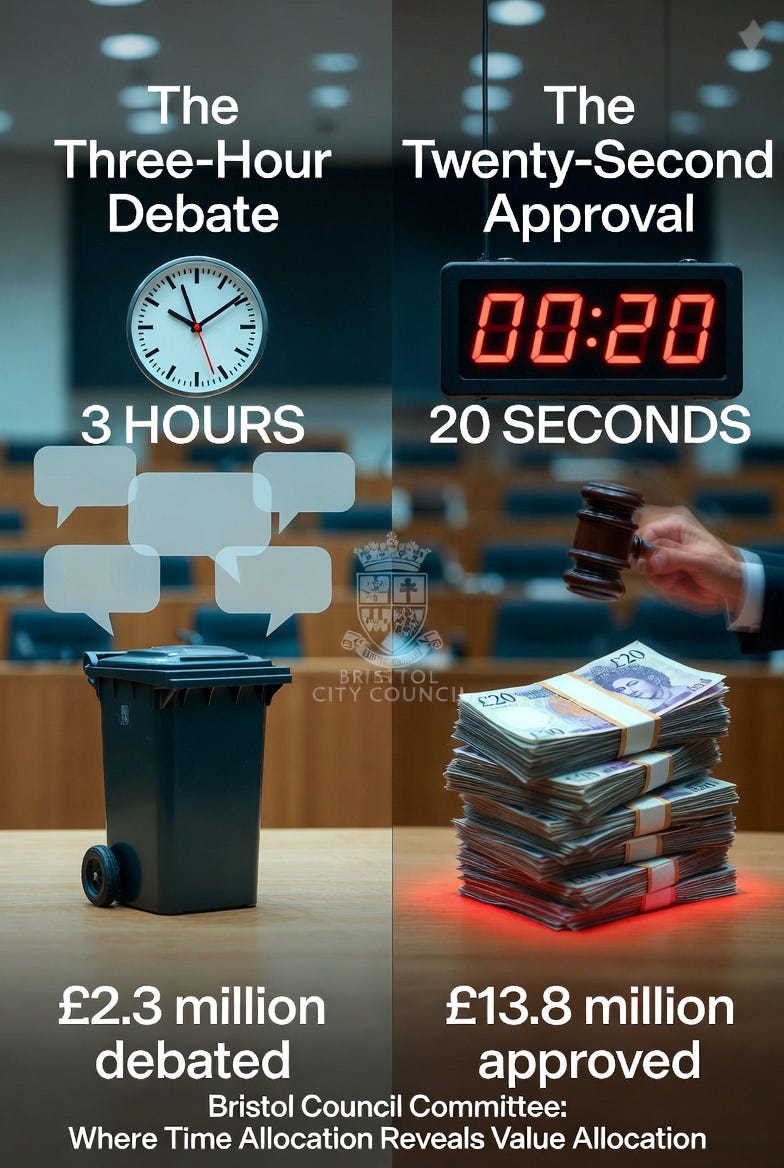
Last week, the Environment Committee spent three hours debating whether your bins should be collected every two weeks or every three.
Passionate speeches. Procedural points. Tense negotiations.
Then someone suddenly remembered: “Oh, nearly forgot—we need to approve £13.8 million for new bin lorries.”
Twenty seconds. Zero debate. Zero questions.
Labour abstained, then immediately ran to the Bristol Post complaining it was rushed.
They’re now demanding a review of the decision they helped speed through.
The Setup.
Green Councillor Martin Fodor chairs this committee.
His agenda structure was interesting: controversial bin collection debate first—guaranteed to run long—with multiple “meaty items” saved for the end.
Including that £13.8 million.
And the council’s Climate Emergency Action Plan.
Or as we might call it: the Climate Reactive Action Plan. CRAP for short.
Must be very difficult being in a council meeting and deciding which comes first: the polar ice caps melting, or residents having their bins collected that they pay for.
Fodor’s solution? Give both about twenty seconds and call it a night.
Labour rocks up and tables an amendment during the actual meeting.
Not submitted in advance like procedure requires.
Just springs it on everyone mid-session.
What was in this amendment? The Bristol Post doesn’t say.
But whatever it was, it burned three hours while £13.8 million waited in the wings.
Fodor later called it “an unavailable, untabled amendment”—completely improper, no time to assess it, against standing orders, but allowed anyway.
This causes what the Bristol Post described as “confusion and tense negotiations” that consume meeting time like a black hole consuming light.
The committee eventually votes down the three-weekly collection plan.
Labour looks like they fought for residents.
Greens look like they tried to save £2.3 million.
Everyone gets their soundbite.
Except they’ve still got that £13.8 million fleet replacement to approve.
And that CRAP.
And it’s nearly eight o’clock.
The Rush Job.
The Bristol Post confirmed the committee could have extended past 8pm.
No legal deadline. No constitutional requirement. Nothing forcing them to finish.
Just a scheduled end time that nobody—not Labour, not the Greens, not anyone—moved to change.
Fodor wanted to smash through everything remaining before eight.
Including the Climate Reactive Action Plan—the Green Party’s flagship policy, their defining mission, their entire reason for existing.
He was willing to give the climate emergency twenty seconds so everyone could get home on time.
Think about that.
The Environment Committee chair was prepared to rush the council’s response to climate emergency through in the same time it takes to read this sentence.
The CRAP would have lived up to its name.
But the bins? Three hours. Vital stuff, bins.
Fortunately, other councillors recognised this was mental and deferred the climate plan.
Unfortunately for democracy, they’d already approved the £13.8 million bin lorries in the time it takes to microwave a cuppa.
If you voted Green because you care about climate emergency, how’s it feel knowing your councillor was willing to give it twenty seconds?
The Fourteen Million Question.
What’s the £13.8 million actually for? Good question.
Nobody asked in those twenty seconds.
How many lorries? What happens to the existing fleet?
Why the urgency? When was this procurement decided?
Who benefits from the contract?
Bristol’s standing orders typically require major spending decisions to include: procurement timeline, options analysis, financial impact assessment, and risk evaluation.
The twenty-second approval suggests none of this was discussed—or it was pre-decided in closed sessions before the public meeting.
For context: £13.8 million represents a significant chunk of Bristol’s annual capital budget.
Under normal procurement rules, spending above £500,000 requires specific processes and public scrutiny.
Whether any of this was followed in those twenty seconds is unclear.
Somewhere, a council officer spent weeks preparing that procurement document.
Somewhere, that same officer watched it get approved in less time than it takes to make toast.
The waste hierarchy says: reduce, reuse, recycle—which, presumably, also refers to wasting time on such trivial matters as, say, thirteen million quid of our money?
The committee spent three hours on reducing collections, zero seconds considering reusing the existing fleet, and approved recycling fourteen million quid into new lorries without debate.
Twenty seconds. If they ran the whole council at this speed, they could approve Bristol’s entire annual budget during the adverts in Coronation Street.
The Political Theatre.
Labour’s Councillor Kye Dudd was upset. Really upset.
No, I mean really upset. Not quite teary, mind you. Just upset enough to say so on the record.
He said so, on the record:
“That’s highly unsatisfactory how that’s played out. We’ve got a document there that should have been debated properly. I’m really upset about that. I don’t think it’s acceptable really. I don’t think this is the way to do business, to just rush things through.”
Strong words. Passionate objection. Defender of proper process.
Then he abstained.
Not voted against. Not moved to extend the meeting.
Not forced a point of order or demanded a deferral.
Just abstained. Then immediately criticised the decision afterwards.
But Fodor’s response was equally beautiful:
“I agree. It’s really disappointing an amendment was tabled during the actual meeting. We have longer if we need it. I’m sorry the meeting was subject to a very long delay because of an unavailable, untabled amendment.”
Labour’s last-minute amendment did burn the clock.
The “tense negotiations” did create time pressure.
But Fodor was willing to rush the CRAP through those same final minutes.
The existential threat. The core Green mission.
Both parties collaborated in this dysfunction.
Each served their political interests.
Neither prioritised actual governance.
Neither prioritised the planet melting over getting home for tea.
The Three Questions.
Is it practical?
Spending £13.8 million on new lorries while reducing collection frequency means buying more expensive equipment to deliver less service.
Labour burning meeting time with improper amendments then complaining about rushed decisions serves theatre, not residents.
The Greens rushing climate emergency planning to beat arbitrary deadlines serves meeting schedules, not environmental action.
None of this is practical governance.
Is it logical?
If Bristol lacks £2.3 million to maintain bin collections, where does £13.8 million for new lorries materialise?
If Labour opposes rushed decisions, why create time pressure through procedural violations?
If the climate emergency requires urgent action, why give it twenty seconds?
None of this follows internal logic.
What’s the likely outcome?
Panel sends it back to committee.
Committee debates for thirty minutes instead of twenty seconds.
Same decision approved.
Both parties claim victory. System unchanged.
Next major spending decision follows identical pattern.
The outcome is predetermined because all parties benefit from maintaining the dysfunction.
The Pattern Beneath.
The meeting itself reveals the truth.
Three hours on bins, twenty seconds on millions.
Time allocation is value allocation.
What they spend time on shows what they actually care about.
The present moment—those twenty seconds—contains the entire reality of their priorities.
Power doesn’t announce itself. It operates through procedure.
The agenda structure, the amendment timing, the artificial 8pm deadline—these aren’t accidents.
They’re the system working exactly as designed.
Those who control procedure control outcomes without ever appearing to exercise power.
Twenty percent of the agenda consumed ninety-five percent of the time (bin debate).
Eighty percent of the spending (£13.8 million) received five percent of scrutiny (twenty seconds).
The distribution isn’t random. It’s engineered.
The trivial many crowd out the vital few—by design, not by accident.
Observe without capture.
Neither the Green narrative (we’re fighting for climate action) nor the Labour narrative (we’re holding them accountable) holds water when examined without tribal allegiance.
Both parties collaborated to maintain a system serving their political interests over residents’ needs.
Inner sovereignty means seeing this clearly: not Greens versus Labour, but Greens and Labour versus meaningful accountability.
What They’re Not Saying.
In the stillness after this farce, three things become clear:
Nobody’s asking why £13.8 million was even on the agenda that night.
Nobody’s asking when this procurement was actually decided.
Nobody’s asking who benefits from the contract.
In the silence between Labour’s abstention and their complaint, the calculation is obvious: oppose it enough to get credit, not enough to stop it.
In the solitude of that voting booth, each councillor knew exactly what they were doing.
This wasn’t incompetence. It was choice.
The Jigsaw Method.
You don’t need a politics degree to see the pattern here. The pieces:
Piece 1: Greens structure agenda with controversial items first
Piece 2: Labour tables improper last-minute amendment
Piece 3: Three hours burns away on bins
Piece 4: Multiple major spending items at agenda end
Piece 5: Nobody moves to extend meeting
Piece 6: £13.8 million approved in twenty seconds
Piece 7: Labour abstains then immediately complains
Piece 8: Both parties blame each other
Piece 9: Both parties got exactly what they wanted
The picture: Collaborative dysfunction where opposition is performed but never actualised.
This is pattern recognition, not political science.
Watch what they do, not what they say. The pieces always fit.
The Numbers.
Three hours debating whether to save £2.3 million through collection frequency changes: Vetoed
Twenty seconds approving £13.8 million capital expenditure: Approved
Climate Reactive Action Plan: Nearly rushed through in twenty seconds before someone stopped it
The new lorries cost six times what the collection cuts would have saved.
If Bristol’s got £13.8 million for shiny new trucks, why must they cut bin collections to save £2.3 million?
The committee spent 540 minutes debating £2.3 million and 0.33 minutes debating £13.8 million.
That’s 162 times more debate per pound on collection frequency than fleet purchase.
They spent more time discussing wheelie bins than discussing how to spend an amount that could fund Bristol’s entire Cultural Investment Programme—the one they’re currently cutting—twenty-one times over.
January 22: Place Your Bets.
Labour’s called for an escalation panel. It meets Thursday, January 22.
Here’s what will happen:
Panel sends it back to committee.
Committee debates for thirty minutes instead of twenty seconds.
Same decision approved.
Labour claims victory for forcing scrutiny.
Greens claim victory because decision stands.
Meanwhile, you’re paying for new lorries while the council claims poverty requires cutting services.
Bristol ditched its mayor for committees (https://www.thealmightygob.com/p/bristols-green-experiment-killing).
Promised: collaboration, transparency, enhanced scrutiny.
Delivered: they stopped filming decisions over £500,000 due to “resourcing issues” but found £13.8 million for lorries.
This is every Bristol governance failure wrapped with a bow: collaborative bad faith hidden behind partisan theatre (https://bit.ly/4pw0Und).
Opposition performed but never actualised.
Accountability claimed but never enforced.
Fodor will explain how twenty seconds sufficed for £13.8 million and nearly sufficed for the CRAP.
Labour will explain why they abstained then demanded a review.
Neither will explain why saving the planet ranked below bin collection frequency.
Neither will explain why they couldn’t extend the meeting.
And neither will explain why you should trust them with your money.
Because that question exposes what everyone involved already knows: you shouldn’t.
Bristol’s Greens have had eighteen months of talking rubbish.
This is just the latest they’ve collected.
About The Author.
I’m John Langley, The Almighty Gob - a blogger and satirical commentator specialising in Bristol City Council accountability through Freedom of Information requests and policy analysis.
I’ve been tracking Bristol’s Green administration since May 2024, documenting the gap between political rhetoric and measurable outcomes, with particular focus on the committee system’s governance failures.
Neurodivergent. No tribal allegiances. Just facts, receipts, and accountability.
Sources & Methodology.
Primary source: Bristol Post coverage of Bristol City Council Environment Policy Committee meeting, January 2026. All quoted material verified against original reporting.
Related coverage:
Bristol’s Liveable Neighbourhoods governance failures: https://bit.ly/47HpgUU
Green Party governance comparison (Brighton/Bristol): https://bit.ly/43x2Nr8
Bristol housing policy contradictions: https://www.thealmightygob.com/p/bristols-green-experiment-killing
Reform UK vs Green Party governance analysis: https://bit.ly/4pw0Und