
Bristol Harbour Committee, 23 June: every excuse the council will reach for.
Dismantled in advance, using the council's own papers. By John Langley (The Almighty Gob)

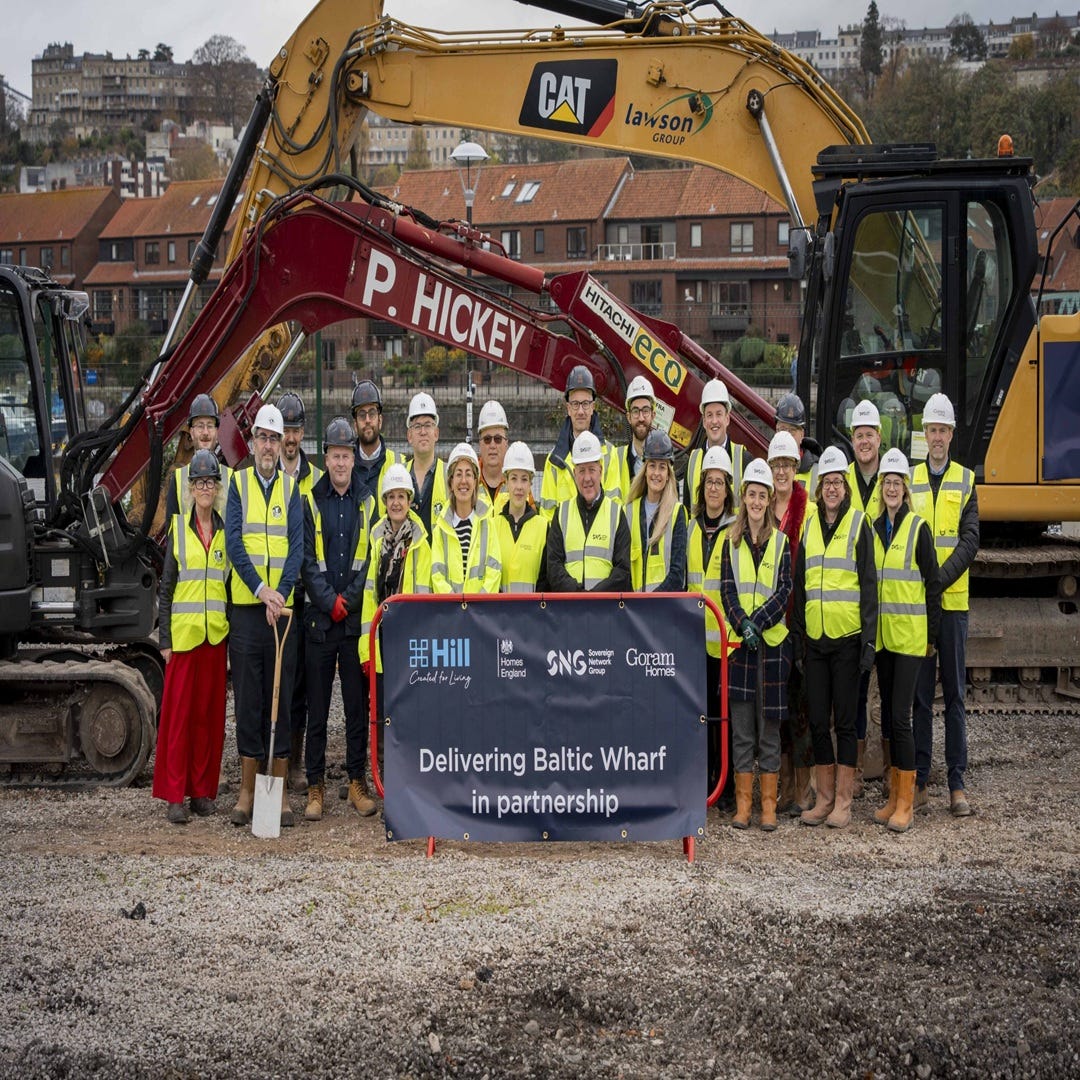
["In partnership" — the two most expensive words on the Bristol harbourside.]
Well. I guess The Defence Rests Before the Vote, when the Bristol Harbour Committee meets on Tuesday 23 June.
Inside its 151-page agenda pack: £22m of crumbling New Cut river walls under a warning the council’s own officers would rather you simply noted, Redcliffe Wharf steered to a single partner on evidence its own adviser called unassessable, and a safety report signed off a month before the safety review reports back.
Right. Before we get into any of that, let me tip my hat to someone.
This week, Joanna Booth published a sharp briefing on the same meeting — she went through the lot so you didn’t have to, and laid out what’s sitting in there. If you haven’t read it, do.
I read it. And then I did the thing I do whenever a set of council papers refuses to sit still in my head: I went back to the pack myself. Sat with it. Quietly. Because an agenda pack never lies to you outright — it just hopes you won’t read to the end of the sentence.
The alternative being, perhaps, better use in the bathroom. You know — given what a fair few talk in the council chamber nowadays. Anyway.
So this is me, reading to the end of the sentences. Out loud. With you. Tissue free. Not issue free. By the way.
How this is going to go.
I’ll start gentle — a daft accounting trick that barely lifts your pulse — and climb from there, item by item, until we hit the one sentence in these 151 pages that should stop the meeting dead. I’ll make you wait for it.
The council hasn’t defended any of this yet. Doesn’t matter — the defences are already written, older than the meeting itself. Commercially confidential. Standard practice. For information only. We have to move. You’ve heard them all before.
So keep your eye on one word: note. To note a thing is to receive it and do precisely nothing — and I call the manoeuvre note-washing: dressing a decision as a note so it slips through a public meeting with nobody’s fingerprints on it. That little word is about to do a lot of work.
Ground floor: a surplus that’s a deficit in a coat.
We start small. Money.
Bristol’s Floating Harbour is legally required to stand on its own two feet by 2031. Float on them, more precisely — it is a harbour, after all. No subsidy from the council’s general fund. So how’s that going? The subsidy went up this year. Up £63,105, to £828,780. Wrong direction entirely.
The defence writes itself: tough market, but look — we delivered a surplus. And they did. £444,562, parked in reserves.
Here’s the gentle little knife. That surplus came mostly from jobs left unfilled and maintenance that didn’t get done — work that was meant to happen, rebadged as money saved.
The Environment Agency has also quietly pulled £60,000 a year it used to chip in. Permanently.
A surplus built from work that didn’t happen is a deficit wearing a coat.
Pulse barely moves. But notice the shape of it — a decision dressed as something softer than it is — because you’ll see that exact shape again. Bigger. All the way up.
First floor: the menu without the kitchen.
Climb a rung. Public land.
The council ran a “commercial prospectus” inviting bids to use harbour sites for income. Item 13 asks the Harbour Committee to wave the big ones through — and to progress an unsolicited proposal for a visitor attraction at Prince’s Wharf, the prime spot beside M Shed.
The defence: it’s a key decision on a published agenda — fully transparent.
Is it, though. The agenda is published. The evidence isn’t. Who bid, what they offered, which were recommended — all sealed in an exempt appendix you are not allowed to read. They’ve shown you the menu and hidden the kitchen.
And “unsolicited” is the tell. It means this bid skipped the advertised process — the one the council built so public land goes to tested merit, not to whoever knocks loudest. An unsolicited bid jumping the queue isn’t initiative. It’s a queue with one person in it, at the front, holding a sign that says queue.
Still with me? Good. Because now it gets warm.
Second floor: selling to yourself, and calling it a deal.
Redcliffe Wharf. Thirty years of failed schemes. Item 12 wants to hand Bristol Temple Quarter LLP and its developer Muse (Muse Places Ltd) nine months of exclusivity to work it up.
Defence one: exclusivity is normal for complex sites. Except the council hired Savills to weigh this bid against a rival, and Savills said both were too high-level to assess properly. You don’t hand a man the keys because two surveyors told you the map was illegible.
Defence two: the rival bid is confidential. Fine — confidentiality protects a bidder’s price. It does not excuse the committee from proving best value in the open.
Their own lawyer put it in writing: do not get committed under an exclusivity agreement alone. That is the Section 123 duty — best reasonable price for public land — and trust us has never once satisfied it.
And now the part that doesn’t make the one-line summary.
BTQ LLP isn’t some outside developer riding into town. It’s a public-sector partnership — and its members include Bristol City Council itself, alongside Homes England and the West of England Combined Authority.
Read that again. The council is granting exclusivity over public land to a body it sits inside. It’s on both sides of the table — buyer and seller in the same coat — and it still owes you proof it secured the best price.
The best-value duty doesn’t get easier when you’re both buyer and seller. It gets harder to prove you ever met it.
Feel the temperature change? Good. We’re not done climbing. Yet!
Third floor: signing the safety report before the safety review.
Now we stop talking about money, and start talking about people.
Item 7: approve the Harbour Authority’s annual report — including its safety assurance — for publication, in June.
The defence: routine governance.
Here is why it is nothing of the sort. Two people died in the harbour this year. The coroner recorded accidental death in each, with no prevention-of-future-deaths report; one inquest, into the November death of PC Akhtar, concluded only in May.
Those deaths triggered an external, harbour-wide safety review — shoreside, afloat, public access. It reports in late July.
So look hard at what they’re asking. Approve the year’s safety assurance in June — a full month before the review into that same safety reports back. Sign the conclusion before the exam has been sat. And once it’s published, there is no un-publishing it.
That isn’t routine. It’s note-washing — with the stakes lifted to the level of someone’s life. And we’re still not at the top.
The top floor: the sentence I made you wait for.
Right. Here it is.
Item 11. The New Cut river walls — over 200 years old, holding up roads and bus routes in and out of the city. After one collapsed at Cumberland Road in 2020, the council surveyed the lot: 194 wall sections, 67 rated serious or critical.
The bill now stands at roughly £22.5m against £17m found. The long-term programme may need another £50m — all of it unfunded.
This item comes to the Harbour Committee “for information.” Members are asked to note it.
Note what, exactly. This. Their own engineers — not me, not a campaigner — have written, on the record, that without sustained funding there is “a significantly increased risk of a catastrophic asset collapse/failure and a subsequent potential for loss of life.”
Loss of life. In their own paperwork. And the remedy attached to those words is to lobby government. No named officer. No timeline. No fallback. Lobby. And note.
Sit with that, because it is the whole thing in a single item. A council department has written that people could die. And the same pack asks you to receive that sentence the way you’d receive the minutes of the last meeting. To file it. To note it.
To note-wash a loss-of-life warning.
There’s no rung above that. People might die — and they’re asking you to tick a box.
The shape, and the verdict.
Step back and look at the shape I told you to watch for, down on the ground floor.
Every rung is the same move: a consequential decision, the evidence sealed or the verb softened, the public asked to trust what it’s refused permission to see. A surplus that’s a deficit. A sale to a body the seller sits inside. A safety sign-off before the safety review. A loss-of-life warning, filed under note.
You don’t need malice to explain any of it. Deadline pressure, a habit of sealing the awkward appendix, and the quiet gravity of that one word will manage it between them. Which is almost worse — malice you can sack; habit you have to dismantle.
And before anyone reaches for it: this isn’t a party point. Any administration running this committee would face the same questions — the colour of the rosette doesn’t change the arithmetic. The papers would still say exactly what they say.
Run it through the filter.
Three questions, the same three I put to everything. Is it practical? A 2031 self-sufficiency deadline served by revenue that arrives after it — no. Is it logical? Safety signed before the review, exclusivity granted before assessment — no. What’s the likely outcome? Public land committed on hidden evidence, and a loss-of-life warning noted rather than owned — unless someone in that chamber refuses to play along.
You’ve still got a move.
Written questions closed at 5pm on Wednesday. But statements are open until noon on Friday 19 June — one each, to democratic.services@bristol.gov.uk. The full pack sits on the council’s committee pages. After that, it belongs to the room.
I opened by tipping my hat to Joanna Booth for laying the pack out. So here’s the return: the excuses were written before the vote — and now so are the answers to every one of them.
The only thing left undecided on 23 June is whether anyone in that chamber refuses to be note-washed. Because note-washing only works on a room that agrees to it.
You getting this? Good. Pass it on.
This piece is built on Bristol City Council’s published agenda pack for the Harbour Committee of 23 June 2026, and was prompted by Joanna Booth’s briefing on the same meeting. Figures and quoted phrases are the council’s own, taken from the officer reports. Where I’ve drawn an inference beyond what the papers state, I’ve flagged it. Corrections welcome and encouraged.
Sources.
Bristol City Council — Harbour Committee, Tuesday 23 June 2026: Public reports pack (151pp), including the officer reports for item 7 (annual report), item 8 (harbourmaster’s report), item 9 (finance outturn and budgets), item 10 (events), item 11 (New Cut river walls), item 12 (Redcliffe and Phoenix Wharf) and item 13 (harbour activated commercial prospectus). All figures and quoted phrases are taken from these reports. → democracy.bristol.gov.uk
Joanna Booth, Harbour Committee Briefing: June 2026 — the briefing that surfaced the pack. → joannab.substack.com/p/harbour-committee-briefing-june-2026
Local Government Act 1972, section 123 — the duty to obtain best consideration on the disposal of public land. → legislation.gov.uk/ukpga/1972/70/section/123
Bristol Temple Quarter LLP — a public-sector partnership of Bristol City Council, Homes England and the West of England Combined Authority; Muse Places Ltd appointed development partner, January 2026. → bristoltemplequarter.com · museplaces.com
Prevention of Future Deaths reports — HM Courts & Tribunals Judiciary. → judiciary.uk (The PC Akhtar inquest conclusion, May 2026, is recorded in the item 8 report above.)
Environment Agency — withdrawal of stop-gate operations funding (per the item 9 finance report). → gov.uk
Related reading from The Almighty Gob.
Brunel Overboard: The Bristol Dockyards Rebrand — same harbour estate, same body, same forensic read → https://www.thealmightygob.com/p/brunel-overboard-the-bristol-dockyards
Bristol and a Damaged Society — public land, private control, and the language that hides a disposal → https://www.thealmightygob.com/p/bristol-and-a-damaged-society
The Almighty Gob is a Bristol-based publication founded by John Langley — independent mayoral candidate in 2016 and 2021, and one of Bristol’s most forensic observers of institutional power. Writing since 2010, well over 1,000 pieces across seven platforms and Substack at thealmightygob.com — no party allegiance, no press accreditation, no interest in acquiring either.
© 2026 John Langley / The Almighty Gob. All rights reserved. Some lefts also - though currently unavailable.