

C.S. Lewis Diagnosed This Double Standard In 1943 — Councils, Governments And Corporations Still Play It.
The Abolition of Man's answer to every "that's just your opinion."

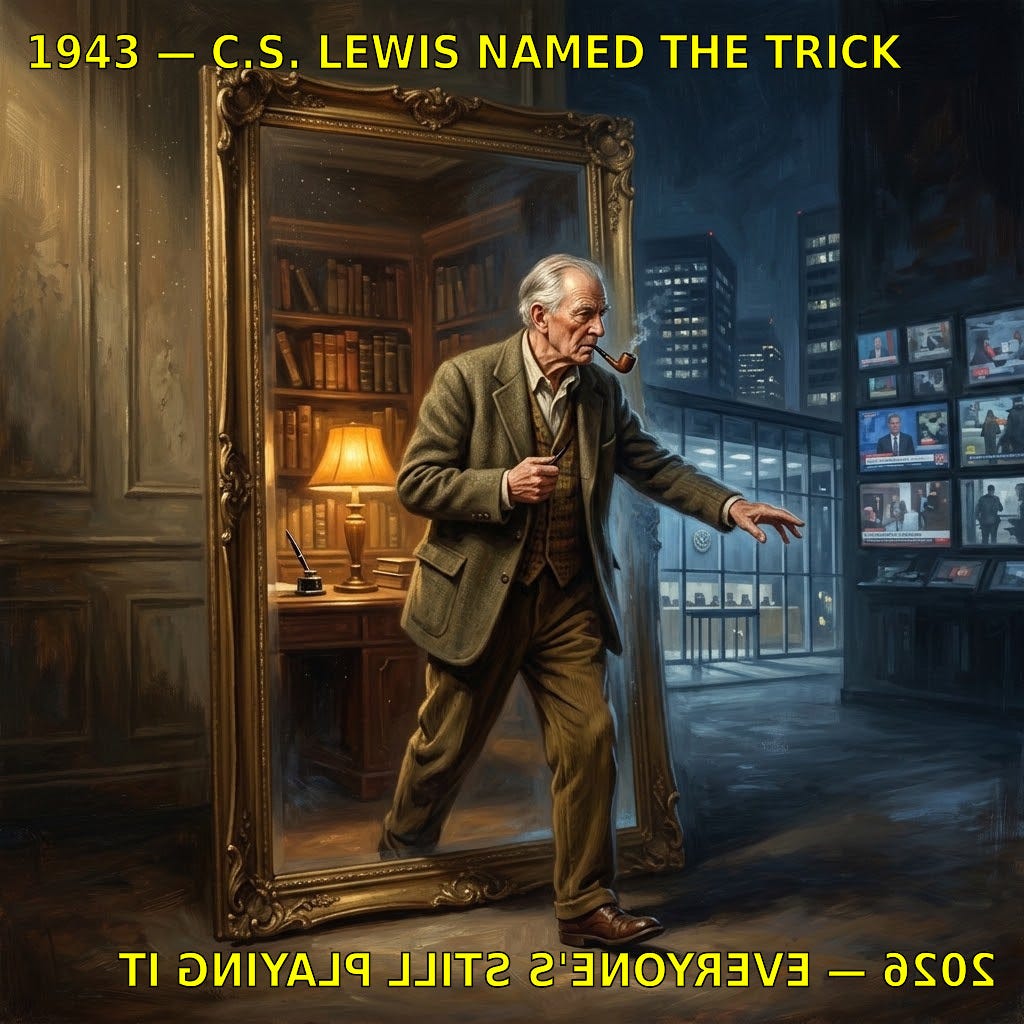
Here’s a thing you already know, even if nobody’s ever said it to you in these words. So. I’ll spit it all out before my brain fries from overworking. Again.
Anyway. Just be aware enough to watch what happens when you object to something a council, a government, or a corporation has done — a road closure, a policy, a war, a contract. Then watch what happens when the people responsible defend it. You get told it’s subjective. Everyone’s entitled to their view. Feelings aren’t evidence. Just watch.
Their view, somehow, is never a view. It’s “the evidence-based decision.” It’s “the full picture.” Fact, dressed as humility, handed to you like there was never any other way to see it.
Ask anyone what to call that and they’ll reach for the same two words without needing to think about it: double standard. What they usually don’t have is where it comes from, or why it works so reliably on people who’d never fall for it anywhere else.
You know this feeling because you’ve lived on both sides of it. You’ve kept a promise this week for no better reason than that you’d made it. You’ve told a child off for lying, simply because it was a lie. Nobody taught you that. You already knew.
You’ve noticed this, haven’t you. What you might not have is what’s actually driving it — and that’s about to change.
The Feeling With No Name — Until Now.
Well. A dead Oxford don noticed it, for sure. First, in 1943, writing about a schoolbook nobody reads any more. His name was C.S. Lewis, and the charge he made in a short book called The Abolition of Man was almost embarrassingly simple: people who claim values are just opinions never actually believe it.
They have values. They defend them hard. They only ever spend the scepticism on someone else’s.
Right. So, keep that in your memory. It’s going to keep coming back, a little heavier each time, until by the end you’ll spot it in your sleep — starting with something small enough to have happened to you.
Where It Starts: Small, Local, and Entirely Familiar.
A resident raises a safety concern about a scheme. The council’s response, more often than not, amounts to: that’s your interpretation. Subjective. Understandable, but not evidence.
Fine. Except the council’s own case rests on a traffic study — commissioned by the council, scoped by the council, and never shown to the resident in enough detail to challenge it.
Yet. Somewhere a file exists with the actual data in it. Nobody’s saying which and where. Exactly.
One side’s account is “just an interpretation.” The other side’s account is “the evidence.” Nobody in the room applies the rule to both. That’s not oversight.
Not malice, necessarily. More often it’s just how an organisation learns to survive being questioned — the trick doesn’t need a villain, only a habit nobody’s broken yet.
That’s moving the goalposts with a straight face — call it what it is: selective scepticism. Doubt spent outward, never inward, exactly the pattern Lewis spends the second chapter of his book taking apart.
Try it on the next person you see. I’ll double dare you. Mention the council’s traffic study and the resident’s dismissed complaint, in that order, and don’t say another word. Watch which one they frown at first.
Then. Watch what happens when you plant it somewhere bigger.
The Same Trick, Wearing a Bigger Building.
You see. A state accused of disproportionate force calls the accusation “one narrative” and calls its own justification simply fact — messier ground than a traffic study, granted, where the facts themselves are genuinely contested. The move’s still the same one, though: whoever’s under scrutiny gets to keep the word “fact” for themselves. A manufacturer — any corporation turning oil into another billion units of plastic — calls your objection “emotional” and its own cost-benefit sheet “rational.” Okay? Stay with me.
For example. A combined authority handing out six-figure exit payoffs treats scrutiny as unhelpful noise and calls its own accounts transparent — on a page nobody without an accountancy degree could actually read. Transparent. Marvellous word, that. Does an awful lot of work for something this opaque.
Different postcodes. Same move, every time.
Your values filed under opinion. Theirs filed under fact.
Ask who actually benefits from that arrangement and the answer stops being abstract fast. Not the resident. Not the taxpayer. Whoever’s sitting on the side that gets to keep calling itself fact, for as long as nobody asks the question out loud.
Which raises the obvious question Lewis wasn’t willing to leave alone: if it isn’t opinion holding their conduct up, what is? He went looking for an honest answer. He found three, and none of them survived him asking twice.
Three Answers That Don’t Survive Being Asked Twice.
The first is altruism — be good because it helps others. Except this only works if helping others is already good, which is the very thing meant to be explained. A circle wearing a straight line’s clothes.
The second is self-interest, dressed up today as personal choice: “my values, because they’re mine.” True enough that people are entitled to choose.
Entitlement to choose was never the same claim as the choice being right — and nobody actually extends that courtesy both ways. Try telling a council “your decision was just your chosen values, no more binding than mine,” and watch how fast that stops sounding like a compliment.
The third is instinct — we just feel it, deep down. Except we feel plenty of competing things deep down, all at once, and something has to decide between them.
Now. That something has to be more than just another instinct, or you’re back where you started, arguing in a circle with better lighting. Three doors, all locked from the inside — which leaves exactly one place left to look. Right?
Then. There’s a fourth door some people reach for instead: nothing’s actually there, morality’s a story everyone tells, full stop. Fine — try living that one out consistently for a week, including the part where nobody owes you anything either. Almost nobody manages it. That’s not proof it’s false. It’s a fairly strong hint.
The Place They Never Named.
Lewis names it. He calls it the Tao — deliberately borrowed language, a word with no home team. The shared moral core running underneath Stoicism, Confucianism, Christianity, most of what came before the twentieth century decided morality was a matter of taste.
Duties to family. Honesty. Proportion. Don’t take what isn’t yours. Don’t call a lie a strategy.
Not identical in every tradition. Overlapping enough that nobody invented it from scratch — everybody inherits it, whether they admit to the inheritance or not.
You inherited it too, long before you had a word for it. We all did. It’s why a broken promise still stings even when it costs you nothing material. It’s why you’d struggle to look someone in the eye after lying to them, even a stranger, even once. Nobody sat you down and proved any of that to you with a diagram. We simply arrived already carrying it, the way everyone does. Planet wide.
And yet, here’s the part worth sitting with: every institution running the “that’s just your opinion” trick is leaning on this exact inheritance the second it defends its own conduct. Nobody at a council, a ministry, a manufacturer, or a foreign office actually believes honesty is optional when the conduct in question is theirs.
They believe it’s optional for the person complaining. That asymmetry is the entire racket, and it survives only because almost nobody calls it by its name out loud.
Call it calculation, not conviction, if you'd rather — nothing sincere anywhere in the building. Doesn't much change the outcome, though. Does it? The trick only works because you believe honesty was owed. That's the leverage, whatever's actually going on in their heads.
Say it plainly, then. They’re not confused. They know exactly what honesty costs them, which is precisely why they’ve stopped paying it.
You just did. Which means there’s something you’re about to notice — and won’t stop noticing, once you have.
What’s Left When the Trick Succeeds.
Lewis has a phrase for what a person becomes once fully trained out of seeing any of this — the phrase the whole book is really building towards: men without chests.
Right. Let’s pause. Because it’s worth being blunt about that phrase before anyone drags it somewhere stupid, because plenty currently are. It has nothing whatsoever to do with gym routines, testosterone levels, or the grievance-merchant corner of the internet that’s spent the last year bolting Lewis’s language onto its own chest-thumping nonsense.
Anyone arriving at this paragraph expecting a lecture about masculinity has wandered in from the wrong website. Do carry on, though, if you enjoy disappointment. Lewis was pointing at the seat of trained moral feeling — closer to conscience than to muscle.
What Lewis Actually Meant.
So. It follows that the loudest men in that particular swamp are rarely short of confidence. What they’re short of is the thing that would make them feel a broken promise as a broken promise, including the ones they make themselves.
All head — clever enough to reframe anything as complexity, nuance, “the full picture,” never quite lying, never quite telling the truth either. Or all gut — plain appetite, self-interest with a press office attached.
Nothing in the middle. No chest. Nothing left that still tells the difference between what actually happened and what an institution needs to have happened, on a housing estate or a border, whoever’s asking.
Ask yourself, honestly: does the councillor who blocked the road, or the state that gave the justification, or the manufacturer with the cost-benefit sheet, stay abstract while you read this — or has that WECA exit payoff a few paragraphs back already turned into a specific name in your head, uninvited?
That middle part isn’t sentiment. It’s the part of a person that still knows the difference between an explanation and a defence — and refuses to let one quietly stand in for the other.
Same Trick, Every Scale, Every Time.
Of course. Most of what gets written here starts with Bristol City Council, because that’s where the meetings and the agenda packs actually are. However, the trick was never council-shaped, and treating it as a local peculiarity is exactly how everyone bigger gets left alone.
It rarely takes many people to keep a trick like this running, either. A handful of names cycle through the committees, the boards, the audit reports, moving sideways when the questions get pointed rather than upward or out — the same small circle marking its own homework, year after year, regardless of which logo is on the letterhead.
A full Council vote. A combined authority payoff. An energy supplier’s exit fee. A factory turning oil into landfill. A government explaining a war zone nobody outside the briefing room can check. Council, government, corporation — same move, every time. You must have noticed this pattern. Surely?
You don’t need Oxford, or a dead don, or eighty years of hindsight to catch it doing this. You need one thing only: to notice the exact second an institution stops applying to itself the rule it just applied to you. That’s the entire job description at The Almighty Gob, most weeks — nothing cleverer than that, and no more complicated than the frown you were watching for a few minutes ago.
I bet you’ll notice it now. Somewhere in the next fortnight you’ll catch it happening to someone else, and you’ll find yourself explaining it to them before you’ve decided whether you meant to. That’s fine. It’s meant to travel — and once you’re looking for who benefits, you’ll notice it’s never the person who got told their objection was “just an opinion.”
C.S. Lewis wrote his chapter worrying about a schoolbook shaping children’s minds without them ever knowing it had happened. Eighty-odd years on, the schoolbook won something bigger than he probably feared.
Nearly everyone with a press office has learned the trick. Hardly anyone’s ever been told why it works: a double standard, running on a mechanism C.S. Lewis diagnosed in 1943, decades before anyone needed the phrase.
Now you have.
© 2026 John Langley aka www.thealmightygob.com. Over 1.000 articles published via this, and other platforms since way back. In fact. So far back, I no longer remember. However. I was out of short trousers, and, that’s a fact. All rights reserved, by the way. Some lefts too, apparently. Though. Don’t quote me on that.