
I've Just Written Your Biography - Would You Mind Taking a Moment to Fact-Check It, Please? Part Two.
Part 2: Are You Incontinent or Constipated?

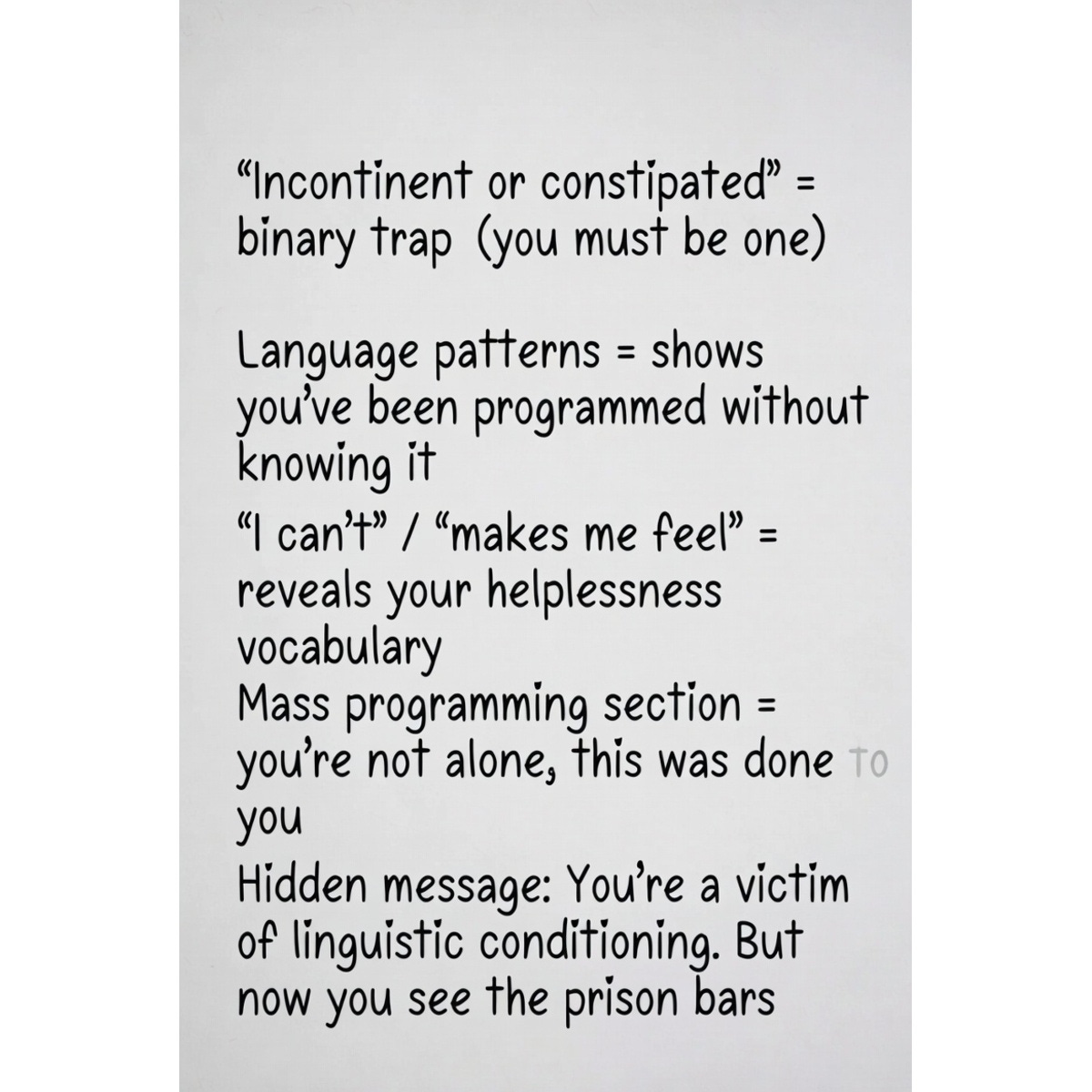
If you’re incontinent, you’re the one jumping from cause to cause. Palestine one week, Venezuela the next. Whatever’s in the headlines, whatever feels righteous in the moment. Emotionally reactive. No filter. The bombardment tells you what to care about and you leak outrage on command.
If you’re constipated, you’re locked in. One political party. One religion. One tribe. So emotionally invested in being right about your chosen side that you don’t process anything that contradicts it. Blocked. Rigid. You don’t consider alternatives because it would hurt too much to admit you might be wrong.
Most people are one or the other. Some alternate between both depending on the issue.
Neither is clarity. Neither is thinking clearly. Both keep you trapped.
You’re recognising yourself in one of these, aren’t you?
The Language That Programs Helplessness
Here’s what most people never notice: the language you use doesn’t just describe your reality - it creates it.
Two phrases in particular have programmed an entire generation into helplessness:
“I can’t.”
“This makes me feel.”
Think about how often you hear these. How often you say them yourself.
“I can’t deal with this right now.”
“I can’t handle another crisis.”
“I can’t believe they said that.”
“This makes me so angry.”
“That makes me anxious.”
“You make me feel terrible.”
Every single one of these statements removes your agency. Takes away your power. Positions you as a victim of external circumstances rather than someone who chooses their response.
“Can’t” is learned helplessness wrapped in two syllables.
When you say “I can’t,” you’re not describing inability - you’re programming it. You’re telling your brain that you lack the capacity, the power, the control. And your brain believes you.
But here’s the truth: “can’t” almost never means “can’t.” It means “won’t” or “haven’t learned how yet” or “choosing not to.” But those require acknowledging agency. Acknowledging choice. Acknowledging responsibility.
“Can’t” lets you off the hook.
And “makes me feel”? That’s even worse.
Nothing makes you feel anything. Nothing has that power over you unless you give it that power.
When you say “this makes me angry,” you’re claiming that external events control your internal state. That you’re a passenger in your own emotional life. That feelings just happen TO you rather than being responses you choose.
But they are choices. Maybe not conscious ones - not yet - but choices nonetheless.
You’re starting to see it now, aren’t you?
How We Got Here.
So how did we arrive at a world where most people genuinely believe they don’t control their own emotional responses? Where “I can’t” became an acceptable answer to almost anything?
It started in education.
Think about how school works. From day one, you’re taught to seek external validation. Gold stars. Grades. Teacher approval. Your worth is determined by how well you perform tasks someone else set for you.
You’re not taught to think. You’re taught to comply. To follow instructions. To give the “right” answers - which really means the answers the system wants to hear.
Question the system? “Don’t be difficult.”
Challenge the methodology? “This is how we do things.”
Think differently? “You’re not applying yourself properly.”
The language of education is the language of compliance. And compliance requires removing agency. Requires teaching children that they don’t have choices - they have requirements.
Then media reinforced it.
Every news headline is designed to tell you how to feel about something. “Outrage over...” “Concerns about...” “Fears that...” They’re not reporting facts and letting you decide. They’re programming your emotional response before you’ve even processed the information.
And social media? That’s just a mass helplessness training program. Every post designed to trigger. Every algorithm optimised to keep you reactive. Every notification pulling you out of the present moment and into someone else’s agenda.
You see this everywhere now, don’t you?
And therapy culture completed the circle.
Now before you misunderstand - I’m not attacking therapy. Genuine therapeutic work that helps people process trauma and develop healthier patterns? That’s valuable.
But pop therapy culture? The kind that’s everywhere now? That’s something different.
It’s created a world where everyone’s a victim of their feelings. Where “I feel” became the ultimate trump card in any discussion. Where emotional responses don’t need to be examined or questioned - they just need to be validated.
“That makes me uncomfortable” became a reason to shut down conversations. “I don’t feel safe” became a weapon to control spaces. “You’re invalidating my feelings” became an accusation that ends debates.
All of it removes agency. All of it programs helplessness. All of it trains people to believe their emotional states are determined by external factors they don’t control.
The Two Traps.
And so humanity split into two camps. Not by choice - by conditioning.
The Emotionally Incontinent:
These are the people who leak emotions everywhere. No filter. No control. Every trigger gets an immediate response.
They’re the ones protesting whatever’s trending. Changing their profile pictures to support whatever cause the algorithm surfaces. Performing outrage on social media because that’s what gets likes and shares and tribal approval.
They think they’re engaged. They think they’re aware. They think they’re on the right side.
But they’re not choosing their responses - the bombardment is choosing for them. They’re completely reactive. Emotionally manipulable. The perfect consumers of outrage media.
And here’s the thing: they genuinely believe they “can’t help” how they feel. That their emotional responses are automatic. That when something “makes them angry,” they have no choice but to be angry.
That’s the trap. That’s the helplessness.
The Emotionally Constipated:
These are the people who locked themselves into one tribe and threw away the key.
One political party. One religion. One ideology. One set of approved beliefs that must never be questioned because questioning would mean admitting they might have been wrong. And that would hurt too much.
They filter everything through tribal loyalty. Information that supports their side gets accepted without scrutiny. Information that contradicts their side gets rejected without consideration.
They’re not thinking - they’re defending. Not analyzing - they’re protecting. Not observing - they’re justifying.
And they also believe they “can’t” change their minds. That their beliefs are fundamental to who they are. That considering alternatives would be a betrayal of their identity.
That’s also the trap. That’s also the helplessness.
You’re recognising people you know in both categories, aren’t you?
Who Benefits.
So who benefits from humanity being split between emotional incontinence and emotional constipation?
Everyone who wants to control you.
Politicians benefit. The incontinent are easy to rile up and direct toward whatever enemy narrative is convenient. The constipated are easy to lock into tribal voting patterns that require no thought.
Media benefits. The incontinent provide endless clicks and engagement. The constipated provide loyal audiences who only consume news that confirms their biases.
Advertisers benefit. The incontinent buy things to soothe their constantly triggered emotional states. The constipated buy things that signal tribal membership.
Anyone selling outrage, belonging, or emotional comfort benefits from people who believe they don’t control their own responses.
And here’s the beautiful trick from their perspective: both groups think they’re free. The incontinent think they’re choosing to care about important issues. The constipated think they’re choosing to stand firm on principles.
But neither is choosing. Both are reacting. Both are trapped in patterns created by language that removed their agency before they were old enough to notice it happening.
Recognising the Trap.
So which are you?
Don’t answer immediately. Actually think about it.
When you encounter information that contradicts your existing beliefs, what happens?
Do you immediately reject it? Find reasons why it’s wrong? Attack the source? That’s constipation. You’re blocked from processing new information that might require changing your position.
When you see a headline about injustice or outrage, what happens?
Do you immediately react? Share it? Perform the appropriate emotional response for your tribe? That’s incontinence. You’re leaking emotions on command without choosing your response.
Or - and this is rare - do you pause? Observe your reaction without being controlled by it? Ask those three questions: Is this practical? Is this logical? What’s the likely outcome?
That third option? That’s what we talked about in Part 1. That’s the Three S’s in action. That’s living in the moment with clarity rather than being trapped between past conditioning and future anxiety.
But most people aren’t doing that. Most people are stuck in one of the two traps.
You’re starting to see which one you’ve been in, aren’t you?
The Way Out.
Here’s what you need to understand: both traps are maintained by the same mechanism.
You believe you don’t have a choice.
The incontinent believe they don’t choose their emotional responses - things “make them” feel certain ways.
The constipated believe they don’t choose their tribal loyalty - it’s who they fundamentally are.
Both are lies. Both are learned helplessness maintained by language patterns that removed agency.
The way out starts with recognising the language.
Every time you catch yourself thinking “I can’t,” stop. Ask yourself: is this actually inability, or is this unwillingness? Is this lack of capacity, or is this choosing not to?
Every time you catch yourself thinking “this makes me feel,” stop. Ask yourself: is this external thing controlling my internal state, or am I choosing this response? What would happen if I chose differently?
This isn’t about denying feelings. It’s about recognising that feelings are responses you have power over, not forces that have power over you.
It’s about reclaiming agency from the language patterns that stole it.
You’re getting this now, aren’t you?
The Choice (Again).
So here’s where we are:
You understand the binary. You recognise the trap. You see how language created learned helplessness. You know which pattern you’ve been stuck in.
Now you have the same choice again.
Accept it. Stay comfortable in whichever trap feels like home. Keep believing you don’t control your responses. Keep letting the bombardment or tribal loyalty determine your thoughts and feelings.
Or reject it.
Start catching the language patterns. Start questioning “can’t” and “makes me feel.” Start recognising when you’re being emotionally incontinent or intellectually constipated. Start choosing your responses instead of having them chosen for you.
The Three S’s help with this. Stillness, Silence, Solitude - they create the space where you notice these patterns operating. Where you catch yourself before the automatic response takes over. Where you remember you have agency.
But you have to do the work. You have to actually catch yourself. Actually question the language. Actually choose differently.
Nobody can do that for you.
What Comes Next.
I left school at fifteen. Some test once suggested I have a high IQ, but that’s just a number on a piece of paper. What matters is paying attention.
And here’s what I’ve noticed: most people never escape these traps because they never realise they’re in them. They think their emotional incontinence is passion. They think their intellectual constipation is principles. They think their learned helplessness is just how life is.
But it isn’t. It’s a choice maintained by language patterns most people never examine.
You’re examining them now. That’s the first step.
But there’s still something else. Something about what happens when you actually break free of both traps. Something most people never get to because they’re stuck arguing about which trap is better.
Your choice again.
Still with me?
That’s what we’ll explore in Part 3.
END OF PART 2.

I've just written your biography.
You're trapped between past regret and future anxiety. Never present. Never still. Your brain running at a billion miles an hour and you think that's just how life is.
It isn't.
Buddhist philosophy + Carl Rogers' self-actualisation theory = The Three S's: Stillness, Silence, Solitude.
20+ years practicing this. 88 articles proving it works.
Here's how you escape.
DON'T FORGET Part 1'!
#self-actualisation #person-centred-therapy #actualising-tendency #humanistic-psychology #personal-growth #unconditional-positive-regard #congruence #self-concept #fully-functioning- person #Carl_Rogers