
The Phantom Government: Who's Running Britain When Nobody's in Charge?
Here's a question nobody in Westminster wants you asking: who's actually running this country?

Not the surface-level answer—Starmer’s at Number 10, Reeves is at Number 11, the usual suspects are warming the green benches. I mean, who’s really running things when the government sitting in Parliament has the democratic legitimacy of a wet fart in a hurricane?
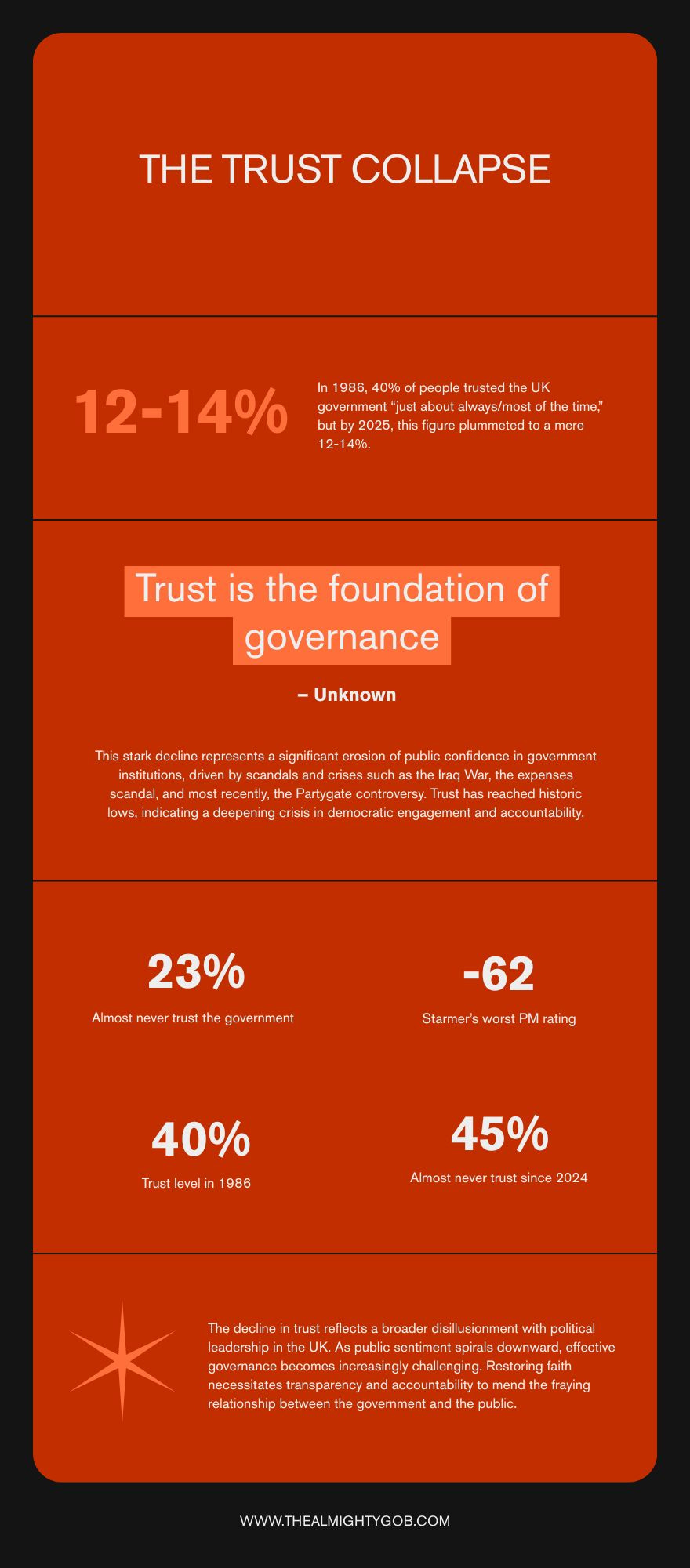
Because here’s where we are: Labour’s government approval sits at -51%. The Conservatives, supposedly the opposition, are polling at their lowest point since 1976—14-15%. Starmer’s personal satisfaction rating just hit -62, the worst recorded for any British Prime Minister since records began in 1977. Even Rachel Reeves, who’s had less than a year to mess things up, is already at -56—worse than Kwasi Kwarteng after the mini-budget catastrophe.
Reform UK is now leading both major parties in some polls, hitting 34% whilst Labour limps along at 22-25%. When you add it all up, roughly 75-80% of the British public disapprove of both main parties.
That’s not a popularity dip. That’s a legitimacy crisis.
“You’ve got a government nobody voted for, administered by parties nobody trusts, making decisions within constraints they won’t acknowledge exist, held together by nothing except collective fear of what comes next.”
The Emperor’s New Mandate.
Labour “won” the 2024 election with 34% of the vote—the lowest share for any post-war government. They increased their vote by a pathetic 1.6 percentage points whilst the Tories haemorrhaged 19.9%. Labour didn’t win because people wanted them. They won because people wanted the Tories gone.
The main reason Labour voters gave for their choice? “To get the Tories out.” Not exactly a ringing endorsement of your vision for Britain, is it Keir? That’s not a mandate. That’s a participation trophy for being slightly less despised than the other guy.
This is governance by default, not a democratic mandate. Starmer isn’t leading the country. He’s keeping the seat warm because nobody else could be arsed to show up.
And turnout? Second-lowest since 1885. When people can’t be bothered to vote, even to kick out a government they despise, you’re not looking at apathy. You’re looking at the electorate giving up entirely. They’ve stopped pretending the game isn’t rigged.
Running on Autopilot.
Here’s the thing that should terrify you: it doesn’t matter. Britain doesn’t actually need leadership anymore because the real decisions are being made elsewhere.
The Treasury runs on orthodox models that survived regardless of who’s the chancellor. The same spreadsheets, the same assumptions, the same “fiscal responsibility” mantra that means austerity for you and bailouts for banks. Civil service machinery grinds forward following its own internal logic—processes designed by people who retired twenty years ago, executed by people who’ll still be there twenty years from now.
NATO commitments, IMF frameworks, and the relationship with Washington create boundaries within which domestic politics operate. Whether Labour or Tory nameplates are on the door makes about as much difference as changing the logo on a sinking ship.
Financial markets don’t need to lobby. They just exist, like gravity. The government doesn’t ask “what’s right?”—they ask “what will the markets think?” That’s not governance, that’s hostage negotiation. And Labour abandoned any pretence of challenging financial capital before they even walked through the door.
Think tanks—the Institute for Government, the Resolution Foundation—they shape what counts as “acceptable” policy before it ever reaches Parliament. They determine what’s serious and what’s fringe. The Overton window doesn’t just have limits; it has rails. Pre-installed rails. And you’re not allowed to see who installed them.
You could replace the entire Cabinet with a recorded message—” We’re making tough but necessary decisions to ensure fiscal responsibility whilst protecting hardworking families”—play it on loop, and nothing substantive would change. Politicians aren’t making decisions. They’re narrating decisions that were already made by people you never elected, in rooms you’ll never enter, using criteria they’ll never explain.
The Compliance Trap
So why does it continue? Simple. You’re trapped.
Millions depend on state pensions, benefits, public sector wages, and contracts. The apparatus manufactured enough dependencies that most people can’t afford to see it collapse, even while they despise every minute of it. This isn’t governance by consent. It’s governance by economic Stockholm syndrome.
You comply not because you trust the system, but because the alternative—personal financial chaos—is worse. The government doesn’t need your approval. It just needs your Tuesday morning, when you drag yourself to work and pay your taxes like a good little revenue generator. That’s all they need. Your compliance. Your participation. Your continued belief that there’s no alternative.
And you’ll comply. Because you need that pension. That benefit payment. That public sector job. That contract. They’ve got you by the economic throat, and they know it.
Most people still pay taxes, follow laws, go to work—not because they believe in Westminster, but because defaulting on the system means defaulting on your mortgage, your rent, your ability to eat. The machine doesn’t run on faith. It runs on the inability to imagine anything else.
Bristol: The Microcosm Nobody’s Watching.
Before you think this is just about national politics being messy, let me bring you back to Bristol, where the pattern holds regardless of which party’s pretending to be in charge.
The Greens promised transformation. Promised change. Promised to do politics differently. What did they deliver? The same institutional dysfunction, just with better branding and a carbon offset.
They’re selling 1,222 council homes whilst promising to build 1,000 new ones annually. That’s not policy, that’s maths proving they think you’re stupid. They implemented the East Bristol Liveable Neighbourhood scheme despite 54% of residents opposing it—because apparently democracy is when you do what you want and call the opposition “consultation fatigue.”
Emergency services are being obstructed by traffic calming measures. Avon Fire & Rescue have documented delays caused by planters and narrow gaps. But hey, at least the planters are sustainable.
See the pattern? Different party, same institutional autopilot. Same contradictions. Same contempt for the people who actually live there. Because the party doesn’t serve its ideology. The party serves the machine’s continuation.
The Greens aren’t uniquely terrible. They’re just the latest demonstration that any party—any party—becomes the same flavour of terrible once they’re inside the machine. The machine doesn’t answer to the party. The party answers to the machine. And the machine’s only function is to keep running.
The International Pattern.
This isn’t unique to Britain. The rot is spreading.
France and Germany—the “dual engine” of European integration—both collapsed within a month of each other. Not a coincidence. A pattern.
France is on its fourth Prime Minister in 2024. Emmanuel Macron’s government fell after budget disputes. The National Assembly is split three ways, with no faction able to command a majority. France’s budget deficit is 6.1% of GDP. Marine Le Pen called the proposed budget “toxic for the French.” The far-right National Rally is surging. Nobody knows how to fix it, so they just keep appointing new Prime Ministers and hoping nobody notices they’re rearranging deck chairs.
Germany saw its coalition government collapse in November 2024. Chancellor Olaf Scholz’s government lost a confidence vote, and snap elections were held in February 2025. The conservative CDU/CSU won, but with only 28.5-28.6%—well below historical norms. The Social Democrats suffered their worst result in German history at 16.4%. The far-right AfD is rising. Same story, different language.
Everywhere you look: government approval cratering, traditional parties haemorrhaging support, far-right and far-left movements gaining ground, coalition governments collapsing over fiscal disputes nobody can resolve because the system can’t afford the promises it made.
This isn’t a British problem. This is what happens when Western democracies reach the end of their ability to pretend the post-war settlement still works. The bill’s come due, and nobody wants to pay it.
When Did This Start?
Trust in the British government has been declining since measurements began in 1986, when 40% trusted government “just about always” or “most of the time.” By 2024, that figure was 12-14%.
The sharpest drops coincided with scandals: the cash-for-questions affair in 1994, the expenses scandal in 2009, Iraq War lies in 2003, Partygate and Liz Truss’s mini-budget in 2022. Brexit broke what remained—Leave voters’ trust collapsed after they realised leaving the EU didn’t deliver what was promised.
The record now shows 45% of Britons say they “almost never” trust governments of any party to put national needs above party interests—up from 23% in 2020 during the pandemic’s height. 58% say they “almost never” trust politicians to tell the truth—up from 39% in 2020.
The pandemic gave a temporary boost to government trust (the “rally round the flag” effect), but it evaporated within months and fell below pre-pandemic levels by October 2020. Dominic Cummings’ lockdown-breaking trip to Barnard Castle destroyed whatever goodwill remained.
Historical research shows that in Britain, only a change of government restores trust to reasonable levels. A general election where the governing party wins does nothing. But here’s the problem: we had a change of government in July 2024, and trust is still cratering. Labour’s already at levels it took the Tories years to reach.
That’s the difference this time. The usual reset mechanism is broken.
The Thing Nobody Will Say.
Here’s what nobody in Westminster will admit: this is already over. We just haven’t acknowledged it yet.
You’ve got a government nobody voted for, administered by parties nobody trusts, making decisions within constraints they won’t acknowledge exist, held together by nothing except collective fear of what comes next.
The question isn’t who’s running Britain. The question is what happens when enough people realise nobody is.
Labour isn’t governing. They’re managing decline within boundaries set by forces they can’t name and constraints they can’t challenge. The Treasury runs its models. The civil service follows its processes. The markets exercise their veto. NATO sets the foreign policy parameters. Politicians stand at lecterns pretending their decisions matter whilst reading from scripts written by people whose names you’ll never know.
The Conservatives can’t rebuild because they’re institutionally bankrupt. Labour’s already squandering what little trust the electorate gave them—and that wasn’t much to begin with. The Lib Dems are professionally irrelevant. Reform is channelling rage but has no infrastructure to govern. The Greens proved in Bristol that they’re just another set of managers for the same broken machine.
Seventy-five per cent of people disapprove of both main parties. That’s not a political problem. That’s the system losing its franchise agreement but still having the keys to the building.
And everyone’s pretending not to notice. The politicians pretend they’re governing. The civil service pretends the ministers matter. The media pretends the debates are meaningful. The public pretends their vote changes anything. It’s a collective hallucination, and we’re all participating because nobody knows what else to do.
This isn’t stable. It’s a holding pattern. A glide path. We’re coasting on the fumes of a system that stopped working years ago, hoping we can land before everyone realises the engine died.
We’re one crisis away—one real crisis, not another manufactured one—from the sellotape losing its adhesive entirely. And when that happens, when people finally acknowledge that this phantom government is exactly that, a phantom, what replaces it won’t be pleasant.
Because we’ve built no alternative, we’ve got atomised individuals, fragmented opposition, institutional inertia running on fumes, and a population that’s forgotten how to do anything except comply and complain.
The machine will keep running until it can’t. The engine will keep turning until it seizes. And nobody—not Starmer, not the Treasury, not the civil service, not the markets, not the think tanks, not the media—has a plan for what happens when it stops.
They’re just hoping it holds together until it’s someone else’s problem.
Spoiler: it won’t.
Frequently Asked Questions.
What is the UK government’s current approval rating?
Labour’s government approval stands at -51% as of mid-2025, with Prime Minister Keir Starmer’s personal satisfaction rating at -62—the worst recorded for any British PM since Ipsos began tracking in 1977. The Conservatives are polling at historic lows of 14-15%, whilst Reform UK leads both major parties at 34% in some polls.
Why is trust in the British government declining?
Trust has declined steadily since measurements began in 1986, when 40% trusted government “just about always” or “most of the time.” By 2024, only 12-14% did. The sharpest drops coincided with major scandals: cash-for-questions (1994), Iraq War (2003), expenses scandal (2009), Partygate and Liz Truss’s mini-budget (2022). Currently, 45% of Britons say they “almost never” trust governments—a record high.
Is this pattern happening in other Western democracies?
Yes. France is on its fourth Prime Minister in 2024 after the government collapsed over budget disputes. Germany’s coalition government fell in November 2024, leading to snap elections in February 2025, where traditional parties achieved historic lows. Both countries are seeing far-right movements surge whilst established parties haemorrhage support—the same pattern as the UK.
What’s happening with Bristol’s Green Party administration?
Bristol demonstrates that the pattern holds regardless of which party governs. The Greens are selling 1,222 council homes whilst promising to build 1,000 new ones annually, and have implemented the East Bristol Liveable Neighbourhood scheme despite 54% of residents opposing it. Emergency services have documented delays caused by their traffic calming measures. Different party, same institutional dysfunction.
Can trust in government be restored?
Historical research shows that only a change of government typically restores trust to reasonable levels. However, the UK had a change of government in July 2024, and trust is still cratering. Labour’s approval ratings after less than a year in office match the levels it took the Conservatives years to reach. The usual reset mechanism appears to be broken.
Spot on. It's wild to think an AI trying to model this political landscape woud just crash and burn, like trying to run an infinite loop in real life.